Wednesday, 24 December 2014

(Spiritual) Home for Christmas

It's Christmas, and we couldn't resist posting this heartwarming story about Sacred Heart Parish in King City.

A Toronto Star clipping from the parish files tells the story of what happened on February 6, 1960:


According to the parish history, the local parishioners banded together and through their generosity, a new church, as shown below, was built within a year. The first mass was held on Christmas Eve, 1960.

Sacred Heart Church as it was in 1963.

Even if you're not at home for the holidays, you can find a spiritual home at a church in any town, big or small, with a family ready to celebrate the birth of our Saviour with you.

Friday, 19 December 2014

"He came unto His own, and His own received Him not."

This verse, John 1:11, was chosen by Archbishop of Toronto Neil McNeil as the theme of his homily on 23 December 1917.  It was the fourth Sunday of Advent and the archbishop preached at St. Joseph's Parish, Highland Creek, and St. Francis of Assisi Parish in Toronto.

Noted on the back of the homily is when and where it was preached.
Archbishop Neil McNeil fonds, MN AR04.06
In the archives, we have the administrative papers of all of our previous ordinaries. These records often include working copies of homilies, articles, and addresses.  Drafts can be very interesting to researchers because they provide some insight into the author's thought process. For example, it's apparent that Archbishop McNeil abandoned his first theme ("There was no room for them in the inn," Luke 2:7) right off the bat.

Marginalia: "J. M. J." in the upper left corner of the first page stand for Jesus, Mary and Joseph
Archbishop Neil McNeil fonds, MN AR04.06
Marginalia can also be fascinating.  For example, the letters "J. M. J." in the upper left corner of the first page stand for Jesus, Mary and Joseph. It is common to find this notation at the top of essays and correspondence of a certain age. Catholic school children were often  taught to write J. M. J. on their page before starting their homework.

Taking time to form these letters is meant as a kind of prayer, invoking the Holy Family to inspire and oversee one's endeavours. The pious practice may also suggest a particular devotion to the Holy Family -  a physical reminder that everything one does is dedicated to J+M+J.


Thursday, 4 December 2014

A March Down Yonge Street: Archives and the Upper Canada Rebellion

At the archives we have the privilege of interacting with historical events through the documents we care for. Books tell us the broad details of history, but letters and photographs tell us how those events affected individuals.

For example, we have several documents that relate to the Upper Canada Rebellion. In 1837, a group of prominent gentlemen who did not like the way that Upper Canada was being administered decided to stage an armed takeover. On December 5th, a group of approximately 700 rebels marched south on Yonge Street from Montgomery's Tavern, which was located at the site of present-day Postal Station K, at the corner of Yonge and Eglinton. They were met and quickly turned back by a group of loyalists. A few days later, a loyalist force dispersed the rebels from the tavern.

We don't know the context of the below document, but for some reason, Bishop MacDonell received certification that Edmund Barnet served with the loyalist force and was injured. Perhaps he was an employee of the Bishop?


"I hereby certify that Edmund Barnett served as a volunteer at my gun on Yonge Street during that attack against the Rebels at Montgomery's on the 7th December last; that he is an excellent soldier; and I have every reason to believe he sustained a severe injury in the leg on the above occasion, having been jammed between the timber of the gun and the gun carriage. [Signed] James Leckie, Captain"

As we have seen in past posts, it was common for people to write to bishops for intercession on behalf of loved ones in different situations:


"My Lord, Under other circumstances I would feel some hesitation in troubling your Lordship, but on the present occasion I have taken the liberty to call your attention to a subject in which I feel particularly interested during the disturbances in December last the Magistrates of the London District found it necessary to confine in the gaol of London many whome they found were not well affected to the British Constitution. Among others a man of the name Alvaro Ladd in whose behalf I fondly hope to interest your Lordship.

"This person I have known since I first came to the London mission and I assure a more moral and uprightly man I have seldom met with. On December last he was torn from his home his wife and children, was thrown into a loathsome prison where he was left to pine as that inclement season under privations not to be mentioned. He was arraigned in March last, for treason. I was present during his trial, was convinced as most of all present were convinced that nothing was elicited during a tedious examination of witnesses to implicate him in the least. And though the judge told the jury that he did not think they could find a verdict for the crown, yet to our great surprise the jury after a short deliberation among themselves returned a verdict for the crown. A verdict which consigns to an ignominious death. An inoffensive man, bereaves a wretched wife of the means of support, and stamps the seal of infamy on the forehead of his children, forever. Though A. Ladd may have no personal claim on your Lordship’s interest, yet he has through another person. A. Ladd my Lord, is the Brother in law of Dennis O’Brien, your Lordship has met him more than once. Your Lordship must also be aware that in the House of D. O’Brien the priests of the London District have always found a house and a home. And I am certain that no priest ever experienced or stood more in need of his attention than I did. And it is for his sake that I interest your Lordship to use your influence and press Sir James McDonell to use his interest in pressing the prayer of the enclosed memorial on the Earl of Durham.

"I remain my Lord with the greatest humility your Lordship’s humble servant, Joseph Maria Burke MA"


"My Lord, Should your lordship succeed in averting from my family a calamity that will forever destroy their peace of mind, I assure your lordship, your charity will not only be not abused but that I will [lose] no opportunity to prove to your Lordship that I can be both sensible and grateful for your Lordship’s kindness. Dennis O’Brien."
Alvaro Ladd, a prominent London area merchant, was involved with a group of rebels who decided to march on Toronto from southwestern Upper Canada. This group was also quickly stopped. Ladd's arrest and trial are described by Colin Read in The Treason Trials of 1838 in Western Upper Canada (pp 106-109) which can be found in the book Canadian State Trials: Rebellion and invasion in the Canadas, 1837-1839, edited by Frank Murray Greenwood and Barry Wright. As explained by Read, Ladd escaped execution.

The University of Western Ontario Archives holds the Dennis O'Brien Fonds. O'Brien was an early merchant in London, and was a supporter of the Catholic Church in that city. He was related to Ladd through his wife's sister, to whom Ladd was married. As a Church benefactor, O'Brien was able to gain the favour of the local Pastor, who advocated for Ladd.

Through these and other documents, we are able to see a small part of  the stories in Canada's history. When combined with documents held by other archives, the story is fleshed out and given life. Like pieces of a mosaic, letters, photographs, and artifacts combine to create a picture of where we have been as a society. It is imperative to preserve these pieces to ensure that the picture remains a clear reflection of the events that made us what we are today.  


Thursday, 20 November 2014

The Life of an Early Seminarian: Work Hard and Play Hard

In the mail we recently received an amazing gift: a collection of photographs belonging to longtime Toronto priest Monsignor James McCulley Clair. They had been in possession of his niece.

Monsignor Clair was born in Cayuga, Ontario. He attended St. Augustine's Seminary from 1915-1921. After he was ordained, he served as a diocesan priest. From 1925 - 1938 he served as Chancellor and Secretary to the Archbishop. From 1938 until his retirement he served as Dean of Barrie.

Included in Monsignor Clair's collection were albums containing photos of life as a seminarian. The photos reveal a heartwarming sense of camaraderie among the young priests-to-be. It is apparent that they are great friends during times of study, times of labour and during times of recreation. 

At the time, St. Augustine's was practically in the middle of nowhere. They farmed the land, and used the space for a variety of other activities. They also had access to Lake Ontario and the Scarborough Bluffs. They were able to spend a lot of time outdoors year round.  

Below are just a few of the photos in the collection. They capture the essence of the era, and elicit a certain nostalgia for a time when instead of being distracted by television, smartphones, computers, and video games, people interacted with each other. 

Presqu'isle - Preparing Breakfast
Playing cards.... I wonder what game? Is that allowed for seminarians?
Lunchtime in the Sugar Camp

The Rival Company & their camp


Hockey was as popular a pastime in the early part of the century as it is today.


Can you imagine a plane landing at the seminary now?

Ready to weigh anchor for Montreal.

Orchestra - St. Augustine's Seminary

Fancy a game of tennis?

Tuesday, 11 November 2014

Record of the Week: A letter from the firing line

Today is Remembrance Day and we have chosen a record from the First World War to commemorate 100 years since the beginning of that great conflict.

ARCAT has a series of letters written to Archbishop Neil McNeil from a Toronto soldier with the 3rd Division of the Canadian Expeditionary Forces. Gunner Gilbert Sim had been studying for the priesthood before enlisting in 1915.  Periodically, Sim wrote to the archbishop of the conditions in the trenches, asking for His Grace's remembrance and blessing:

"August 1916...I am now at the firing line.  I have had many adventures since leaving Toronto but my heart ever turns to that fair city to which I feel I belong.  Day and night a constant stream of troops, wagons, and timbers are moving up the line. It is very sad to see the beautiful  churches all blown to ruins.  Of course I cannot write much.  I beg your Grace will remember me.  I am learning lessons in the very hard school in which I find myself..."
First World War, FWGC02.04
After being in action during the Battle of Arras, the storming of Vimy Ridge, and the taking of Passchendaele, Sim wrote of his desire to be discharged.  He wanted to continue his clerical studies in order to return to the front as a military chaplain.

You can see Gilbert Sim's personnel records on the Library and Archives Canada website, and search the digitized records of soldiers of the First World War.

Archbishop Neil McNeil was the ordinary of Toronto during the Great War and he is known for defending the Pope's neutral position.  McNeil is also credited with delivering one of the war's shortest patriotic speeches to a Toronto regiment about to be deployed.  At the non-denominational meeting he simply said:
“You are tired and anxious to spend these last hours with your friends and I will not keep you long.
If I were a young man I would be going with you. But I am an old man and must stay home.
Keep yourselves physically fit to fight and spiritually fit to die. God bless you.”*
*Boyle, George. Pioneer in Purple (Montreal: Palm Publishers, 1951), pp. 139-40.

Thursday, 6 November 2014

New exhibit on Military Chaplains

Today, St. James Anglican Cathedral in Toronto opens a new exhibit to mark the centenary of the Great War.  Called to Serve presents records and artifacts from chaplains of numerous faiths serving Canada's military from the nineteenth century to present day.

ARCAT contributed photographs to the exhibit, including the image on the poster below.


According to the media release:
"The first ever of its kind in Canada, this exhibit will chronicle and pay tribute to the
brave service of the padres who donned battle dress and joined members of the armed
forces on the front lines of past wars and still walk with them today in regions of armed
conflict and natural disasters. Unarmed and often working alongside medical field
personnel, chaplains lend spiritual support to fighting troops, comfort the wounded and
bereaved, console the dying and provide dignified burial for the dead. They also care
spiritually for the families of military personnel. 
"Reaching back into history, the comprehensive display will chronicle the Canadian
chaplaincy’s evolution from its largely Christian origins before the Boer War to the
inclusive multi-faith mosaic of men and women it is today. Called to Serve will tell its
powerful story through photographs, paintings, press clippings, posters, letters, poems,
uniforms, insignia, embroidery, liturgical apparel and artifacts, as well as testimonies
from across generations and across the land."
If you are looking for a unique way to observe Remembrance Day, stop by this unprecedented (and free!) exhibit in the heart of Toronto from now until November 16th.

Friday, 31 October 2014

Record of the Week: the mysterious Death Mask

Today is All Hallows' Evening - or Hallowe'en if you enjoy grammatical contractions. With its roots in Western Christianity, All Hallows' Eve is the vigil before All Saints' Day. All Souls' Day follows on November 2nd, commemorating all the faithful departed.

Essentially, this part of the liturgical year is for remembering the dead. So what could be more appropriate than a death mask?

The 'Unknown Death Mask', a.k.a. the Archives' creepiest artifact.
Artifacts Special Collection, AF.107
Death masks are typically plaster casts of a person's face taken after death. Before the invention of photography, they were often created as mementoes of the deceased, or as a reference for portraiture. Masks of unknown corpses were also made to help with identification.

Our own plaster piece was in desperate need of identification. It was described as 'unknown death mask' in our artifacts catalogue. For the purposes of this blog, we wanted to cast some light on the issue (weak pun intended).

Handling the mask gingerly with cotton gloves, we searched for any identifying marks:
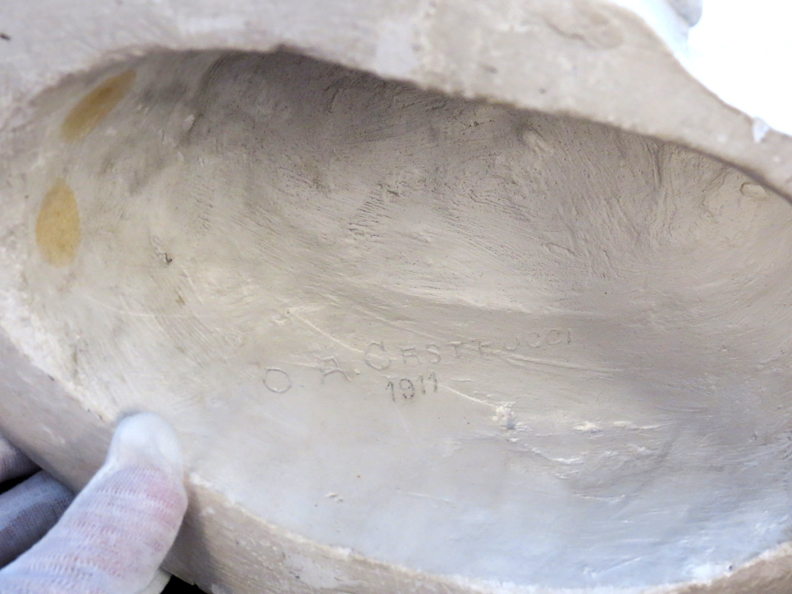
The maker's signature and date of creation: "O.A. Castrucci 1911"
Lo and behold, inscribed in the plaster is "O. A. CASTRUCCI 1911".  Our database did not find any Toronto clergy with this surname.  However, an online search confirmed that Castrucci Co. was a plaster cast studio located on Yonge Street in Toronto.*  This made us pretty confident that the deceased must be an important local figure.

Out of biological necessity, masks are created close to the date of death, so we searched our database to see who had died in 1911. Amazingly, two Archbishops of Toronto - Fergus McEvay and his predecessor, Denis O'Connor, C.S.B. - died within weeks of each other in the middle of that year.

Both of these bishops were robust in life and similar-looking, as evidenced by their portraits below. Both men died after suffering from disease, which would account for the gauntness of the face in the death mask.

Portraits of Archbishops of Toronto, Denis O'Connor C.S.B (left) and Fergus McEvay (right)
Somewhat disturbing are the eyelashes and eyebrow hairs embedded in the plaster.
After very little deliberation, we determined that this is likely the face of Most. Rev. Fergus McEvay, fifth ordinary of Toronto (1908-1911).  His prominent aquiline nose, which is noticeably crooked at the end, was the deciding factor.

Halloween mystery solved!

More on death masks: some of the most famous death masks include those of Dante Alighieri, Mary Queen of Scots, and Napoleon Bonaparte. The Laurence Hutton Collection of Life and Death Masks at Princeton University Library contains over a hundred likenesses of English and American literary and political figures.
_______________________________
*Klempan, Brabara. "Early Manufacture of Artists’ Materials in Canada: A History of Canadian Art Laboratory," Journal of the Canadian Association for Conservation, 37 (2012): p.50.
Zucchi, John E. Italians in Toronto: Development of a National Identity, 1875-1935 (Montreal: McGill-Queen's University Press, 1990), p.148.