Showing posts with label Archbishop McNeil. Show all posts

Friday, 20 December 2019

"Give us a brief heart-space to see no sight, Save the One Star in all the crowded night"

Anne Sutherland Brooks was born in Guelph, Ontario, on July 14, 1900. Although Presbyterian, she attended the Catholic Loretto Academy, as well as the Guelph Collegiate Institute. Following this, she earned her teacher's certificate at the London Normal School.

By her mid-twenties, Anne began to attract attention as a poet, with her verses being published in numerous periodicals across Canada, the United States and the United Kingdom. In 1927, Ryerson Press published her chapbook of poetry titled, Within a Wicket Gate. One of her poems, "Poverty", was published in the New York Times.

In 1929, Archbishop McNeil made a request through the Loretto Sisters for Anne to send him a selection of Christmas poems for his Christmas greeting card.

Letter from Anne Sutherland to Archbishop McNeil
October 31, 1929

Archbishop McNeil Fonds
MN AH18.120
Anne Sutherland Christmas Poems I-III
Sent to Archbishop McNeil
October 31, 1929

Archbishop McNeil Fonds
MN PB03.12
Anne Sutherland Christmas Poems IV-VI
Sent to Archbishop McNeil
October 31, 1929

Archbishop McNeil Fonds
MN PB03.12

In 1930, six of Anne's poems were included in the anthology, Modern Canadian Poetry. As a member of the Toronto branch of the Canadian Authors Association, she was awarded the members' division poetry prize in 1932 and 1933. In 1934, Theodore Roosevelt Jr. included Anne's poem, "The Bird I Do Not Know", in the Roosevelt Bird Sanctuary Anthology. Her poem, "The Empty Little Cabin", was included in The Desk Drawer Anthology: Poems for the American People.

In 1935, Anne married Edward Arnold Brooks. In addition to caring for their children, John Edward Arnold and Anne Elizabeth, Anne Sutherland Brooks continued to recite her poetry and participate in radio broadcasts of children's stories. She passed away in 1996.

We hope you have enjoyed these beautiful Christmas poems, as well as this special slice of Canadian literary history. Merry Christmas from the staff at ARCAT!

Friday, 22 March 2019

Stand Up and Be Counted

In the variety of records available to historians and genealogists, censuses are among the most useful. They are a snapshot of the population at a particular time. The data can be overwhelmingly voluminous, but a lot can be learned both about the population and about individual citizens.

Though there were censuses as far back as ancient times, the first census in North America was completed in 1666 by Jean Talon, the Indendant of New France. He listed 3,215 people living in and around Quebec City, Montreal, and Trois-Rivieres, and used the information to plan how to make the population and economy of the colony grow.

After confederation, a census of Canada was taken every ten years starting in 1871. The first census was important to ensure the makeup of parliament accurately represented the population.

In 1931 Canada's first Dominion Statistician, Robert H. Coats, wrote to Archbishop McNeil to convey the importance of the general Census of Canada and to ask for his help in urging parishioners to participate. He highlighted that the information collected would only be used for statistical purposes because historically censuses had been used in some places to identify who to tax or who could serve in the military.

"The Census is the decennial stock-taking of the nation, designed to show from the widest angle the point that has been reached in the general progress of the nation. More particularly, it measures the human element in the state - their numbers, sex, age, conjugal condition, nationality, occupation, religions, etc., etc. ... It is not only the duty, but the legal obligation of all members of the community to answer all Census questions as fully and accurately as possible."

May 12, 1931

MN AH20.53
Archbishop McNeil Fonds

Governments aren't the only ones who use censuses to make plans for the people they represent. The Church also needs statistics to be able to responsibly and effectively allocate resources and enhance programming. In addition to using the civil census to track the population and demographics of an area, the Archdiocese also collects statistics about each parish.

The earliest example we could find of a bishop collecting statistical information about the area in his care was this 1827 document. Though it doesn't list the individuals in the area, it has the number of Catholic males and females under and over the age of 16 in South Western Ontario.

Return of the Roman Catholick (sic.) population of the Western District of the Province of Upper Canada for 1827.-

M AC21.01
Bishop Macdonell Fonds

There were several examples of documents like the one below, which was created for St. Paul's Parish in 1838. It tells us that in the area that St. Paul's served (the City of Toronto and area - 1,296 square miles!), the population is 2,500, of which about 750 generally attend mass. Under "Remarks," it notes that the people are "Labourers & poor mechanics - very few rich though several are respectable;" and of the church, "There is no school - no sacristy - no bell - Burying ground attached not well fenced."


Other pastors actually listed each family in an area, which is great for genealogists!

Census of Catholics on the Dundas Mission, page one

December 1833

M AC04.01
Bishop Macdonell Fonds


Some even went as far as to canvas Toronto neighbourhoods collecting information such as the name of the head of each family, the ages of the inhabitants, religion, and occupation. ARCAT has a few notebooks listing residents of the wards of St. David, St. Lawrence, St. James, St. George, St. Andrew, St. John, and St. Patrick. Below is an example of John Elmsley's 1847 list showing some Queen St. inhabitants.

1847 Census of St. Patrick's and St. James Wards

HO 13.43

ARCAT Holograph Collection

Library and Archives Canada has databases available on their website for searching censuses from 1926 and earlier. You can find information about your ancestors such as their levels of education, their employment, and the type of home they lived in. You can check that out on the Library and Archives Canada Website.

If you'd like to check out the Catholic "censuses" that we have here in the archives, check out our website for more information!


Friday, 14 December 2018

God's Christmas Gift to Man

As the cold weather sets in and Christmas appears less than two weeks away, the streets and malls are gradually filling up with a frenzy of holiday shoppers. For some, you may still be brainstorming ideas of what gifts to get for the loved ones on your list.

This week, with the gift-giving nature of this holiday in mind, I went searching in our archives. If you're facing the cold and the crowds this weekend: good luck. In the meantime, enjoy this lighthearted Christmas hymn titled, "God's Christmas Gift to Man" by A. Farmer:

"God's Christmas Gift to Man" by A. Farmer
[before 1934]
Archbishop McNeil Fonds
MN PB03.08
 

Friday, 27 July 2018

Record of the Week: Vincere Vel Mori

From the rocky Outer Hebridean Isle of Barra came the clan from which descended Toronto's seventh bishop, Neil McNeil.

Clan MacNeil Fast Facts:

  • The clan claims to descend from Irish king Niall of the Nine Hostages of the third century. 
  • The motto is Vincere Vel Mori, which translates to 'Victory or Death.'
  • Medieval Kisimul Castle is the seat of the clan's chief. 
  • The clan was known for pirating in the 1500s.
  • Archbishop McNeil would have come from the group of MacNeils who emigrated to Cape Breton in the early 1800s.

In the 1920s, the Clan MacNeil Association of America wrote to Archbishop McNeil to recruit him. Though they were successful with his brother, we're not sure if he actually joined the association. 

Reverend dear Sir:

Your forefathers came from the Isle of Barra, just a little island off the coast of Scotland, only eight miles long and four miles wide, and from no other place, for you are a Macneil and as such we extend an invitation to you to join the Clan Macneil Association of America.

This Association was organized nine years ago, and its purposes (as set forth in the Constitution) are "to foster and promote Scottish Clan traditions, sentiments and interests, especially those relating to the Clan Macneil; to cultivate social intercourse among the members; to uphold good citizenship of the Members in their respective countries; and to encourage cordial relations among the English speaking nations."

What do not appear int the Constitution are the goodwill created among the Members; the many friendships formed; the enjoyable programs of the Annual Meetings; the carrying to Macneils far and near of welcome word of each other through the Clan Macneil News; the tracing and recording of Members' genealogies; the several successes of the Association in making permanent and public records of the Clan's accomplishments in the development of America; and the fact that we are the only active individual Clan Association in North America.

The annual dues are $5.00 a year, which includes subscription to the Clan Macneil News. All officers in the Association serve without pay and all money goes for actual expenses. I am mighty proud of our name. I want you to join us. It would be a pleasure to have your application for membership addressed to me, personally, at 2095 Broadway, New York, N.Y. 

Cordially yours, H.N. McNeill

October 1, 1930

MN AA03.205a
Archbishop McNeil Fonds

Though there are many ways to spell MacNeil, all are welcome to join the clan!

Friday, 6 July 2018

Toronto's Archbishops Live at Massey Hall


Last weekend Gordon Lightfoot played the last concert at Toronto's Massey Hall before two years of renovations. In its 124 year history, the greatest names in music including Igor Stravinski, George Gershwin, Bob Dylan, Neil Young, Glenn Gould, Charlie Parker, Joni Mitchell, and St. Michael's Choir School amongst many others have performed in the space. It holds the distinction of being Canada's oldest concert hall, but its design has held up as an intimate space to hear world-class musicians.

Over the years, the Archbishops of Toronto have been invited to and have attended many events at Massey Hall including a 1933 protest against Hitler. In 1959 Cardinal McGuigan joined the St. Michael's Choir School boys onstage: 

Cardinal McGuigan addresses the crowd at a concert honouring Ukrainian Greek Catholic Metropolitan Archbishop Andrew Sheptytsky, OSBM.

December 13, 1959

PH 34/03P
ARCAT Photograph Collection  


Archbishop McNeil was invited to an event celebrating the opening of a house on Beverly Street by Sir Arthur Pearson to train men blinded in the first world war:

"Archbishop Neil McNeil, Toronto.

Dear Sir, -

I beg to enclose herewith a platform ticket for the Public Testimonial to be held at Massey Hall on Tuesday, January seventh, at 8 P.M. in honor of the Canadian Soldiers blinded in the war and Sir Arthur Pearson, Bart.

The Hon. W.J. Hanna, K.C., will preside and, besides Sir Arthur Pearson, there will be a number of interesting speakers.

On behalf of the institute, I am pleased to extend to you an invitation to be present and to occupy a seat upon the platform.

Yours faithfully,

L.M. Wood, President."

January 2, 1919

FW GC01.68
First World War Collection


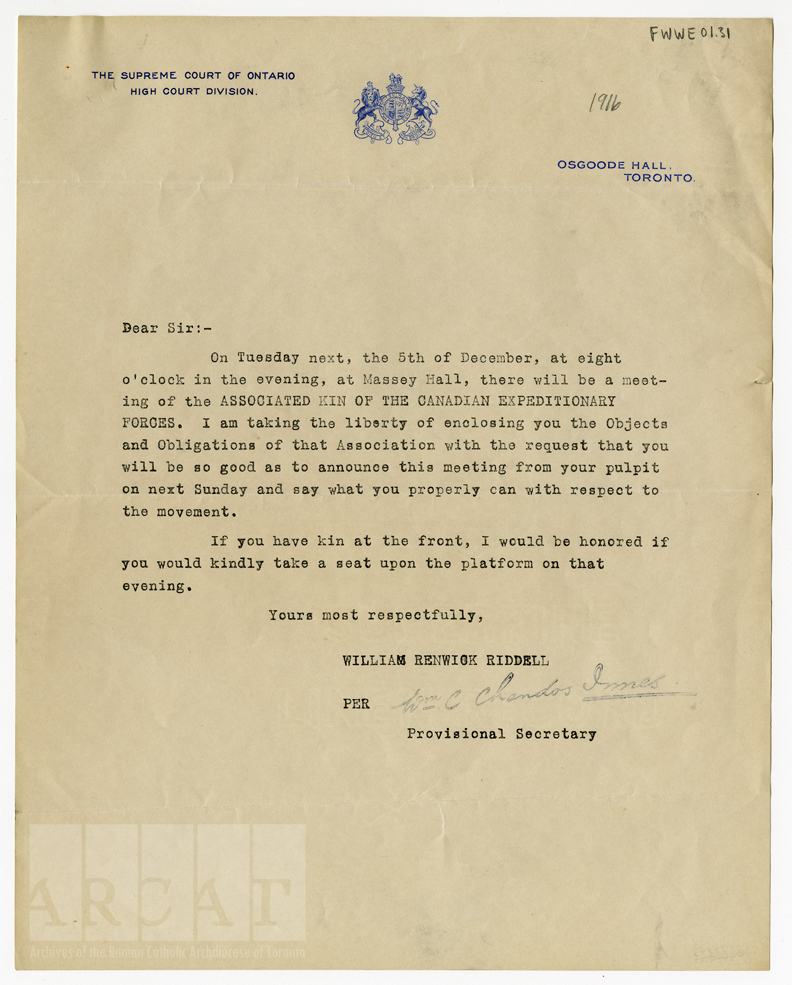
In 1916 Toronto pastors were asked to announce a meeting at Massey Hall of the Associated Kin of the Canadian Expeditionary Forces, which was an association of relatives of First World War soldiers working to "promote and care for the best interests of the men who [were] fighting for King and Country."

"Dear Sir:-

On Tuesday next, the 5th of December, at eight o'clock in the evening, at Massey Hall, there will be a meeting of the ASSOCIATED KIN OF THE CANADIAN EXPEDITIONARY FORCES. I am taking the liberty of enclosing you the Objects and Obligations of that Association with the request that you will be so good as to announce this meeting from your pulpit on next Sunday and say what you properly can with respect to the movement.

If you have kin at the front, I would be honored if you would kindly take a seat upon the platform on that evening.

Yours most respectfully,

William Renwick Riddell" 

1916

FW WE01.31
First World War Collection


The Catholic Youth Organization held a rally in 1938:

"His Excellency
The Most Reverend James C. McGuigan, D.D.
Archbishop of Toronto
invites you to be present at the
Catholic Youth Organization Rally
in Massey Hall
Wednesday Evening, January 19th, 1938
at 8.15 p.m.
Reserved seats will be held until 8.10 p.m."

MG TA01.115
Cardinal McGuigan Fonds


The National Chorus of Toronto performed annually from 1903 to 1928:

"The National Chorus
Announces its Thirteenth Annual Concert at
Massey Hall, on Tuesday evening, January 18th
With Mr. Morgan Kingston as the assisting soloist,
and the net proceeds to be devoted to Red Cross purposes.

Their Royal Highnesses the Duke and Duchess of Connaught and the
Princess Patricia have announced their intention of being present.

Tickets may now be procured at Tyrrell's Book Store, 780 Yonge Street, near Bloor Street."

1916

MN AH05.03
Archbishop McNeil Fonds


Admiral Earl Beatty of the British Navy visited Toronto in 1921:

"Dear Archbishop McNeil;-

On Monday, next, November 28th, at 2 P.M., Admiral Earl Beatty, O.M., etc., will be the guest of the Navy League of Canada at Massey Hall.

As Head of the Roman Catholic Church, we are enclosing a ticket, which will admit you, by way of the stage door, to the platform. Will you kindly be seated by 1.45, as the Admiral will enter at 2 o'clock.

Admiral Earl Beatty O.M., etc., will be in the City from 8 A.M. to 4 P.M., therefore, he will only be with us for half an hour, but the League feels happy in being thus honoured. Please reply by telephone, Saturday morning, if possible.

In view of the fact that platform space is very limited, it will be necessary for you to present this ticket.

Faithfully yours, Cecil S.Williams Lieut Colonel. Manager."

November 25, 1921

MN AH10.134
Archbishop McNeil Fonds


Archbishop Pocock was on the board of directors of the Toronto Symphony Orchestra, which performed at Massey Hall until Roy Thomson Hall opened in 1982. He kept a copy of their 1964-1965 brochure. That year concert goers would hear the Canadian premiere of Britten's War Requiem, Stravinsky's Rite of Spring, and Prokofiev's Romeo and Juliet, amongst other great classical works. The back of the brochure shows pricing for season tickets. Fifty dollars would get you fifteen concerts in one of the best seats in the house:

1964-1965 Toronto Symphony Orchestra Season Ticket price chart.

PO OOR22.02b
Archbishop Pocock Fonds 


Massey Hall holds a special place in my heart because it was the venue of the first rock concert my sister took me to when I was in grade 10. I've seen many of my favourite artists there since then, and I'm looking forward to seeing more after the renovations are finished. It will be exciting to see the changes! In the meantime, I'll watch the Live at Massey Hall series online.


Friday, 15 June 2018

Tell Me, Where Do the Children Play?


Maypole Dancing, St. Andrew's Playground

August 26, 1914

City of Toronto Archives, Fonds 200, Series 372, Subseries 52, Item 429

Archbishop McNeil was the kind of person who really took an interest in the welfare of the people of the city. It is evident from the records that he wanted to improve the lives of the citizens in his care, so it came as no surprise to discover that he was on the board of the Toronto Playgrounds Association for several years starting in 1913.

Dear Sir,-

At a meeting of gentlemen interested in The Toronto Playgrounds Association it was decided unanimously to ask you to accept the office of Vice President of the Association and I was requested to bring the matter to your attention.

We would be very pleased indeed if you could see your way clear to accept this office since the only aim of the Association is to provide recreation and happiness for young people. There are two Vice Presidents and the other gentleman proposed is Rev. Provost Macklem, the head of the Trinity University. Would like to know soon if it is possible for you to accept. 

Yours sincerely,

J.J. Kelso

February 8, 1913

MN AH02.11
Archbishop McNeil Fonds

A letter from the secretary of the Toronto Playgrounds Association

January 30, 1914

MN AH03.09
Archbishop McNeil Fonds

At the turn of the century, Toronto's continued growth had given rise to neighbourhoods like St. John's Ward where it was too easy for children to get into mischief when they weren't in school. A movement grew to address this problem by constructing places for children to participate in organized activities.

In 1911, The Toronto Daily Star printed "ten good reasons why Toronto citizens should support supervised playgrounds:"

  1. "All children should have a safe place where they can play. You had when you were a child. Your children have now. Give children, who have no other safe place, where they can play, supervised playgrounds.
  2. "There are crowded districts in Toronto, which the Toronto Playgrounds Association has not been able to reach yet. The association needs more money, the city needs more playgrounds.
  3. "The children of these crowded districts are eagerly hoping for a supervised playground. Are they to have a playground this year? The best work you can do for the children of your city is to help support supervised playgrounds.
  4. "The supervised playground lessens truancy.
  5. "It diminishes juvenile crime. 
  6. "The value of a crowded district is greatly increased to the people who live in it by a supervised playground.
  7. "Supervised playgrounds for children mean better citizenship for everybody.
  8. "People who play together will find it easier to work together.
  9. "Every dollar subscribed to the work will bring happiness to some child in the city.
  10. "The child who is trained to play with all his might and honestly with his young companions is more valuable to himself and the community than the child who is kept away from play by the harmful attractions of amusements never meant for children" (The Toronto Daily Star, April 26, 1911, p. 12).


Toronto's first supervised playground was opened in 1909 in St. Andrew's Square, which is located near Adelaide St. and Brant St. The Globe newspaper described the facilities:
"Toronto's first equipped and supervised playground was formally opened yesterday afternoon. It is known as St. Andrew's Square Playground, Farley avenue, just south of the old St. Andrew's Market, and the formal opening was a gratifying success...
"The ground, which is rather dusty at present, is divided into two parts, the easterly half being devoted to the girls and very small boys, and the westerly half to larger boys. A wire fence encloses the whole ground, and girls and larger boys are separated by a wire fence... The supervision is under the charge of the Toronto Playgrounds Association...
"The boys' section of the ground is equipped with parallel bars, teeters, giant stride or maypole, trapeze, swinging rings and rope ladders. The girls' section is provided with swings, giant stride or maypole, sand courts, teeters, basket ball, and a slide resembling a chute, the last-named being the most popular attraction on the ground, so far as the small tots are concerned. The ground is to be open from 9 a.m. until 8.30 every day, except Sunday. When the schools reopen no school children will be admitted during school hours." (The Globe, August 12 1909, p. 12)
St. Andrew's Playground

October 14, 1913

City of Toronto Archives, Fonds 200, Series 372, Subseries 52, Item 196

For more on the beginning of Toronto's playgrounds, check out the excellent website from last year's City of Toronto Archives exhibition From Streets to Playgrounds.

Today, the City of Toronto's website lists 794 playgrounds. With this handy map, it's easy to find the one closest to you so you can get out there and play!

Friday, 1 June 2018

To the Catholic Electors of South Ontario!

Once again Ontarians are being bombarded with messages from all sides about important issues in the upcoming provincial election. With the rise of different forms of media, campaigns have reached new heights of vying for our attention, and the constant noise can feel overwhelming. 

Here in the archives, we found that fervent lobbying efforts are nothing new. People of the past were just as passionate about the issues that affected them, and they wanted to make sure that the voters were on their side.

In the 1870s, one group didn't want anyone to vote for the incumbent Premier Oliver Mowat, who they claimed insulted Catholics:

To The Catholic Electors of South Ontario!

[1875]

LTA01.23
Archbishop Lynch Fonds


In 1934, the Catholic Taxpayers' Association wrote to the heads of colleges, convents, and hospitals to ask them to vote for the Liberal party because they believed the Conservative party was dominated by the Orange Order:

"Experience has shown that it is futile to depend upon the Conservative party, dominated, as it is just now by the Orange Order, and that we must pursue relentlessly our policy to vote against any Government that has failed in rendering justice to us."

June 13, 1934

MN AE11.07
Archbishop McNeil Fonds


Cardinal McGuigan sent word specifically to the people of Trinity riding asking them to vote to defeat the local Communist candidate:

"His Eminence the Cardinal has asked me to tell you that he wishes you to make a good announcement at the Masses on Sunday next urging the people who live in Trinity riding to exercise their franchise in the by-election..."

November 4, 1954

MG PO08.26a
Cardinal McGuigan Fonds


Archbishop McNeil saved a circular released by the Knights of the Ku Klux Klan of Canada that asked the electors of New Brunswick not to vote for Catholics, as they were considered 'Romans':

"Be not forgetful of that binding oath you took 'neath the Fiery Cross, wherein you swore to pledge your life, vote, and sacred honour, to protect the Constitutional rights and privileges of our Country and keep it free from all Foreign domination."

[1935]

MN AS12.89
Archbishop McNeil Fonds


Making sense of the rhetoric coming from all sides wasn't easy, but the Bishops of Toronto reminded Catholics that it was important to make their voices heard. Pastors were instructed not to publicly take a particular side, but to encourage their parishioners to take advantage of their right to vote. 

"Catholics your religion and the religious education of your children are both attacked. You are bound in conscience to protect both. The battle is to [be] fought at the polls. Those who do not go, fail in their duty to themselves and their children."

December 22, 1886

L AA13.17
Archbishop Lynch Fonds

"People who have the right to vote should vote, and vote conscientiously. It is not a matter to be treated lightly."

[1934]

MN AS12.90
Archbishop McNeil Fonds


The Church continues to encourage Catholics to learn about the issues and participate in our democracy. To help make sense of what the candidates are saying, Catholic Charities of the Archdiocese of Toronto has released a 2018 Ontario Election Guide, as well as a list of questions to ask. Check them out, and stand up on June 7 to make your voice heard!

Friday, 16 February 2018

Record of the Week: Lenten Regulations, 1928

In honour of the beginning of Lent, our Record of the Week is a list of Lenten Regulations issued by Archbishop McNeil in 1928.

During Lent, Catholics prepare for Easter through penance, fasting, prayer and almsgiving. These traditions can be traced back to as early as the fourth century, however how they are practiced has undoubtedly changed to reflect local needs and contemporary issues.

The regulations below specify exactly who must fast, when fasting is to be observed, and what must be abstained from, in the boundaries of the Archdiocese of Toronto.

MN AH17.08a

Archbishop McNeil Fonds

 It is interesting to compare these to the Regulations Bishop de Charbonnel issued in 1855. Reading the two side by side, there appears to be a shift in the scope of the regulations. For example, Rule 10a of the Archbishop McNeil regulations suggests some new ways the pious can observe Lent:
"Avoiding all public amusements, such as theatres, moving picture shows, dances, etc." 
You can learn more about how we observe Lent and the Easter season today through the Archdiocese of Toronto's website.

Friday, 29 December 2017

From Atlantic to Pacific, Gee the Traffic is Terrific

We have heard it said that for the holidays, you can't beat home sweet home, so we know lots of our readers have been on the road this week.

For a local trip, perhaps you took the Harbourfront streetcar past the site of the old Maple Leaf Stadium at Lakeshore and Bathurst? Or maybe the Wellesley bus to Castle Frank Station?

Cardinal McGuigan in a procession for Rosary Hour at Maple Leaf Stadium in 1947.

PH09G/29P
ARCAT Photo Collection

A TTC bus helping to shuttle crowds during the 1984 papal visit.

PH65/927CP
ARCAT Photo Collection


For journeys a little farther afield, why not take the train? You get to relax instead of dealing with highway traffic. 

This photo of men beside a train engine originally belonged to Archbishop McNeil.

[1910-1930]

PH 08/05P
ARCAT Photo Collection

Cardinal McGuigan steps down from a sleeping car on the Canadian National Railway with J.P. Johnson, the railway vice-president.

[1946-1955]

PH09/40P
ARCAT Photo Collection

Cardinal McGuigan accompanied some visiting bishops on a train tour of Canada in 1947. This photo would have been taken somewhere in British Columbia or Alberta.

PH09G/10P
ARCAT Photo Collection


Maybe you could take the train to the city where you meet the boat for your cruise vacation. It's a nice time of year to be in the tropics!

Cardinal McGuigan and Bishop Allen socialize in the posh lounge on board the R.M.S. Queen Elizabeth. At the time, the boat was the largest ocean liner, operating between New York City and Southampton, England.

[1946-1955]

PH09/31P
ARCAT Photo Collection


Or perhaps you're going to ring in the New Year in style somewhere overseas. Probably best to fly in that case.

Pope Saint John Paul II touches down at Pearson Airport during his 1984 visit and is greeted by Cardinal Carter.

PH65/16CP
ARCAT Photo Collection

Wherever your holidays take you (Penetanguishene for some homemade pumpkin pie?), and whichever method you choose, safe travels!


Friday, 8 December 2017

The Hand of God Has Been Laid Heavily Upon Us: 100 Years Since the Halifax Explosion

100 years ago this week, Halifax was devastated after a collision in the harbour sparked a fire aboard a munitions ship. The resulting blast was the most powerful explosion in history before the Second World War. Approximately 2,000 were killed, 9,000 were injured, and 1,249 buildings were destroyed. Windows were shattered up to 100 kilometres away.

In the following weeks, Archbishop McNeil (who was originally from Cape Breton) received letters describing the destruction. Archbishop Edward McCarthy of the Archdiocese of Halifax sent the following after receiving a $2000 donation from the Archdiocese of Toronto:

Letter from Halifax Archbishop Edward McCarthy to Archbishop McNeil describing the devastation of the blast.

14 December 1917

MN TA01.20
Archbishop McNeil Fonds


"Halifax, Dec. 14th 1917

"His Grace - The archbishop of Toronto

"My dear Lord Archbishop,

"How shall we ever thank you sufficiently for your kind words of sympathy, and still kinder deed in sending us $2000 for the relief of the sufferers in St. Joseph's parish? They were both sorely needed. No one can have any idea of the extent of the calamity or of the gruesomeness of the sights but those who were eyewitness of the scene. I shall never forget it as long as I live. It simply baffles description. St. Joseph's parish is almost wiped out. Church, presbytery, Convent, two parish halls and schools, all destroyed beyond repair. St. Patrick's Church, with its beautiful Munich windows, is badly damaged. The whole roof will have to come down. In the Cathedral there is not a pane of glass left, and the worst of it all is, we can claim no insurance. Every Catholic Institution - the orphanage, seminary, Home of the Good Shepherd, Infants' Home, St. Teresa's Home for servant-girls out of employment, Sacred Heart Convent, Infirmary, all have been badly riddled though not beyond repair. Certainly for some strange purpose, which we cannot understand, the hand of God has been laid heavily upon us. About 6000 houses, they think, have been either leveled to the ground, or impossible of repair. This, of course, means that 20,000 people are left homeless, and that we will have to clothe, house and feed them for the winter. The number of dead is estimated at 2000, and the wounded are nearly 3000. We beg your Grace to be good enough to convey to the good people of your Archdiocese our hearty thanks for the very substantial and generous help they have sent. May God reward you and them a thousand fold for it all.

I am, Your Grace, Most gratefully yours in Xto.
+Edward McCarthy"


Archbishop McNeil's uncle wrote to him from Halifax on January 6, 1918:

"My Dear Nephew,

"My first word is to wish your people and diocese, your clergy and yourself a very happy New Year in the best sense of the term. We are in a mess yet in this city. I drove through the ruined district today and am convinced I understated the situation in my letters to you and Mary. How any escaped from the destroyed and wrecked houses it is difficult to explain from any human point of view. It is known that in some instances parties living in flat roofed two storey houses made their way to safety through breaks in the upper floor and the roof which was down so near the ground that they were able to step from the roof on to the adjoining street. All school houses suffered severely, and several have been condemned - others are so much damaged that the restoration will cost almost as much as rebuilding. Several churches are beyond repair too...

"The chair I sat in when the explosion occurred was cut by glass an inch long and nearly a quarter deep and that across the grain too, right back of where my head was. Mrs. M is well otherwise than in her eyesight which has grown so dim she cannot come down stairs without help and guidance. About the end of the month she will be surgically healed and we are all hopeful of best results - though at her age success does not always follow.

"Annie's sister ... is recovering the last few days nicely but will feel the loss of her eye and the cuts on her nose and brow keenly. Her son Dick has no doubt a sightless eye - besides a loss of over $3000 in property. His elder brother is laid up from a blow received in the explosion which he did not feel at first and Dick's 9 year old boy had an eye removed. The incidents make us more thankful for the protection God accorded us." (MN AA03.37A Archbishop McNeil Fonds)

It is difficult to imagine what Haligonians went through that day and in the months that followed, but many institutions have produced resources to help us remember them. For more information, check out the website of the Archives of the Archdiocese of Halifax-Yarmouth dedicated to remembering the explosion. The Nova Scotia Archives has many online resources available, and CBC has an interactive website telling the story of the accident.

Friday, 6 October 2017

We Request the Pleasure of Your Company


Cardinal McGuigan raises a toast at a dinner held in honour of Queen Elizabeth II's coronation at Toronto's Empire Club.

1 June 1953

PH 09E/16P
ARCAT Photograph Collection

This weekend, people across Canada will celebrate Thanksgiving. Sharing a meal with family and friends has been a way to celebrate and mark occasions since time immemorial. Whether it's a formal event in a hotel ballroom or an intimate affair in a friend's home, a meal is an excuse to gather and enjoy good company. This week we are featuring a few of the many invitations to dinner and luncheon that we have here in the archives.

The Duke of Orleans presents his compliments to Mr. McDonald and will be very glad to see him at dinner on Sunday next at four o'clock, if he is not otherwise engaged.

13 August, 1813

M AE07.10
Bishop Macdonell Fonds

The professors and students of Trinity Medical School request the pleasure of the company of His Grace, Archbishop Lynch at their eleventh annual dinner, to be held at the Rossin house, on Thursday, Nov. 10th, 1887, at 8 p.m. R.S.V.P.

November 1887

L AH32.158
Archbishop Lynch Fonds

To meet His Excellency The Governor General and Marchioness of Lansdowne
The Lieutenant Governor of Ontario and Mrs. Beverley Robinson request the honor of His Grace the Archbishop's company at Dinner on Friday, the 19th of September at Eight o'clock. Government House, Toronto. An answer is requested to the A.D.C.

September 1887

L AE06.96
Archbishop Lynch Fonds

The President, Executive and Members of The Canadian Club of Toronto and the Empire Club of Canada request the pleasure of the company of Archbishop N. McNeil, at a Luncheon in honour of His Excellency The Rt. Hon. Earl of Bessborough, P.C. G.C.M.G., to be held in the Royal York Hotel, Tuesday, November 24th, 1931 at 12.45 o'clock. R.S.V.P. before 10 a.m., Monday, Nov. 23rd, to J.M. Philip, Secretary Canadian Club, 1003 Bank of Hamilton Bldg. Guests will assemble in Hall A, at 12.30 o'clock.

November 1931

MN AA23.140
Archbishop McNeil Fonds 

Mr. Ray N. Bryson, President of the Boy Scouts Association, District of Toronto, invites you to join him as his guest at a dinner given in honour of Major-General Dan C. Spry, C.B.E., D.S.O., Chief Executive Commissioner of Canada's Boy Scouts. 

This will be held at hte Granite Club, 63 St. Clair Avenue West, Tuesday, December 2nd. Guests will assemble in the Men's Lounge Room, main floor, at 6:30 p.m. Dinner served at 6:45 p.m. Dress: Scout uniform or business dress.

All 1947 Officers are invited to attend including Mr. R.C. Berkinshaw, the chairman, and Members of the Advisory Board, the Board of Honour and Members of the Executive Committee.

R.S.V.P. by November 27th to Mr. Herbert B. Greenaway, Suite 604, 57 Bloor Street West, Toronto, Ontario.

November, 1947

MG SO22.19
Cardinal McGuigan Fonds

Have a great weekend of giving thanks for great dinner companions!


Friday, 4 August 2017

Record of the Week: Here's One For the Music Geeks

If you've ever attended a graduation ceremony, or even seen one on television, the writer of this week's highlighted document will be familiar to you. Sir Edward Elgar was a British composer whose Pomp and Circumstance March No. 1 in D has been played at North American high school and university graduation ceremonies since 1905 when it was performed at Yale University:


Of course that's not the only thing that Elgar is known for. He was wildly popular with early 20th century audiences, and is now regarded as a preeminent figure in the pantheon of British composers. Elgar was a Catholic, and one of his masterpieces was The Dream of Gerontius, which was based on a poem by Cardinal Newman. 

In 1925 Elgar wrote a letter in reply to J. Campbell McInnes, a British singer who moved to Toronto in 1919. McInnes had written to Elgar to ask him to visit Toronto as part of his efforts to improve the state of local Church music. Unfortunately, there's no evidence to suggest that Elgar actually accepted the invitation, but we are pleased to have the signature of such an influential composer here in the archives: 

Letter from Sir Edward Elgar to J. Campbell McInnes

December 16, 1925

MN AS08.11
Archbishop McNeil Fonds

We have featured the signatures of many interesting historical figures in The Archivist's Pencil, but this one is special for certain music geeks amongst the archivists. 

Friday, 28 July 2017

Dokumenton de la Semajno

Earlier this week marked the anniversary of the highly influential publication Unua Libro. On July 26, 1887, Dr. L.L. Zamenhoff published this volume, where he unveiled a newly constructed language that he promised was easy to learn and that he hoped would become a universal second language, free of linguistic prejudice. His ultimate goal was to contribute to peace and understanding between nations.

Today, Esperanto is the most widely spoken constructed language in the world. The language became known as Esperanto based on Zamenhof’s pseudonym, Doktoro Esperanto (“Doctor who hopes”). 

In honour of Unua Libro's 130th anniversary, our dokumenton de la semajno (record of the week) is a letter from F. Kaelble to Archbishop McNeil asking for an endorsement for the Catholic Esperanto Movement in Toronto in 1932.


"...the thing I have in mind is the formation of a Catholic Esperanto Association to bring the different country's in closer contact as far as Catholics are concerned."

October 23, 1932

MN AH21.97
Archbishop McNeil Fonds


Mr. Kaelble asks for the Archbishop’s blessing in forming a local Catholic Esperanto Association, and for the opportunity to talk to young Catholics about how Esperanto relates to their faith. As a member of Universala Esperanto-Asocio (Universal Esperanto Association) he believes that Esperanto could allow Catholics from around the world to share and discuss the Gospel regardless of their first language.

The religious potential that Mr. Kaelble saw in Esperanto was not unique. In fact, the Catholic Esperanto Movement is almost as old as the language itself. Father Alexandras Dambrauskas learned of the new language in 1887 when he was a student at the Ecclesiastical Academy of St. Petersburg. After reading Zamenhof’s booklet, he wrote his first postcard to the author in 1896.  The following is a rough translation of the original Esperanto text:
... Our Catholic Church is an immense family (...) But in a family there must also be a language comprehensible to all. (…) But Latin, being a language of priests, is no longer sufficient for all relations ... Lay Catholics are equally entitled to desire that the common father [the Pope] speaks to them in the commonly understood language . It can not therefore be French or Italian, or another of the [national] living languages, but only the [living] international language. (Source)

The 1900s proved to be formative years for the Catholic Esperanto Movement. Espero Katolika (Catholic Hope), a religious periodical written entirely in Esperanto, published its first edition in October 1903. The aforementioned Father Dambrauskas also published an early Catholic Esperanto work, “Versajxareto" (Little Book of Verse), in 1905.


Public Domain image, via Espero Katolika

The first page from the first edition of Espero Katolika, October 1903. This poem is in honour of Pope Pius X.
Pope Pius X bestowed the first papal blessing of the Catholic Esperanto Movement in 1906 after being presented with a bound edition of the Espero Katolika. His Holiness issued a second blessing of the Catholic Esperanto movement in 1910 following the creation of Internacia Katolika Unuiĝo Esperantista (IKUE, or The International Union of Catholic Esperantists).

Esperanto has also been included in the Urbi et Orbi papal address since April 3, 1994, when Pope John Paul II wished the audience "Felicxan Paskon en Kristo resurektinta" (a Happy Easter in Christ risen) for the first time. You can listen to Pope Benedict XVI say the traditional Easter Blessing in Esperanto here.

The Catholic Esperanto Movement shows no signs of slowing down. In recent years we can see how the internet has helped strengthen the Catholic Esperanto Movement. The IKUE and Espero Katolika both have online presences. The Vatican Radio, which has offered regular broadcasts in Esperanto since January 2, 1977, now offers programoj en esperanto (programs in Esperanto) online. Other Catholic Esperanto reference tools include an Esperanto translation of the Bible, and an overview of Catholic Esperanto history

If you're looking to learn the language, La Kanada Esperanto-Asocio (Canadian Esperanto Association) might have a club near you.

Friday, 23 June 2017

Voices of the War: Letters from 1917

By this time 100 years ago, the First World War had been raging for nearly three years. Canada was a huge part of the war effort, whether on the front or at home. The Archives has many records relating to the Great War. This week’s blog features a handful of them from 1917.

The war touched many lives, and Archbishop McNeil was not immune. His 30-year-old nephew, Tom, spent a great deal of time overseas and periodically wrote his uncle.

In the Field
Oct. 24th, 1917

Dear Uncle:
Have been putting off writing you from month to month.
Thought you would be more or less interested in my whereabouts.
Cannot possibally (sic) write a letter of any interest from the field but as soon as I go to England I will write you a good letter.
I am in my third year in the field and I am planning on going home on leave should this war last any longer than the spring.
We are advancing every day now and the oppinion (sic) on this front is that the actual fighting will be over in March .18.
Up to the present I have been on all parts of the Western Front. When we came to France first early in .15, we were continually bombed by the enemies[’] planes. Some wonderful change now. Where any work or move was on the enemy planes were always overhead. Now we do not see an average of 1 plane a day from the other side.
Cannot write any of my account as the censor rules are very strict.
I am enclosing a cheque. Very sorry same was so long delayed. Do hope you will pardon me.
Hoping you are in good health and taking good care of your-self.
Your fond nephew
Tom

MN AA03.35
Archbishop McNeil fonds


Archbishop McNeil also knew priests who served in the Canadian Expeditionary Force (CEF). Fr. Julius Pirot wrote this letter to McNeil about his duties at a hospital in France and a charming account of the soldiers’ reactions after battle. Pirot also mentioned sunken hospital ships. By the time this letter was written at the end of April 1917, ten British hospital ships had been sunk during the war, almost all of them torpedoed by German U-boats. As McNeil's nephew indicated in his letter above, censors were very strict about what information could be shared. Evidence of this can be seen in Pirot's letter, where parts have been scratched off or cut out (and subsequently fixed by an ARCAT archivist).

In France, April 27th, 1917

Your Grace,
I must let you know that I am still alive. Indeed, thanks God, I am always well and happy in my work. I spent three months at the camp of Shornecliffe, and was sent here on the 5th of March. The work is practically the same everywhere. I am now in charge of a Canadian hospital and of an Imperial camp. There are about 700 Catholics in the camp and 50-70 in the hospital. Of course the patients just pass through in their way to England. You have heard that some of our Hospital-ships were sunk, what’s certainly an awful thing. Is this the end of the world? God only knows what we are going to see this year. [censored] Nevertheless our boys are wonderful. You should see them after a battle! When they arrived here from Vimy, a noisy joy filled the hospital. They were proud, of course! and how dirty! And they fell in the cots, and it was too sweet for anything to hear them snoring! One cannot help loving them dearly, for it is a fact that the fire of battle purifies their hearts and spirits. I never heard any of them complaining. And they’re so glad to see the priest! – I have my billet at the parish-house, but we board at the hospital. In this part of France, one fourth of the people go to church. The others are indifferent. War did not improve them very much. Poor France! She has not suffered enough yet; but the Catholics here have no courage: they let the others do as they like, and the others, laughing at them, continue to destroy the Church. [censored] 
I hope that Your Grace is enjoying good health. Toronto must be very nice by this time with her great display of tulips. In France we have no flowers yet; spring is very late, and it is cold. “no bonne” say the soldiers; and they know what that means in the trenches!
Please Your Grace pray for us
J. Pirot
Chaplain C.F.
No. 2 Stationary Canadian Hospital, France

FW CS01.26
First World War fonds


People often asked the Archbishop for prayers or comfort or help. Understandably, wartime increased these occurrences, as people had more reason to be concerned about their loved ones.

Vancouver, B.C.
June 5th, 1917

Your Grace:
My son Gerald has joined the Royal Flying Corps and leaves for Toronto on Thursday of this week to do his little bit for his country.  I have given him a letter of introduction to you and Mrs. Barry and myself would take it as a great honor and favour if you would take a little interest in him.
We have never had one anxious moment about him, and now that he is a man we feel that his habits are well formed and that he has strength of will to take care of himself; yet this being the first time he will be away from us for any length of time we would like you to have your fatherly eye on him.
Thanking you in anticipation for any trouble we may be putting you to. I beg to sign myself on behalf of Mrs. Barry and myself
Yours faithfully
J. F. Barry

MN AH06.85
Archbishop McNeil fonds


More than anything, Gilbert A. Sim, a gunner in the CEF, wanted to be a chaplain. He wrote multiple letters to Archbishop McNeil from 1915 to 1917, hoping that McNeil would help him in that regard. In Sim's last letter to McNeil, which is written in a booklet measuring just 14 x 8.5 cm (5.5 x 3.25 in), Sim listed the many battles he took part in and again expressed his desire to be a chaplain. 

304354
Heavy T.M. Battery
3 Division Canadian
France
Dec. 1917

My Lord Archbishop
I beg to wish Your Grace a very Happy New Year, and also to mention a subject which is very much on my mind.
Your Grace knows very well under what conditions I enlisted and I have now been in the Army over two years, the best part of that time having been spent in France and Flanders in the front line.
I was in action at the third battle of Ypres, the second Battle of the Somme, Causalette (sic) [Courcelette] and the taking of Beaumont Hamel, the Battle of Arras and the storming of Vimy Ridge, and lastly in the hard fighting in Belgium which included the taking of Passhendale (sic). I have endeavoured all through this to be true to my beautiful Faith and to my calling as a Cleric, and I feel that I can now approach Your Grace as to my future.
I had intended to apply for a Commission but have been advised by Chaplains, many of whom I know, to write first to you, to see if it would be possible for Your Grace to procure for me a discharge that I might be enabled to continue my training for the Priesthood, for which end I have already devoted so many years of my life.
I might then be able to return to the Army with the only Commission for which I really long and for which I think I should be most suited. Your Grace already has my papers previous to my enlistment. With regard to my military record I can refer to my Commanding officer Captain Bennett, M.C.
Begging a blessing 
I have the Honour to be
My Lord Archbishop
Yours most respectfully
Gilbert A. Sim, C.F.A. [Canadian Field Artillery]

FW GC02.12
First World War fonds


In order to deal with requests such as Gilbert Sim’s, Archbishop McNeil may have referred to the statement from the Office of Militia and Defence sent to him by Col. Charles F. Winter, Military Secretary of the Militia, which explained methods of dealing with personal requests concerning soldiers serving overseas in the CEF. Requests included promotions, commissions, leave or discharge, and return to Canada.

Letter from Charles F. Winter to Abp. McNeil,
Feb. 1917

FW CS01.23
First World War fonds
Memorandum Regarding Methods of Dealing with Personal Requests Concerning Soldiers Serving Overseas
with the Canadian Expeditionary Force, 
Feb. 1, 1917

FW CS01.23
First World War fonds


During the war, life changed dramatically both overseas and at home. Fr. Melville D. Staley wrote Archbishop McNeil about the shortage and high cost of food in France and also noted that he had received a shipment of socks for the soldiers. 

No. 2 Canadian Stationary Hospital
B.E.H.
France

July 2nd/17

Your Grace,
I write to advise you that I have left England and am now located at the above address. God has blessed me with good health enabling me to carry on my work quite alright. Food is very dear here and suffering and misery from the war is plainly evident on all sides, but one cannot help it but admire the spirit of the people. I see in a shop window melons, small ones, at twenty francs a piece which will give you an idea of the price of foodstuffs which varies accordingly.
I received not long ago a very nice consignment of home made socks from Our Lady of Lourdes Patriotic Association. It was indeed a great gift and the soldiers appreciated them very much. I have brought a few I had left with me.
Remember me kindly in your pious prayers and with every good wish. I remain
Your obedient servant
Fr. M. D. Staley

FW CS01.32
First World War fonds


Sending food and items of clothing were just two of the myriad ways in which Canada contributed to the war effort. This booklet briefly details all aspects of Canada’s role in the war up to March 1917. Its sections cover departmental war activities, economic effects, the nickel problem, the Ross rifle, and preparations for after the war. More specific topics – including equipment, censorship, and the work of Canadian women to establish Canadian hospitals overseas – are also described.

Canada's Effort in the Great War to March, 1917

FW WE01.33
First World War fonds


The booklet contains a list of contributions in kind, such as food, clothing, bedding, games and so on. The numbers are remarkable, and they continued to increase as the war progressed.

Canada's Effort in the Great War to March, 1917,
pp. 77 and 78


FW WE01.33
First World War fonds


For most of us, it is impossible to grasp the hardships that soldiers, their families, and their communities had to endure throughout the First World War. As archbishop, McNeil would have had the challenge of dealing with requests from individuals across the country and overseas while thinking about his own friends, colleagues, and family members who had joined the fight. The records highlighted here, as well as many others in ARCAT's collection, bring personal war stories to life and further remind us to be thankful for those people we hold dear.