Showing posts with label Diocese of London. Show all posts

Friday, 27 April 2018

Poems of a Soul Friend

Since 1998, April has been designated National Poetry Month to "celebrate poetry and its vital place in Canada’s culture."

During his episcopate, the Archdiocese of Toronto had its very own poet-in-residence in His Eminence, G. Emmett Cardinal Carter.

Cardinal Carter (1912-2003) is often remembered for reading his poetry at various events. In 1979, he founded the Cardinal's Dinner, the largest annual community dinner and fundraiser in the country. It became a tradition for Carter to recite a poem at the end of his Cardinal's Dinner speech.

Photographs Collection, PH18C/104CP

G. Emmett Cardinal Carter gives his Cardinal's Dinner speech at the annual fundraiser, ca. 1990. It became tradition for him to end his speech by reciting one of his poems.


A few years before his death, Cardinal Carter self-published a collection of his favourite poems, entitled The Poems of a Soul Friend. In honour of National Poetry Month, we are sharing selections from this booklet and the draft copies that we hold in the Archives.

Cardinal Carter fonds

Cardinal Carter's self-published book of poems, The Poems of a Soul Friend, as well as the original draft of the opening poem, "I do not have the words of Yeats," written in 1999.
Cardinal Carter fonds

This poem was written a couple of years after Cardinal Carter resigned as Archbishop of Toronto. It speaks of his early career and vocation in hometown Montreal, his appointment to Bishop of London, and to Toronto, where he finished his episcopal duties.

Cardinal Carter fonds

We have written previously about Cardinal Carter's beloved dogs, who were often the subject of his poetry.

Cardinal Carter fonds

An example of one of the poems that Cardinal Carter presented at the Cardinal's Dinner, 1992. It was written when he was leaving the Diocese of London for his appointment as Archbishop of Toronto. Carter had a great appreciation for the outdoors and the waterfront in particular. In addition to Lake Huron, he wrote poems about Fourteen Island Lake, where his family cottaged, Grand Bend, Ontario, and Tergensee in Bavaria.


Cardinal Carter fonds

The final poem of his book, "Steadfast", reflects on growing old.

Sunday, 13 August 2017

Record of the Week: Archbishop Walsh's episcopal ring?


Provenance is a fundamental organizing principle in archives. It refers to the individual, family, or organizational body that created or accumulated material in a collection. The principle of provenance dictates that records of the same origins be kept together to preserve their context, rather than grouping items of various origins together by subject (the way books are catalogued) or medium (as artworks may be).

As provenance is intrinsic to our profession, it is very frustrating to be faced with an item whose previous owner cannot be identified. With textual records, there are often clues, but an artifact without accompanying documentation can be a real mystery.

Last year, custodianship of some of our former bishops' rings was transferred from the Chancery Office to the Archives. Unfortunately, it was not clear as to which of our bishops these rings had belonged.

A Roman Catholic bishop receives an episcopal ring when he is consecrated. Aside from those personally purchased or gifted, bishops' rings belong to the Church. The ordinary of a See inherits the previous bishop's ring collection, which is held in trust. A bishop may be buried with a ring that he owned, but all those belonging to the Church must be returned upon his death. Bishops may also choose an episcopal ring formerly worn by a predecessor, which can further obscure its provenance.

Accession 2016-047

Rose gold episcopal ring with a large amethyst, flanked on either shoulder with a mitre, cross and crozier.
On the gemstone is etched a dove holding a branch embellished with tiny diamonds.
Accession 2016-047

Inside the band is engraved: Nov. 10-1867 and Nov. 10-1890


From this tradition, we can conclude that the episcopal rings transferred to the archives were likely worn by a bishop that retired or died in Toronto. One of the rings in question has two dates engraved on the band: "Nov. 10-1867 and Nov. 10-1890". The former is a significant date to only one of our ordinaries: Archbishop John Walsh was consecrated bishop on that day, after being appointed Bishop of Sandwich (i.e. Windsor), the former seat of the Diocese of London, Ontario.

Case closed? Not quite.

Most Reverend Walsh was appointed Archbishop of Toronto on August 13, 1889 (coincidentally, 128 years ago today) and installed here on November 27, 1889. Therefore, the second date seems to have little significance to Archbishop Walsh. The word "and" in the engraving suggests (at least to me) that the dates refer to the same person rather than a subsequent wearer.  In any case, November 10, 1890 does not pertain to any of our other bishops.

To determine if the ring was ever worn by Walsh, we checked his official portraits taken in London and in Toronto. Unfortunately, it's not a match. The ring in the photos seems to have a large central stone encircled by a halo of small diamonds. The setting is lower than that of our mystery ring.

ARCAT Photographs Collection, PH 05/01P

Carte de visite portrait of Most Reverend Walsh, Bishop of Sandwich (and then London, when he move the seat of his See back there) by Frank Cooper, Artistic Photographer, Dundas St., London, Ontario [ca. 1880?]

ARCAT Photographs Collection, PH 05/02P

Carte de visite portrait of Most Reverend Walsh, Bishop of Sandwich, by Edy Bros. photographers, 214 Dundas St., London, Ontario [ca. 1870?]

ARCAT Photographs Collection, PH 05/13P

Portrait of Most Reverend John Walsh, Archbishop of Toronto, seated, and Apostolic Delegate to Canada, Cardinal Rafael Merry del Val, who was a Monsignor at the time. Taken in Toronto, 1897. The sign under the chair states:

"Entered according to Act of the Parliament of Canada, in the year 1897, by Frederick Lyonde, at the Department of Agriculture"

The mystery ring is certainly larger and more ornate that the ring he is wearing in the portraits, which is probably the ring from his consecration gifted by the Toronto clergy. Most Reverend Walsh began his career in Toronto and was much respected by his fellow priests. According to the Jubilee Volume 1842-1892 of Archbishop Walsh and the Archdiocese of Toronto, the clergy presented "a mitre, crozier, pectoral cross and ring" to "their dearly beloved brother."

Though the photos do not confirm that our mystery ring belonged to Archbishop Walsh, they do not remove the possibility either. Bishops may own multiple episcopal rings, and they are a common gift. Fancier ones may be saved for special occasions rather than everyday use.

One could speculate that he was given this ring to mark his elevation to archbishop on the anniversary of his consecration date. November 10, 1890 would have marked the first anniversary of Walsh's consecration that he celebrated as Archbishop of Toronto. Although it would have been more appropriate to bestow an archbishop's ring on Walsh at his Installation Mass in 1889 (or, for that matter, in the Jubilee year of 1892 when the diocese turned 50 and Walsh celebrated 25 years of ordination), it is not completely outside the realm of possibility.

Until further information comes to light, that frustrating question mark will stand beside the issue of provenance.

To read about provenancial mysteries that we've actually solved, see these former posts:

Record of the Week: "the famous cameo ring"
Record of the Week: the mysterious Death Mask
Record of the Week: Cardinal McGuigan Gets the Key to the City
***We are also happy to announce this week that the short biographies of our former bishops and archbishops (which used to be hosted on ARCAT's now defunct website) have been migrated to the Archdiocese of Toronto's site. You can read more about Archbishop Walsh here.***

Friday, 28 August 2015

It's our 100th post!

It has been two years since we started The Archivist's Pencil and this is our one hundredth post.
In honour of this milestone, we thought it would make a lot of cents (!) to feature ten records with reference to "100":

Archbishop Lynch fonds, LRC69.23

Offering of 100 lire on the occasion of the golden jubilee of Pope Leo XIII's priestly ordination (24 December 1886)
First World War, FWGC01.13

"21st April 1916
Your Grace, 
This morning your cable 'hundred masses' arrived here, and I hasten to express my profound thanks for this great kindness and valuable help...
Three of my priests have been appointed military chaplains in connection with the expedition against German East Africa...
It took me over two months to visit all the missions; - I covered over 750 miles on a push bike."

Parish Collection, St. Mary's Toronto

"Souvenir of St. Mary's Parish, Bathurst and Adelaide Streets, Toronto, Ontario
Centennial Year 1852-1952"

St. Mary's is the third oldest parish in the city, after St. Paul's Basilica and St. Michael's Cathedral

Archbishop Neil McNeil fonds, MNAH16.104

"June 17, 1927...Enclosed find receipt for 100 Special Permits (Minister of the Gospel)."

The Liquor Control Board of Ontario (LCBO) was created in 1927 with the end of prohibition, which had been introduced in the province in 1916. However, temperance was still encouraged and from 1927 to 1962, the LCBO required people who wanted to purchase liquor to possess a permit. This letter to the LCBO suggests that priests were issued special permits for mass wine.
Archbishop Neil McNeil fonds, MNAH16.104

"Monastery of Our Lady of Charity, August 31, 1921
Enclosed is our cheque for One hundred dollars, the fifth and last payment on our new lot in Mount Hope Cemetery."

Mount Hope Cemetery is one of two operational Catholic cemeteries in downtown Toronto. It opened in 1900 as St. Michael's Cemetery began to fill up.
Archbishop Neil McNeil fonds, MNAH05.16

 "March 17, 1916
Your Grace, Just a note this evening to ask you if I could have a little extension of time in saying the remainder of those 100 Masses,
'ad intentionem,' which you so kindly gave me last October.  I offered 50 of them to the Bishop when I returned but he evidently had a good number of intentions on hand, because he didn't care to take mine."
Bishop de Charbonnel fonds, CAC02.09

September 15, 1853 - An Indenture made between the Roman Catholic Episcopal Corporation and John Butler, yeoman, for a transfer of land in the Township of Dereham, County of Oxford in consideration of one hundred pounds of lawful money.

The 1850s was a decade of wrangling over whether to adopt a sterling monetary system or a decimal monetary system based on the US dollar. In 1853, the sterling coinage was made legal tender, and all other silver coins were demonetized.  Therefore, one hundred pounds of lawful money refers to the British pound. The first Canadian coinage was not authorized and executed until 1858.
This land in the county of Oxford became part of the Diocese of London, which was erected in 1856.
Archbishop Lynch fonds, LRC44.12

Letter from Bishop Lynch asking Pope Pius IX to grant an indulgence of 100 days to the members of the Altar Boys' Confraternity, also for the College of St. Basil, the House of Providence, the Loretto Sisters, the St. Joseph Sisters and the various priests. (June 13, 1862)


Archbishop McEvay fonds, MEAF02.02

A letter from Archbishop McEvay scribbled on an envelope explaining that $100 worth of stock, received from Robertson and Coughlin, was sold for $32.00 (February 22, 1905)
Archbishop McNeil fonds, MNAH03.12

"Toronto, Feb. 2/14
Most Rev. Archbishop, This is the first opportunity I have had to reply to your letter re new hospital and infants' home.  While my means are not great I will try to send $100 a year for five years..."

This letter refers to St. Mary's Hospital and Infants' Home, which addressed the lack of  maternity care for young, unmarried Catholic women. Archbishop McNeil invited the Misericordia Sisters of Montreal to establish and administer the home in 1914.


Friday, 12 June 2015

Visit to lovely London, Ontario

ARCAT staff recently attended the Archives Association of Ontario conference in London, Ontario.  The theme “Do we have it RIGHT?” addressed legal issues in archives: balancing access and privacy; the rights of donors, users and third-parties; and the wonderful world of copyright.

We figured it would only be right and just to pay a visit to our fine colleagues at the Diocese of London, Cardinal Carter Library and St. Peter’s Seminary.

The Diocese of London is considered one of the suffragan sees of Toronto. It was established (along with the Diocese of Hamilton) in 1856 to accommodate the influx of Irish immigrants. However, the diocese is home to the oldest parish west of Montreal, and holds some of Ontario's earliest marriage and baptism records, starting in the 1760s. The archives are located in the recently renovated Diocesan Centre and overseen by archivist Debra Majer.


Diocesan Centre entrance with display of artifacts from the Diocese of London Archives

Inside the storeroom at the Diocese of London Archives.
The portrait depicts Bishop Michael Fallon, O.M.I., ordinary of London from 1909 to 1931.
On shelves to the right: historical parish registers containing sacramental records are stored in this central, climate-controlled location for optimal preservation. 

The Diocese of London is home to the oldest parish west of Montreal, Our Lady of Assumption Parish in Windsor.
 The diocese holds some of Ontario's earliest vital records, including this 1764 marriage record from the parish. 

The reading room at the Diocese of London Archives. A Canadian chaplain's service kit is on display.

Before Cardinal Carter became the Archbishop of Toronto, he was appointed bishop of London. The library at King's University College is named in his honour.  The Director of Libraries, Claire Callahan, showed us around the special collections and display cases featuring Cardinal Carter artifacts.


Entrance to the Cardinal Carter Library through the newly renovated Darryl J. King Student Life Centre, King's University College, University of Western Ontario.
Cardinal Carter was the Bishop of London from 1964 to 1978, prior to his appointment to Toronto.

Cardinal Carter special collections exhibit at the library.
ARCAT has loaned a few items to the library for display, including the Cardinal's pectoral cross and a mitre.

Cardinal Carter artifacts on display in the Eaton Special Collections Room.

Finally, we made our way through the verdant grounds to St. Peter's Seminary, the alma mater of our current Archbishop of Toronto, Thomas Cardinal Collins. Following a quick peek at the seminary's beautiful chapel, librarian Frances Theilade gave us a tour of the seminary's library and the small, but skillfully arranged, archives.

St. Peter's Seminary Chapel.
View of the stained glass windows and wood carving in the sanctuary.
The windows are the subject of a book and film series, Panes of Glory.

The lower potion of the chapel walls are lined with richly carved wood panels.  Pews in the choir seating are flanked with carved angels - each with an individual personality.

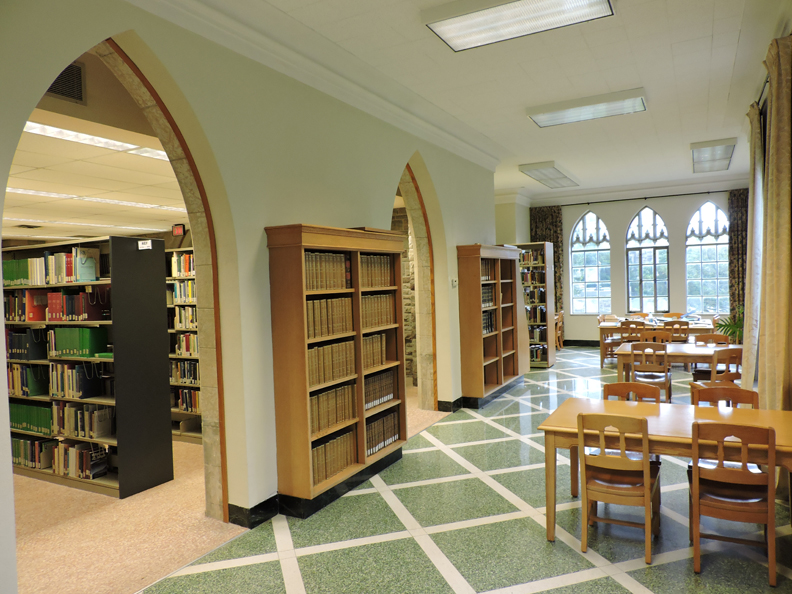
The A. P. Mahoney Library at St. Peter's Seminary.
This part of the library was previously the seminary cloisters, as you can see from the exposed stonework and arched doorways. The stacks are located where the courtyard used to be.
Interesting artifacts from the seminary's archives:
A papal zucchetto of Pope Pius X, given to Bishop Fallon. Popes have a custom of giving away their skullcaps if presented with a new one as a gift. 
Left: The seminary's librarian shows off brass shells from WWI that were turned into a pair of vases.
 Right: A seal worthy of the Lannisters.

 Thanks again to Deb, Claire and Frances for welcoming us to the Forest City.