Showing posts with label Pope Pius IX. Show all posts

Friday, 8 February 2019

Record of the Week: The Late Pope Pius IX

On February 7th, 1878, Pope Pius IX died. Archbishop Lynch saved the February 16th issue of Canadian Illustrated News commemorating the late pontiff:

The Late Pope Pius IX.

February 16th, 1878

L AJ01.01
Archbishop Lynch Fonds


Pope Pius IX Fast Facts:
  • He was history's longest serving Pope, from June 16th, 1846 to February 7th, 1878.
  • He was the last sovereign of the Papal States, which were seized by the Kingdom of Italy over several years ending in 1870.
  • He was known as 'Pio Nono.'
  • He convened the First Vatican Council, which defined Papal Infallibility.
  • He defined the Dogma of the Immaculate Conception.
  • He brought rail service to the Papal States, and his private rail cars are on display in Rome.
  • He raised Toronto to a metropolitan see in 1870, making Bishop Lynch an Archbishop. 
  • He created 17 dioceses in Canada.  
  • He was the first pope to be formally photographed.
  • He suffered from epilepsy.
  • He was beatified September 3rd, 2000, by Pope Saint John Paul II. 
Read the article inside the newspaper about Pope Pius IX here.

Friday, 7 December 2018

A Singular Grace and Privilege Granted by Almighty God

December 8 is the Feast of the Immaculate Conception, when we celebrate the beginning of Mary's original-sin-free life. Though Church Fathers and theologians spoke of and debated Immaculate Conception for centuries, Pope Pius IX formally enshrined the idea in Catholic dogma on December 8th, 1854 in his bull Ineffabilis Deus:
"Wherefore, in humility and fasting, we unceasingly offered our private prayers as well as the public prayers of the Church to God the Father through his Son, that he would deign to direct and strengthen our mind by the power of the Holy Spirit. In like manner did we implore the help of the entire heavenly host as we ardently invoked the Paraclete. Accordingly, by the inspiration of the Holy Spirit, for the honor of the Holy and undivided Trinity, for the glory and adornment of the Virgin Mother of God, for the exaltation of the Catholic Faith, and for the furtherance of the Catholic religion, by the authority of Jesus Christ our Lord, of the Blessed Apostles Peter and Paul, and by our own: "We declare, pronounce, and define that the doctrine which holds that the most Blessed Virgin Mary, in the first instance of her conception, by a singular grace and privilege granted by Almighty God, in view of the merits of Jesus Christ, the Savior of the human race, was preserved free from all stain of original sin, is a doctrine revealed by God and therefore to be believed firmly and constantly by all the faithful.""

Mary holds a special place in the hearts of Catholics, and our love for her comes through in art, music, literature, and prayer. We were especially impressed by the altar that was decorated at St. Michael's Cathedral for the Feast of the Immaculate Conception in 1908:

Immaculate Conception Altar at St. Michael's Cathedral

December 8, 1908

PH102/0001/166P
ARCAT Photograph Collection

Immaculate Conception Altar at St. Michael's Cathedral, detail.

December 8, 1908

PH102/0001/166P
ARCAT Photograph Collection

Perhaps parishioners said the words of this 11th century prayer in front of this beautiful altar:
O Mary, you are inviolate, pure and without stain, you who became the glistening gate of heaven. O most dear and gracious Mother of Jesus, receive our modest songs of praise.
We beg you with heart and lips: make our bodies and our souls pure. By your sweet prayers, obtain eternal pardon for us. O Mother most kind! O Queen! O Mary! Who alone remained inviolate!

For more on the history of the Immaculate Conception dogma, check out articles from the International Marian Research Institute here and here.

Friday, 20 October 2017

On this Day: First Vatican Council Suspended

On October 20, 1870, one-hundred and forty-seven years ago, Pope Pius IX suspended Vatican Council I.

The First Vatican Council was the 20th ecumenical council called by the Catholic Church, convoked by Pope Pius IX on 29 June 1868.  Several hundred ecclesiastical dignitaries, including our own Bishop Lynch, convened between 8 December 1869 and 20 October 1870  to discuss contemporary problems confronting the Catholic Church and to define matters of Church doctrine and practice.

Engraving of First Vatican Council, c. 1870.
Source: Wikimedia Commons (original source unknown)

The Council had met only four times before political turmoil left the Holy Father with little choice but to prematurely suspend the Council. Italian Unification had been a looming problem for the Papal State since the 1860s, and the threat only deepened with outbreak of the Franco-Prussian War. The war prompted Napoleon III to recall his garrison from Rome before ultimately surrendering on September 2nd 1870. Without any protection from the French Empire, Rome was captured and annexed by the Kingdom of Italy on September 20, 1870.

Below is a papal statement made by Cardinal Paracciani Clarelli, Arch-Priest to St. Peter's Basilica, announcing the suspension of the Ecumenical Council on October 20, 1870. (ARCAT Papal Statement Collection, L PS53.01)


The seizure of Rome and the suspension of the Vatican Council were turning points in Roman Catholicism. The effects of these events certainly left their mark on the faithful in our Archdiocese; a newsclipping reveals that parishioners gathered at St Michael's Cathedral to form a public meeting and protest the injustices in Rome.

Toronto Roman Catholics respond to the annexation of Rome.
Protest No. 4 speaks against the disruption to the Holy Father and the Ecumenical Council


1870

L AG06.04

Archbishop Lynch Fonds

Vatican Council I never reconvened after it was suspended, however it did have the significant accomplishment of defining the doctrine of papal infallibility. And, significant for us, it was also during Vatican I that Pope Pius IX raised Toronto to an Archdiocese, making Lynch Archbishop of Toronto.

Friday, 17 March 2017

A Real Work of Arch

In December 1841, the diocese of Toronto was created out of the Archdiocese of Kingston. It remained a diocese for over 28 years. During that time, the diocese had three bishops, including John Joseph Lynch, who became the third Bishop of Toronto in April 1860 after the resignation of Bishop de Charbonnel. On March 18, 1870, at Vatican Council I, Pope Pius IX raised the See of Toronto to metropolitan status, making it an archdiocese and thereby elevating Lynch to first Archbishop of Toronto. To celebrate this anniversary, this week's blog features some documents relating to these two special events.

Lynch had written to a couple of cardinals in 1865 about why Toronto should be raised to a metropolitan see. A few years later, he wrote to Pope Pius IX requesting the same:

Letter from (at that time) Bishop Lynch to Pope Pius IX, written in Latin,
September 21, 1868

L RC50.18
Archbishop Lynch fonds


Bishops from a number of dioceses also appealed together to the Holy See for the See of Toronto be raised to metropolitan status:

Copy of a letter from the bishops of Montreal, Ottawa, Hamilton, [unknown], Toronto, and Sandwich
to the Holy See, written in Latin,
January 29, 1870

L RC52.06
Archbishop Lynch fonds


We thought it would be fun to share the beautiful full-page watermark on the second page of the bishops' letter:

L RC52.06
Archbishop Lynch fonds


It is unclear how much influence, if any, the letters from Bishop Lynch and others had on the pope's decision to raise the See of Toronto to metropolitan dignity, but it became official with this papal bull:

March 18, 1870

L RC52.09
Archbishop Lynch fonds


Here is the papal bull of Lynch's nomination as first Archbishop of Toronto:

March 18, 1870

L RC52.10
Archbishop Lynch fonds


Archbishop Lynch wrote a pastoral letter while in Rome regarding the erection of the Archiepiscopal See (Archdiocese) of Toronto:

First page of Abp. Lynch's pastoral letter,
April 6, 1870

L AA11.05(a)
Archbishop Lynch fonds


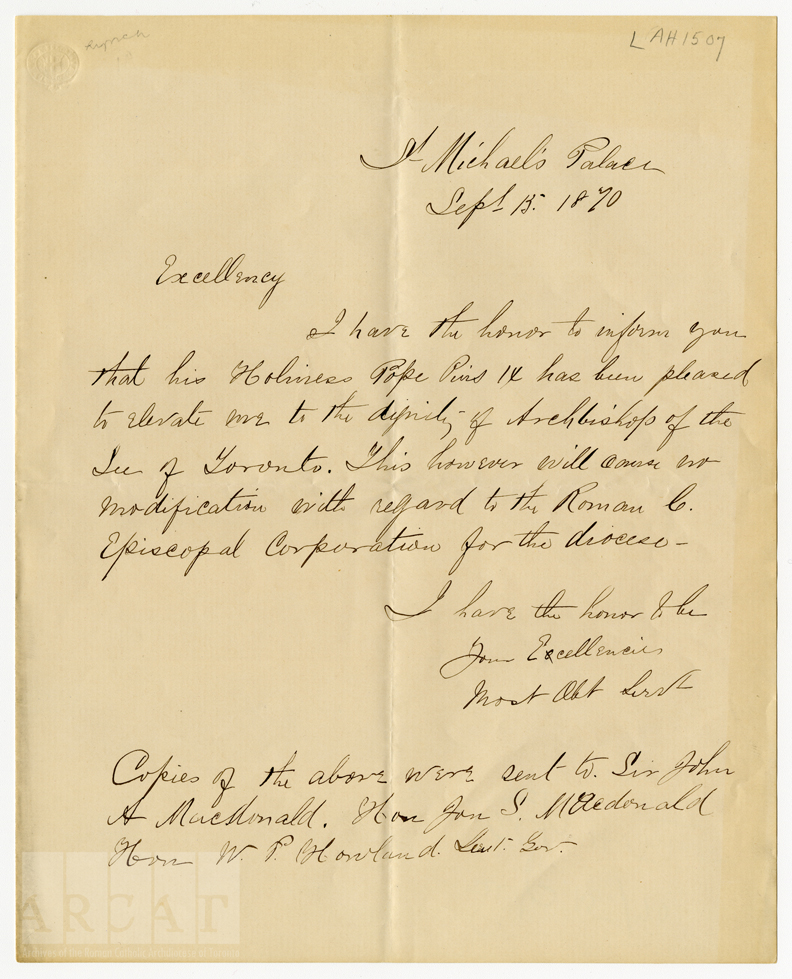
Archbishop Lynch's official induction was in September 1870. He sent a copy of the letter below to the Prime Minister, the Premier of Ontario, and the Lieutenant Governor of Ontario to inform them of the news:

St. Michael's Palace
Sept. 15, 1870

Excellency
I have the honor to inform you that his Holiness Pope Pius IX has been pleased to elevate me to the dignity of Archbishop of the See of Toronto. This however will cause no modification with regard to the Roman C.[atholic] Episcopal Corporation for the diocese.
I have the honor to be
Your Excellencies
Most obt. servt.

Copies of the above were sent to Sir John A. Macdonald, Hon. J. S. Macdonald, Hon. W. P. Howland, Lieut. Gov.

L AH15.07
Archbishop Lynch fonds


Lynch received a reply from Hon. W. P. Howland, congratulating him on his promotion:

Government House
Toronto. 16th September 1870

My Lord Archbishop
I have the honor to acknowledge your Grace's letter of the 15th inst. acquainting me that His Holiness Pope Pius IX has been pleased to elevate you to the dignity of Archbishop of the See of Toronto, upon which event permits me to render to Your Grace my hearty congratulations.
I have the honor to remain Your Grace's most obedient servant
W. P. Howland
Lt. Governor

L AH15.02
Archbishop Lynch fonds

Lynch remained Archbishop until his death on May 12, 1888, and is buried in the garden of St. Michael's Cathedral in Toronto.

The Archdiocese of Toronto is having a year-long celebration of its 175th anniversary with many activities. For more information, please see the media release.

Friday, 17 June 2016

Happy (Holy) Father's Day!

This Sunday is Father's Day. In the Catholic Church, we all share one spiritual father, the Pope. This week we thought we'd highlight records from some of the Holy Fathers who have reigned since the creation of the diocese in 1841.

Gregory XVI: February 2, 1831 - June 1, 1846

1839 apostolic letter of Gregory XVI condemning the slave trade.

M PS21.01
Bishop Macdonell Fonds

Blessed Pius IX: June 16, 1846 - February 7, 1878

This photo of Pope Pius IX is a carte de visite, which was a popular photograph format of the 1800s. Cartes were traded and collected by many. You could almost say they were the 19th century Facebook!

PH 25/23AL

Part of a letter from Pius IX to the Catholics of Toronto, complete with signature.

July 9, 1862
L RC44.15


Leo XIII: February 20, 1878 - July 20, 1903

Another carte de visite from the same album as the photo above with a drawing of Leo XIII.

PH 25/23AL
Signed letter from Leo XIII in response to the Bishops of the province of Toronto on the occasion of the Pope's Golden Jubilee of Priestly Ordination.

June 20, 1886
L RC69.10

Saint Pius X: August 4, 1903 - August 20, 1914

Postcard of Pius X from 1954.

PH 59/03PC

Benedict XV: September 3, 1914 - January 22, 1922

Letter from Benedict XV to Archbishop McNeil imparting apostolic blessings on the occasion of McNeil's 25th anniversary of his episcopal consecration.

September 8, 1920
MN RC109.03

Pius XI: February 6, 1922 - February 10, 1939

A telegram from Pietro Di Maria, Apostolic Delegate, informing Archbishop McNeil of the election of Cardinal Ratti as pope under the name Pius XI. The apostolic delegate is the pope's representative to the Church in Canada. Since the 1960s Canada has had an Apostolic Nuncio, who is the pope's representative to the government as well as to the Church.

February 7, 1922
MN DS24.02

Venerable Pius XII: March 2, 1939 - October 9, 1958

Postcard of Pius XII.

PH 62/04PC

Saint John XXIII: October 28, 1958 - June 3, 1963

John XXIII with Toronto Mayor Nathan Phillips and Mrs. Phillips.

PH 63/13CP

Blessed Paul VI: June 21, 1963 - August 6, 1978

Image of Paul VI printed on silk and used as a greeting card.

PH 64/03

Letter from Paul VI to Cardinal McGuigan congratulating him on his Golden Jubilee of priestly ordination.

May 10, 1968
PO RC4810.09

Servant of God John Paul I: August 26, 1978 - September 28, 1978

John Paul I blessing Cardinal Wojtyla (Pope John Paul II).

1978
PH 82/01P
Booklet from the Requiem Mass for John Paul I at St. Michael's Cathedral. Unfortunately, this pope only lived 33 days in office, which made 1978 a year of three popes.

1978
OC29


Tuesday, 23 June 2015

Papal Encyclicals of the Past

Last week, the world received a letter from Pope Francis entitled Laudato Si': On Care for Our Common Home. He wrote about our responsibility to care for the environment.

Encyclicals, which are circular letters written by the Pope, have been around in their modern form since Pope Benedict XIV began to write letters in the 1740s. The letters are written in a pastoral teaching style, and generally address the ways that the Catholic faith interacts with contemporary issues of the world at large. 

Below are a small selection of Papal Encyclicals from ARCAT's holdings:

1846 - Pope Pius IX - Qui Pluribus - On Faith and Religion
P PS28.01 
1847 - Pope Pius IX - Praedecessores Nostros - On Aid for Ireland
P PS29.01
1851 - Pope Pius IX - Exultavit Cor Nostrum - On the Effects of the Jubilee
C AK01.05
1864 - Pope Pius IX - Quanta Cura - Condemning Current Errors
L PS46.01
1894 - Pope Leo XIII - Iucunda Semper Expectatione - On the Rosary
W RC77.03  
1903 - Pope Pius X - E Supremi - On the Restoration of All Things in Christ
O RC86.04
1907 - Pope Pius X - Pascendi Dominici Gregis - On the Doctrines of the Modernists
O RC90.11 
1932 - Pope Pius XI - Caritate Christi Compulsi - On the Sacred Heart
MN PS114.01
1936 - Pope Pius XI - Vigilanti Cura - On Motion Pictures
MG PS118.01
1953 - Pope Pius XII - Fulgens Corona - On the Marian Year and the Dogma of the Immaculate Conception
MG PS135.02
1954 - Pope Pius XII - Sacra Virginitas - On Holy Virginity
MG PS136.04
1956 - Pope Pius XII - Haurietis Aquas - On Devotion to the Sacred Heart
MG PS138.01
1957 - Pope Pius XII - Miranda Prorsus - On Motion Pictures, Radio and Television
MG PS139.04
1962 -Pope Saint John XXIII - Paenitentiam Agere - On the Need for the Practice of Interior and Exterior Penance
MG PS144.02
1967 -Pope Paul VI - Populorum Progressio - This Is Progress
MG PS149.03
1968 - Pope Paul VI - Humanae Vitae - On Human Life
MG PS150.04

And just for fun, an encyclical from the office that was a precursor to the Congregation for the Doctrine of the Faith condemning the use of magnetism in superstition, hypnotism and clairvoyance:

1856 - Supreme Sacred Congregation of the Roman and Universal Inquisition - Adversus Magnetismi Abusus - Against the Abuse of Magnetism
C RC38.05

ARCAT holds many more Papal Encyclicals, including Pius IX's Nullis Certe, on Temporal Power and Napoleon III, Leo XIII's Quod Apostolici, which condemns socialism, and Pius XI's Mit Brennender Sorge on the state of the Church in Germany. 

Tuesday, 18 March 2014

Record of the Week: Diocese of Toronto is raised to Archdiocese


Portrait of Most. Rev. Lynch by Kurz & Allison, Art Publishers, Chicago,1884.
PH04/04P

On this day in 1870, the See of Toronto was elevated to an archdiocese, making Bishop John Joseph Lynch its first archbishop.

This decision was made during the First Vatican Council, 1869-1870 (so-called because it was the first council held at the Vatican Basilica).

These two bulls of Pope Pius IX:
  • divide the Ecclesiastical Province of Quebec to erect the Ecclesiastical Province of Toronto, and raise the See of Toronto to metropolitan status;
  • nominate Bishop Lynch to the Metropolitan See of Toronto.
As a result of Toronto gaining metropolitan status, the Dioceses of Kingston, Hamilton, and Sandwich were also established as suffragan sees.

Bulls of Pope Pius IX dated March 18, 1870
L RC 52.09 & 52.10