Showing posts with label Year of Consecrated Life. Show all posts

Friday, 29 January 2016

Year of Consecrated Life: Missionary Orders

This will be our last post marking the Year of Consecrated Life, which comes to an end on February 2nd. Over the last year we have attempted to gratefully remember some of the religious orders that have ministered in the Archdiocese of Toronto.

We are blessed to have living and serving among us more than 900 religious men and women of 100 different religious congregations. Although we could not feature them all, you can still honour these orders by observing the World Day of Prayer for Consecrated Life on Sunday, January 31 at 3 p.m. at St. Paul's Basilica (83 Power St., Toronto). This will be a special Mass to close the Year for Consecrated Life.
___________________________

This week, we highlight three missionary orders: The Missionary Oblates of Mary Immaculate, Scarborough Foreign Mission Fathers, and Our Lady's Missionaries.

The Polish Oblate Fathers (O.M.I)
Last week, the Missionary Oblates of Mary Immaculate celebrated the 200th anniversary of their order's foundation by the French aristocrat priest Eugene de Mazenod. The Oblates' first aim was to serve the impoverished parishes of Provence, whose spiritual needs had been neglected following the French Revolution and Napoleon's anti-clerical governance.

In 1841, Canada became the first foreign mission of the Oblates with headquarters in Montreal. Towards the end of the nineteenth century, the order sent for more priests from Europe who would be able to speak the languages of new immigrants to Canada.

In 1935, the first Oblates of Mary Immaculate arrived in Toronto to administer St. Stanislaus Kostka Parish.  These Polish priests were part of the Polish Oblate Province in Canada, called Assumption Province. Following World War II, thousands of Polish immigrants came to Canada and settled in Toronto.  Under the Oblates' leadership, parishioners were able to place every family that arrived.

The Polish Oblate Fathers have continued to administer St. Stanislaus and well as St. Casimir's (Toronto), St. Maximilian Kolbe (Mississauga), and St. Eugene de Mazenod (Brampton). The Assumption Province Oblates also run the Queen of Apostles Renewal Centre in Mississauga.

Read more about the Oblates in Canada in this special section of The Catholic Register.

Photographs Collection, Religious Orders Series, PH27O/01P

Group photo of the Oblate Generalate in Rome, 1949
with Cardinal McGuigan and Bishop Allen (front, 4th and 6th)

Photographs Collection, Parish Series, PH0101/16P

Archbishop Pocock celebrating Mass at St. Stanislaus Parish on the 25th anniversary of the St. Stanislaus Parish Credit Union.

The Credit Union, with its roots in social justice and charity, was instrumental in settling post-war Polish immigrants in Toronto.

Photographs Collection, Religious Orders Series, PH27O/02PC

Postcard of the Oblates' Queen of Apostles' Retreat House in Port Credit.
The location continues to be a popular retreat house in the archdiocese. 

Scarboro Foreign Mission Society
Rev. John Mary Fraser, the founder of Scarboro Missions, was a Toronto-born priest ordained in Italy to serve as a missionary. In 1902, he became the first North American priest to undertake mission work in China and, after eight years, decided the job was too large for one man.

In 1918, Fr. Fraser was permitted to establish the China Mission Seminary in the Archdiocese of Ottawa to train priests to accompany him overseas. The building soon proved too small to accommodate growing vocations so Fr. Fraser moved to the Archdiocese of Toronto. A new seminary was constructed in 1924 on the grounds of St. Augustine's Seminary, Scarborough, which allowed for shared classes. Because of its new location, the China Mission Seminary was renamed, and ordinandi called Scarboro Foreign Mission Fathers (S.F.M).

In 1949, following the Communist Revolution, all missionaries were expelled from China. The Mission Fathers changed their focus to other countries in Asia and Latin America.

In 1974, due to Vatican II reforms and declining vocations, the Mission began accepting lay men and women into their ministry. The organization is now called Scarboro Missions and defines itself as a society of Canadian Catholics, both priests and laity.


Photographs Collection, Religious Orders Series, PH27S/09P

Msgr. John Mary Fraser, founder of Scarboro Foreign Missions, in front of his new church in Fukuoka, Japan (c.1950s)

Scarboro Foreign Missions were originally based in China but all missionaries were expelled in 1949, following the Communist Revolution. Undaunted by the closure of the China mission, Monsignor Fraser soon accepted an invitation from the Bishop of Nagasaki, Japan to establish a new mission in that country. In May 1950, at 73, he left Toronto for a new life in Japan.

Sacred Objects Exchange, SOX-135

Travel size chalice and paten set with case.  The set was donated to the Archdiocese of Toronto's Sacred Object Exchange by Scarboro Missions. It was used by missionaries for celebrating mass while in transit on ships to China.

Our Lady's Missionaries
Another mission order with roots in Toronto is Our Lady's Missionaries (O.L.M).

The order of women was founded in 1949 by Msgr. Dan R. Macdonald, in Alexandria, Ontario. The first novices were trained for religious life by the Sisters of St. Joseph of Toronto. In 1956, the first graduates were invited to staff a parish school in St. Catharines (then a part of the Archdiocese of Toronto) and then provide nursing staff for a hospital. With this financing, the Order opened their first missions in Japan and Nigeria.

To address the need for low-cost housing in downtown Toronto, the Missionaries purchased the old Princess Hotel at Church and Dundas Streets.  By 1963, the building was completely renovated and reopened as the Maryglen Girls Residence, a safe-haven for thousands of young women coming to Toronto.

Our Lady's Missionaries continue to contribute dually to their home base in Canada and their missions in Brazil, Nigeria and the Philippines. They share their lives with the least privileged, focusing on children, families and women’s concerns.

This month, the O.L.M. hosted a book launch of Our Story, a history of Our Lady’s Missionaries from their beginnings until 2015.


Photographs Collection, Religious Orders Album, PH31P-228AL

Photos of Our Lady's Missionaries properties (c.1960s), including the Maryglen Residence for Young Women in Toronto.


Friday, 15 January 2016

Year of Consecrated Life: The Paulists and the Catholic Information Centre

The Missionary Society of St. Paul the Apostle was founded in 1858 by five convert priests in New York City. Their ministry focused on reaching out to Protestants in North America by evangelizing in the Roman Catholic tradition.

The Paulists became renowned for their preaching style. The early order would send missionary teams to churches to conduct "Parish Missions" and this is how the community first arrived in Canada. At one such parish mission held in 1912 at St. Paul's Parish in Toronto, the Paulists drew huge crowds, resulting in the conversion of 212 Protestants. 

In 1913, Archbishop Neil McNeil invited the Paulists, under Fr. Thomas Burke, CSP, to establish and staff the Newman Centre at the University of Toronto, which they did until 1936. The following year, the Paulists agreed to administer St. Peter's Parish in perpetuity.

In 1938, Archbishop McGuigan urged the priests at St. Peter's to run instructive courses for prospective converts, which resulted in 50 to 75 conversions per year. The popularity of the courses, held in the church basement, prompted Fr. Frank Stone, CSP, to push for a purpose-built education facility. And so in 1958 the Catholic Information Centre (CIC) was built adjacent to the parish, at 830 Bathurst Street.

In addition to classes for converts, the CIC held workshops for Catholics wishing to grow in their faith, as well as marriage preparation classes for couples.

The Paulists' zeal for evangelizing and proselytizing expanded to media communications and the order became known for its radio shows, film productions and publishing presses.

By 2015 the Paulists determined that they did not have enough vocations to stay in Toronto. In June they returned to New York, and administration of St. Peter's Parish and the CIC reverted to the Archdiocese of Toronto.
Read these Catholic Register articles for a timeline of the Paulist century in Canada, and a reflection on the Paulist legacy.
The CIC building will continue to be used as a training facility by the archdiocese. During a recent cleaning of the building, a poster featuring photographs of the Catholic Information Centre was discovered and brought to the archives.

Photographs Collection, Religious Orders, PH27P/17P

Before the Catholic Information Centre was built, the Paulists held instructional classes in the basement of St. Peter's Church.
This is a photo of the "co-instructors" with Fr. Frank Stone, CSP (right) taken in 1948.
Fr. Stone initiated the building of the Catholic Information Centre.
Photographs Collection, Religious Orders, PH27P/09P and /10P

The Catholic Information Centre under construction, April to September 1958.
The CIC is located at 830 Bathurst Street, just south of St. Peter's Church, Toronto.
Photographs Collection, Religious Orders, PH27P/11P and /12P
The Catholic Information Centre under construction, April to September 1958.
Photographs Collection, Religious Orders, PH27P/13P and /14P
The Catholic Information Centre under construction, April to September 1958.
Photographs Collection, Religious Orders, PH27P/16P

Architect Lindsay Wardell's hand drawn rendering of the Catholic Information Centre, viewed from Bathurst Street, ca. 1957
Photographs Collection, Religious Orders, PH27P/15P

Catholic Information Centre, south side: equipment for construction of the Bloor subway line, 1960s. The CIC is situated across the street from Bathurst TTC station.

Friday, 20 November 2015

Year of Consecrated Life: The Congregation of St. Basil

Fr. Joseph Lapierre, CSB,
first Superior General.
This month we are highlighting The Congregation of St. Basil, one of the first religious orders to come to Toronto. Their origin can be traced back to the end of the 18th century in France, where political turmoil made being a Catholic priest and teacher dangerous; however a priest named Fr. Joseph Lapierre secretly operated a school in the small mountain village of St-Symphorien-de-Mahun.

A few years later when it was safe, Fr. Lapierre, with the help of a few other priests, began operating a school in the nearby town of Annonay. On November 21, 1822, 10 priest-teachers formed an association to ensure the continuation of education in the Annonay area and for life in common.

Collège du Sacré-Coeur, Annonay
1867 
One of their former students was named Bishop of Toronto: Armand-Francois-Marie de Charbonnel. The Bishop knew that he would need help establishing schools and staffing parishes in his new See. He approached his former teachers for help, and in 1850 he arrived in Toronto with Patrick Molony, who was a native of Ireland.

Molony described his arrival in Toronto with Bishop Charbonnel thus:

"We went up the magnificent St. Lawrence as far as Kingston, which is a bishopric. From there we continued our journey over Lake Ontario for one beautiful night in the clear moonlight, and at 7 o'clock on the morning of September 21, I caught sight of Toronto. Monseigneur gathered around him on the bridge of the ship and there we recited in choir the Litany of the Saints and the Salve Regina. It was known in the city that we were due to arrive, and consequently our fine people, poor children of Erin, made much ado. They gave us no time to disembark but crowded about us, pressing close to see and throwing themselves down before the Bishop. The quays, and all the streets were blocked with people. We were conducted in procession to the Cathedral. The Bishop of Montreal and several priests from that city were with us. We were received like true apostles. The following day Monseigneur took solemn possession of his See. He officiated at Vespers preaching in English to a congregation of 3,000 persons, Catholics and Protestants." 

Captain Elmsley
Fr. Molony was soon joined by four other Basilians, and they established what eventually became St. Michael's College. By 1856, with the support of John Elmsley, the college moved to its present location on Clover Hill (near the intersection of the present day Bay and Wellesley Streets). St. Basil's Parish was also established. The school operated as a high school, a college and a minor seminary. In 1950 the high school moved to its current location at Bathurst and St. Clair Streets. The Basilians went on to staff other city high schools such as Michael Power, and parishes such as Holy Rosary.

As the Basilian Congregation in Toronto grew, members spread to the Windsor area, into Michigan and New York State, and eventually down to Texas, Mexico and Colombia. They have administered and staffed many high schools, colleges and parishes across North and South America while maintaining a small presence in Annonay. Five Basilians have been bishops, including Vancouver's current Archbishop Miller, London's current Bishop Fabbro, Toronto's Archbishop O'Connor, Bishop Ramirez of Las Cruces, New Mexico, and George Bernard Cardinal Flahiff, who was Archbishop of Winnipeg. 

The Basilian Fathers have been integral to the Archdiocese of Toronto since their arrival. Their influence can be seen in the thousands who have been educated at their schools. They continue to teach, but are also beginning to run workshops for Catholic teachers to ensure that the philosophy behind their motto, "Teach Me Goodness, Discipline and Knowledge," spreads even further.  

An unidentified 19th Century Basilian


"A few of the '28 '29 Novices"
Basilian Novitiate, near Bathurst and St. Clair Streets
Novices circa 1930
Basilians on Strawberry Island (Lake Simcoe), 1936. The Basilians used the island as a vacation and retreat centre from the mid-1920s until the mid-2000s. They played hosts to Pope John Paul II when he was in the area for World Youth Day in 2002.  
The newly built shrine on the Island.
August, 1936
Cardinal McGuigan tours Strawberry Island with Father McCorkell
1936
Sports have always been an important part of Basilian Education. The St. Michael's Majors hockey team won the Memorial Cup four times. One of their players, David Bauer (left), went on to become ordained as a Basilian. As a priest, he coached Canada's Olympic hockey team in the 1960s, and was awarded an honorary Olympic medal for sportsmanship. He was inducted into the Order of Canada in  1967 and into the Hockey Hall of Fame in 1989. 
Sports were also an important part of student recreation.
St. Michael's College, 1946-1947.

All images courtesy of the General Archives of the Basilian Fathers.

Friday, 9 October 2015

Year of Consecrated Life: Sisters of St. Joseph

This month in our Year of Consecrated Life series we are featuring the Sisters of St. Joseph of Toronto, who arrived in the city on October 7th, 1851. 

In the history of the Catholic Church, a lot of the hardest social work has been taken up by Religious Sisters. Orders of women religious have been responsible for running hospitals and schools as well as reaching out to vulnerable and marginalized populations. 

One of the earliest orders to come to Toronto was the Congregation of the Sisters of St. Joseph (CSJ). The congregation was originally founded in Le Puy-en-Velay, France in 1648. Like so many other orders, the Sisters were disbanded during the French Revolution, and many of the members were jailed or executed. One of the Sisters, Jeanne Fontbonne, was able to refound the order in 1807 in Lyons. In 1836, a group of Sisters was sent to St. Louis, Missouri, and in 1851, four Sisters from that group led by Sister Delphine Fontbonne headed to Toronto at the request of Bishop de Charbonnel. 

Depiction of the arrival of the Sisters of St. Joseph in Toronto from Frontier Women: Sisters of St. Joseph,
written by Sister Veronica O'Reilly, CSJ, with artwork by Pierre Huffner, 1986.
Religious Orders Series, Sisters of St. Joseph

The work of the Sisters of St. Joseph quickly expanded. They became health care workers, educators, and cared for the city's poor. In Toronto, they founded House of Providence, Sunnyside / Sacred Heart Orphanage, St. Michael's Hospital, Our Lady of Mercy Hospital, St. Joseph's Hospital, and St. Joseph's College. Sisters from Toronto went to Hamilton, London, Barrie, and other Ontario places as well as expanding into Western Canada. 

St. Joseph's Convent, Wellesley and Bay, 20 September, 1877
Photographs Collection, PH 28S-11P
Originally published in James Esson's Glimpses of Toronto.
A Sister nurses patients at St. Michael's Hospital, Toronto, ca. 1954
Photographs Collection, PH 28S-18P
Original held by St. Michael's Hospital Archives
House of Providence, 1914. Originally located on Power Street, near St. Paul's Basilica.
Photographs Collection, PH 31P-227AL(17)
Sacred Heart Orphanage, 1914. Located on the site of present day St. Joseph's Hospital in Sunnyside.
Photographs Collection, PH 31P-227AL(22)

The Sisters of St. Joseph continue to be dedicated to working in the community in many different ways. For more photos and more information about the history and present work of the Sisters of St. Joseph, check out their website.

Friday, 31 July 2015

The Year of Consecrated Life: The Congregation of the Most Holy Redeemer

St. Alphonsus Liguori
Image from Wikimedia Commons

August 1st is the feast day of St. Alphonsus Liguori, who founded the Congregation of the Most Holy Redeemer - the Redemptorist Fathers.


St. Alphonsus founded the Congregation in Italy in 1732. A well educated priest and later Bishop of Sant'Agata de' Goti, he was canonized in 1839 and made a Doctor of the Church 1871 for his contributions to moral theology. His original intent for the Order was to minister to the poor around his home city of Naples.

The Congregation spread to Germany and other areas of Europe, then eventually to the United States, and from there to Canada - first to Quebec City in 1874, to Ste. Anne-de-Beaupre in 1878, and then to Toronto in 1881 at the invitation of Archbishop Lynch to take over St. Patrick's Parish, where they continue to remain in residence.


Letter from Pius IX on the subject of St. Alphonsus Liguori, discussing his defence of the faith and support of papal teachings, and attaching to his feast day a plenary indulgence for all who confess and visit a Redemptorist Church.
July 7, 1871
L PS54-01

As Fr. Karl Schindler, CSsR explains in his book To Serve God's People: A Hundred Years of the Redemptorists at St. Patrick', the Cradle of the Toronto Province 1881 - 1981, "The first Redemptorists to come to Toronto were Fathers Eugene Grimm, John Hayden, Augustine McInerny, and Brothers George and Alexander... They arrived in Toronto, January 15th, 1881. The following day, January 16th, His Grace signed the contract whereby the Redemptorist Fathers took possession of St. Patrick's Church. On February 12, Father F. Krein arrived from Quebec City to begin work for the German-speaking Catholics of Toronto."

By the late 1890s there were over 2600 members of the St. Patrick's congregation. In 1903 the Congregation started work on a new Church beside their monastery on McCaul St. The new St. Patrick's was dedicated on November 1st, 1908, and the old church became Our Lady of Mount Carmel, a parish for the Italian population in the area.

Today there are over 5000 Redemptorist Fathers internationally, with members of the congregation working in cities across Canada. Their numbers have included four saints, four blesseds, and six martyrs. They continue to uphold St. Alphonsus' vision of "[bringing] the message of the gospel to the most poor and abandoned" as pastors of many churches. They are also active in the areas of bioethics, social justice, and music.

For more information about the Canadian Redemptorists, visit their website. Don't forget to check out their archives page for excellent photographs. 

Tuesday, 30 June 2015

The Year of Consecrated Life: Carmelite Orders

The Order of the Brothers of the Blessed Virgin Mary of Mount Carmel was established around 1154 A.D. near the fountain of Elias on Mount Carmel, Israel.  The founders, after witnessing the horrors of the Crusades, retired as hermits to live a cloistered Christian life.*  The Blessed Virgin Mary appeared to one of the early priors and presented him with the brown scapular - a sort of work apron - which is why Carmelite Orders wear brown habits. As the Order’s patroness, Mary is referred to as Our Lady of Mount Carmel.

Carmelite Brothers and Fathers were invited to the Archdiocese of Toronto in 1875 by Archbishop Lynch. In Niagara, they built a monastery directly above the Canadian Falls. The house served as a spiritual retreat centre and became a Carmelite seminary in 1919.  In 1958, the Diocese of St. Catharines was established, separating the Niagara peninsula and the Carmelites from the Archdiocese of Toronto. However, Carmelite fathers were later invited by Archbishop Pocock back to the archdiocese to serve as pastors in Mississauga and Barrie parishes. The Mount Carmel Spiritual Centre in Niagara Falls continues to offer facilities for retreats and conferences.

Photograph courtesy of Wanita Bates, 2014


The original Carmelite monastery and seminary in Niagara Falls is now called the Mount Carmel Spiritual Centre.  It offers facilities, accomodations and services for retreats and conferences. The 2014 Catholic Archivist Group conference was held here.

Female branches of the ancient Order of Carmel have also served Toronto. After petitioning Archbishop Neil McNeil, the Carmelite Sisters of the Divine Heart of Jesus were invited to establish an orphanage and minister to Polish and Italian immigrants in the city. Upon their arrival in 1913, the archbishop drove the nuns around house hunting in his own carriage, until they decided on a place on Ossington Ave.*

Religious Order series,  Carmelite Sisters of the Divine Heart of Jesus, Foundations 1912

Letter to Archbishop McNeil, petitioning him to allow the Carmelite Sisters "to establish our community in Toronto for the purpose of serving the Emigrants." 
Photographs Collection, Religious Orders album, PH31P-228AL, ca.1960s

Top: Carmelite Provincial Motherhouse, Novitiate and Home for the Aged in Erindale (Mississauga), purchased in 1954. 
Bottom: Children's Home at 312 Ossington Avenue, Toronto, the Sisters' first home.

In 1967, another female Order, the Carmelite Missionary Sisters of St. Theresa of the Child Jesus came to Toronto.  They continue to run the Carmelite Day Nursery.


*Archdiocese of Toronto. Walking the Less Travelled Road: A History of the Religious Communities with the Archdiocese of Toronto 1841-1991 (Toronto: Mission Press, 1993), pp. 15-20.

Saturday, 18 April 2015

The Year of Consecrated Life: Franciscan Orders

This week, we are highlighting the many Franciscan orders that have been present in the Archdiocese of Toronto throughout its history.

St. Francis of Assisi is one of the most popular and well known saints. The orders that follow the example of St. Francis demonstrate a shared commitment to the values of poverty, simplicity, and self-denial. They live the Gospel in joy and hope and walk in the footsteps of Jesus with humility and charity.

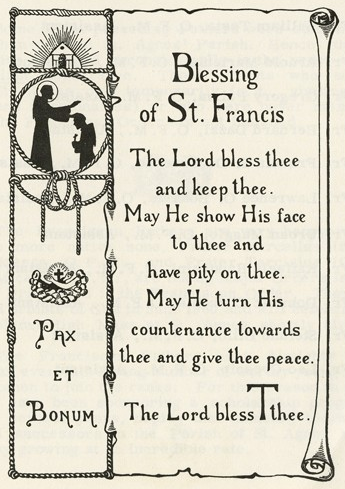
Franciscan friars and religious are especially noticeable due to their distinctive habit or robes. They typically wear a brown, black or gray habit with a simple three-knotted cord which represents their vows of poverty, chastity, and obedience.

TX.56: Complete black/brown Franciscan habit. Includes: a) cassock; b) hood; and c) cincture. 
In researching for this post we discovered anew some Vocations posters and literature distributed by the Felician Sisters of Mississauga and the Capuchins of Mount Alverno in Orangeville. Although the items are from several decades ago, the message remains relevant.


Religious Orders fonds: Franciscan Felician Sisters (C.S.S.F.): Publications: Vocations Posters

Religious Orders fonds: Capuchins (O.F.M. Cap.): Capuchins of Central Ontario - Orangeville, Ont.: History
The following is a list of Franciscan orders who are currently sharing or have shared their missions and ministries with the Archdiocese of Toronto:


Religious Orders fonds: Franciscans (O.F.M.): Publications
from: The Franciscan Fathers of the Immaculate Conception Province: Silver Jubilee Commemoration at Saint Agnes Church Grace and Dundas Streets Toronto, Canada. 1959.

Friday, 27 February 2015

The Year of Consecrated Life: The Order of St. Augustine at Marylake

February brings the season of Lent, which is a time of prayer and reflection before Easter. What better time to feature a religious order who have provided a place for those things in the Archdiocese of Toronto for seven decades?

The Order of St. Augustine traces its origins to 1244, when several Tuscan hermits were asked by Pope Innocent IV to unite as an order under St. Augustine's Rule, which is the oldest known guide to living in a religious community.

Fast forward to the 1940s, when Archbishop McGuigan heard about the work a group of Augustinians were doing in Nova Scotia. He had been interested in opening a spiritual center within the archdiocese, and so he invited the order to start a foundation in King City.

MG DS 44.66b

"Your Excellency, I beg to inform Your Excellency that the Sacred Congregation of Religious, favourably complying with the request presented by the Augustinian Fathers and approved by Your Excellency, has granted the "Beneplacitum Apostolicum" for a new foundation of their Order in your Archdiocese, in the place known as "Marylake".

"While making to Your Excellency this communication, with best regards and wishes, I remain Yours sincerely in Christ, + Ildebrando Antoniutti"

The Augustinians took over an 814 acre estate located on Keele Street north of King City that was originally developed by Sir Henry Pellat (of Casa Loma fame). The lake on the site, known as Lake Marie, was renamed as Marylake, and the property was dedicated to Our Lady of Grace. The buildings were converted to become a monastery and retreat center. In addition, the order operated a dairy farm.

On August 15, 1943, 12,000 people attended the dedication of the chapel and blessing of the statue of Our Lady of Grace. On November 11, 1961, the Augustinians were given the care of Sacred Heart Parish in King City. In 1964, a new monastery and shrine were dedicated. The organ in the new chapel was constructed from combination of two organs: one from the Seagram House in Toronto, and the other from the Eaton Estate. In 1999, Villanova College was opened on the property.

Over the years, Marylake has been an important spiritual haven in the Archdiocese of Toronto. Tens of thousands have taken part in the retreat programs offered by the Augustinians.

For more information about the Augustinians at Marylake, check www.augustinians.ca.

For more information about the Order of St. Augustine, check www.augustinians.net.


PH27A-04PC: Main Gate

PH27A-07PC: Monastery with Outside Altar

PH27A-10PC: Main Barn, Blessed Frederic Hall and Dairy

Newer shrine and monastery with view of the lake

Holstein herd

Friday, 16 January 2015

The Year of Consecrated Life: Celebrating the Loretto Sisters

The Year of Consecrated Life began at the end of November 2014 and will conclude on February 2, 2016.  The objectives for the Year of Consecrated Life are: gratefully remembering; and embracing the future with hope. To support these objectives we will post one blog per month featuring a religious order currently present in the Archdiocese of Toronto throughout the Year of Consecrated Life.


We begin the celebration by focusing on the first female religious order to establish itself in Toronto, the Institute of the Blessed Virgin Mary (I.B.V.M.), commonly known as the Loretto Sisters.

In 1847, Bishop Michael Power, the first bishop of the still new Diocese of Toronto used an ad limina visit to Rome to conduct a recruitment drive for priests and religious in Europe. On June 1, 1847 he visited Mother Teresa Ball at Rathfarnham, Ireland and the two agreed that sisters would be sent to establish schools in Toronto.

Five sisters arrived in Toronto on September 16, 1847 amid the typhus epidemic. No one greeted them upon their arrival as Bishop Power had not yet received the letter (below) detailing their travel plans. Despite the circumstances, they had set up their first residence on what is now Adelaide Street within a week and opened a school.

Religious Orders fonds: Sisters of Loretto (I.B.V.M.): General Correspondence, 1816-1849, July 20, 1847.

"Loretto AbbeyRathfarnhamDublin20th July 1847
Most Honored Lord,

"I was gratified with your Lordship's letter, dated from Toronto, 25th of last June.  I wrote today to inform Dr. O'Connell P.P. of Sts. Michael and John's Chapel that five of our Nuns will be prepared to sail from Kingstown to Liverpool 2nd August to proceed by the Packet, which will sail 3rd August for Boston U.S.

"The sixth Religious selected to complete the number desired by your Lordship exchanged this life, we trust, for heaven 5th of last July: possibly a candidate for Religious life may offer at Toronto and be trained to supply the place of one, who we hope, will intercede for the little colony, who go to propagate the holy faith under the auspices of the sacred hearts of Jesus and Mary and under the patronage of our glorious protector St. Michael. 

"No Titles[?] can be more appropriate for the numbers of our Institute, than that of the Diocese.It will not be easy to supply the places vacated by our Sisters, who volunteer for Canada we wish to send steady persons, who will be creditable abroad, as they have been edifying in their native country.

"Since writing the above Dr. O'Connell P.P. called and will be ready for our five to sail from Kingstown 10th August and from Liverpool to New York U.S. 11th August by the "Garrick". Passages for each from Liverpool to New York 25 pounds[?]."...
Religious Orders fonds: Sisters of Loretto (I.B.V.M.): General Correspondence, 1816-1849, July 20, 1847.

..."We have chosen Mrs. Anne Hutchinson for Reverend Mother she is 30 years of age; her religious appellation is Mary Joseph Loyola.

"Her assistant will be Mrs. Fleming, called Mary Gertrude she is aged 27 years.Mrs. Dease in religion Mary Teresa is well educated and intimate with Mrs. Phelan known to us, by the name of Mary Bonaventura and prized.

"The fifth is Sister to Reverend Mother, we style her Mary Valentina, she was educated in our school.All enjoy health and are are amiably disposed.If it meet your Lordship's wishes I can have a person with a religious vocation trained in the model school Dublin who can forward free schools in Canada by introducing the most approved plans for conveying knowledge.

"Two were already benefited, a third is to join a class in the Model School next month.
This is the 14th anniversary of our first filiation from this Abbey. Toronto will be the 10th Foundation from Loretto, Dublin. May it be equally prosperous with the preceding establishments.

"Since I received the honor of your Lordship's visit, a very beautiful demesne superior to Rathfarnham has been added to our acquisitions: a fine house too on it.

"All our Sisters enjoy their usual health.Soliciting the benefit of your Lordship's prayers,

"With esteem and respect,
Your humble servant in Jesus Christ
Frances Teresa Ball

"To Right Rev. Dr. Power"

Within a month Bishop Power had died of typhus. By March 1851, three of the five original sisters had died and were buried in St. Michael’s Cathedral crypt. Another had returned to Ireland. This left Teresa Dease as superior.  She took up the mantle of leadership and spent nearly four decades shaping the growth of the I.B.V.M. in North America.


First page of the entry entitled, "Sisters of Loretto"
 PH 31P/228AL, Religious Orders of the Archdiocese of Toronto Album believed to have been created in the 1960s.


In 2009, the Lorettos celebrated 400 years since their foundation by Mary Ward. A display celebrating this milestone was erected in the Pastoral Centre lobby:

ARCAT staff photo.
The Loretto Sisters currently work in education, the promotion of justice, and ministries of spirituality and pastoral care. They are truly contemplatives in action responding to the needs of the time.  For further information on the Institute of the Blessed Virgin Mary (I.B.V.M.) please see their website.

For further historical information please contact the Institute Archives of the Canadian Province.

For information on vocations please contact: Sr. Lynn Cira, IBVM, Loretto College, 70 St. Mary Street, Toronto, ON Canada M58 1J3; Phone: 416-925-2833 ext. 5231; E-mail: lorettovocations@bell.net

For general information on vocations please contact the Archdiocese of Toronto's Office of Vocations.

For further information on The Year of Consecrated Life, please see the November 28, 2014 post on the Archdiocese of Toronto blog.