Showing posts with label halloween. Show all posts

Friday, 30 October 2015

Record of the Week: Case of the Body Snatchers

A view of St. Michael's Cemetery, Toronto

The rise of body snatching from graveyards in the nineteenth century led to gated and walled cemeteries, some of which even had watchtowers.

Body snatching is the disinterment and theft of fresh corpses from graveyards. Body snatchers, or "resurrectionists," often supplied cadavers to medical schools for dissection during the eighteenth and nineteenth centuries. It was a lucrative business and one that was rarely prosecuted successfully.

Other sources of corpses for anatomical study were executed prisoners or those who died in poorhouses with no relatives to claim them. However, as many new medical schools were established in the United States and Canada, demand for cadavers was far greater than the legal supply. In the UK, body snatching was so prevalent that families of the deceased often watched over graves for days after burial. Eventually, legislation in Europe and the colonies was enacted to allow doctors and anatomy teachers to dissect donated bodies.

Read more about Body-Snatching in Ontario.

This letter was written to Bishop Alexander Macdonell of Kingston (the only Catholic diocese in Upper Canada at the time). It seems that Bishop Macdonell had received a complaint that the priest in Amherstberg, Ontario was exhuming the dead. To calm the bishop, Rev. Augustin Vervais explains that the incident was actually a case of body snatching. Apparently the trafficking of corpses across the Detroit River between Malden, Ontario and Gibralter, Michigan was common practice:
"Malden, 27 April 1841
Console yourself Monseigneur, there is nothing as grievous as that which you announced in your letter. So --
For a long time, there had been those who were making a business of removing dead bodies from the English cemetery - no sooner interred than removed. They take them, so they say, to Gibraltar, which is in front of Malden, an American state, to be dissected there.
Last December 24th, some days after I had myself buried a Catholic Irishman...a respectable citizen named Olivier Bertrand told me that he had risen from his bed around midnight to the cries of dogs and that he had seen some men in the cemetery. Some of us went to look, and we found, close to the ditch, two sticks and a pipe, and a little farther, a white sheet and a cord. The people dug to find the man had been removed - there were only his cloth and his slippers. The people were happy at having been warned by Mr. Olivier Bertrand.
Some days after, I buried a woman, and her relatives guarded the body for several nights. We learned nothing useful - what a futile exercise." [translated from French]


Bishop Macdonell fonds
M BB19.06

 Included with the letter is testimony from Olivier Bertrand, corroborating the story:

[translated] "I certify that several months ago I advised M. le Curé [the priest] that I had seen some men in the cemetery, that the noise of the dogs had led me there, and that, in my opinion, M. le Curé did well to excavate in order to safeguard and to save our relatives.
Malden 28 April 1841 [signed] Oliver Bertrand"


Bishop Macdonell fonds
M BB19.06

Friday, 31 October 2014

Record of the Week: the mysterious Death Mask

Today is All Hallows' Evening - or Hallowe'en if you enjoy grammatical contractions. With its roots in Western Christianity, All Hallows' Eve is the vigil before All Saints' Day. All Souls' Day follows on November 2nd, commemorating all the faithful departed.

Essentially, this part of the liturgical year is for remembering the dead. So what could be more appropriate than a death mask?

The 'Unknown Death Mask', a.k.a. the Archives' creepiest artifact.
Artifacts Special Collection, AF.107
Death masks are typically plaster casts of a person's face taken after death. Before the invention of photography, they were often created as mementoes of the deceased, or as a reference for portraiture. Masks of unknown corpses were also made to help with identification.

Our own plaster piece was in desperate need of identification. It was described as 'unknown death mask' in our artifacts catalogue. For the purposes of this blog, we wanted to cast some light on the issue (weak pun intended).

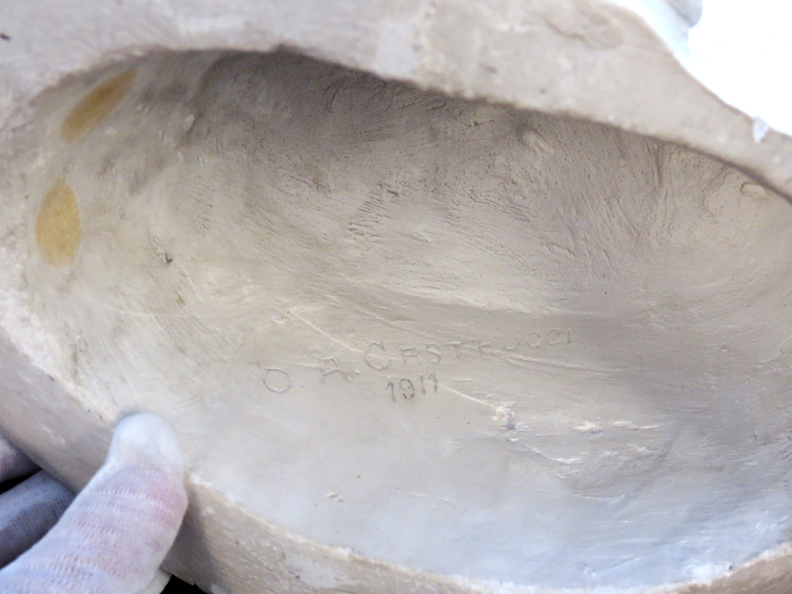
Handling the mask gingerly with cotton gloves, we searched for any identifying marks:

The maker's signature and date of creation: "O.A. Castrucci 1911"
Lo and behold, inscribed in the plaster is "O. A. CASTRUCCI 1911".  Our database did not find any Toronto clergy with this surname.  However, an online search confirmed that Castrucci Co. was a plaster cast studio located on Yonge Street in Toronto.*  This made us pretty confident that the deceased must be an important local figure.

Out of biological necessity, masks are created close to the date of death, so we searched our database to see who had died in 1911. Amazingly, two Archbishops of Toronto - Fergus McEvay and his predecessor, Denis O'Connor, C.S.B. - died within weeks of each other in the middle of that year.

Both of these bishops were robust in life and similar-looking, as evidenced by their portraits below. Both men died after suffering from disease, which would account for the gauntness of the face in the death mask.

Portraits of Archbishops of Toronto, Denis O'Connor C.S.B (left) and Fergus McEvay (right)
Somewhat disturbing are the eyelashes and eyebrow hairs embedded in the plaster.
After very little deliberation, we determined that this is likely the face of Most. Rev. Fergus McEvay, fifth ordinary of Toronto (1908-1911).  His prominent aquiline nose, which is noticeably crooked at the end, was the deciding factor.

Halloween mystery solved!

More on death masks: some of the most famous death masks include those of Dante Alighieri, Mary Queen of Scots, and Napoleon Bonaparte. The Laurence Hutton Collection of Life and Death Masks at Princeton University Library contains over a hundred likenesses of English and American literary and political figures.
_______________________________
*Klempan, Brabara. "Early Manufacture of Artists’ Materials in Canada: A History of Canadian Art Laboratory," Journal of the Canadian Association for Conservation, 37 (2012): p.50.
Zucchi, John E. Italians in Toronto: Development of a National Identity, 1875-1935 (Montreal: McGill-Queen's University Press, 1990), p.148.