Showing posts with label artwork. Show all posts

Friday, 23 November 2018

Today's Breakfast: Surreal

I started working in the Archives Department at the Archdiocese about 3 weeks ago. Within that time, I have been settling in and familiarizing myself with the extensive and varied holdings preserved here. While exploring our database one afternoon, my eyes suddenly landed on the word, “Dali”. It was Salvador Dali listed as a creator, and the item was an original relief wall sculpture located in one of our storage rooms. As a huge Salvador Dali fan myself, I immediately darted to its location and feasted my eyes upon this original work by the artist.

Relief wall sculpture mounted on velvet in a gold frame

AW82
Artwork Special Collections

AW82
Artwork Special Collections 

Titled, “Christ of St. John of the Cross”, the sculpture has been done in gold patina and hangs at a modest size of 76 x 46 cm. This sculpture happens to be one of many copies produced by Dali between the years 1951-1983 from a single master mold. The gold patina version was specifically limited to two editions of seventy-five sculptures each, and our friend sits at number 5 of the first edition. Other versions include platinum, silver and bronze patina.

Edition and copy number

AW82
Artwork Special Collections

The relief wall sculpture, "Christ of St. John of the Cross”, was originally developed from a painting by Dali of the same name, as seen below:
Christ of St. John of the Cross. c. 1951.
Oil on canvas. 204.8 x 115.9 cm.
Kelvingrove Art Gallery and Museum, Glasgow.
Digital photo taken from Gala-Salvador Dali Foundation. Cat. No. 667.

As one can see, the sculpture and the painting bear a striking resemblance to one another, sharing the central image of Christ with a boat and fishermen at the bottom of the image. Dali's inspiration for this painting, and ultimately the sculpture, came from two places: a drawing done by Saint John of the Cross, a 16th century Carmelite priest, after he had seen a vision of Christ during prayer (view it here); and the vision that Dali, too, had experienced when he dreamt of an image of Christ on the cross.
At the bottom of his studies for his painting, Dali wrote: 
“In the first place, in 1950, I had a ‘cosmic dream’ in which I saw this image in color and which in my dream represented the ‘nucleus of the atom’. This nucleus later took on a metaphysical sense; I considered it ‘the very unity of the universe’, the Christ! In the second place, when, thanks to the instructions of Father Bruno, a Carmelite, I saw the Christ drawn by Saint John of the Cross, I worked out geometrically a triangle and a circle, which aesthetically summarized all my previous experiments, and I inscribed my Christ in this triangle.”
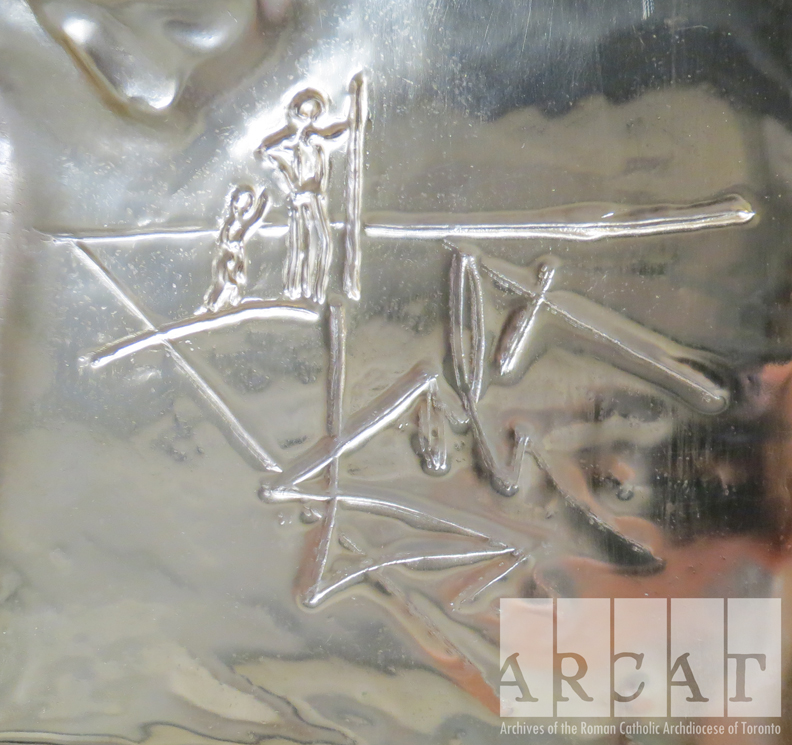
Close up of figures and Dali signature

AW82
Artwork Special Collections

When the original painting was first exhibited, it was deemed “banal” by an important art critic and was not well received as it broke from the artist’s more surrealist techniques. Several years later in 1961, the painting would be slashed by a visitor while hanging in the Glasgow Museum. This did not deter Dali from creating hundreds of these relief wall sculptures. The painting has since been repaired and continues to have a profound effect on its viewers.
ARCAT received its relief wall sculpture through a donation in 2003 from the Estate of G. Emmett Cardinal Carter.

Friday, 17 November 2017

Leonardo and the Viaticum Cabinet

Leonardo da Vinci (1452-1519), Salvator Mundi, painted circa 1500. Oil on walnut panel.
Christie's, New York

 This painting by Leonardo da Vinci was auctioned on 15 November 2017 at Christie’s in New York.  Twenty minutes into the sale, a winning bid of $400 million USD was entered by an anonymous buyer. After associated fees, the sale price of over $450,000,000 is the highest ever paid for a work of art at auction.  

The big news in the art world this week was the sale of Salvator Mundi, the recently rediscovered painting by Leonardo da Vinci, for a record-setting $450 million USD. It is one of sixteen extant works attributed to the Renaissance master, as well as the last known Leonardo painting that was held in private hands. It remains to be seen whether the anonymous new owner will allow it to be displayed for public consumption.

Salvator Mundi, "Saviour of the World", depicts a frontal portrait of Jesus Christ dressed in contemporary garb with his right hand raised in blessing and his left holding a transparent orb. The same mysterious quality that has made Leonardo's Mona Lisa the most recognizable painting in the world is here captured in the otherworldly gaze of Christ's amber eyes.

Painted around 1500, the work once belonged to King Charles I of England. As the painting changed hands and deteriorated it was repeatedly touched up - a common practice at the time. Eventually, the overpainted original was believed to be one of the many copies produced by other artists. In 1958, it sold for only £45.

The story of Salvator Mundi's rediscovery, which began in 2005, is a fascinating read.

So fascinating, in fact, that it made us wonder if there was a hidden Leonardo painting lurking in the bowels of the Archives. Had any of our bishops snapped up an Old Master of questionable provenance en route to their ad limina visit?

The results of our search were, sadly if inevitably, much more humble. We turned up a single reproduction of the second most famous painting in the world: Leonardo's The Last Supper. Hardly surprising, given that it is believed to be the most mass-reproduced work of all time.

Top: Leonardo da Vinci, The Last Supper, 1495-1498, oil/tempera on plaster
Below: Reproduction of The Last Supper, viaticum cabinet detail, ARCAT Artifacts Special Collection, AF.285

The Last Supper was painted on the refectory wall of Santa Maria delle Grazie convent in Milan. Leonardo used experimental techniques and paint, and the huge mural started to deteriorate almost as soon as it was finished. It has suffered under the hands of many would-be restorers over the centuries. Further deterioration occurred when the refectory was used as a stable by Napoleon's troops and when its roof was torn away by Allied bombing during WWII, which left the paint exposed to the elements for several years.

Suffice it to say, both the original painting and our reproduction have suffered from environmental exposure.

It was a rediscovery for us nonetheless. This Last Supper reproduction had originally been described in our catalogue as part of an ambry - a recessed cupboard in a church used for storing holy oils. However, when we pulled the artifact out of storage, it was clear that it was not an ambry. Further research led us to conclude it was, in fact, a viaticum cabinet, also known and a "sick call box," or a "last rites cabinet."

Viaticum refers to the Eucharist given to a sick or dying person as part of the last rites. The Latin meaning is "provision for a journey"; this final Eucharist is the spiritual nourishment that will fortify a dying person on their passage from this world to the next. Before Vatican II, it was common for Catholic households to have a viaticum cabinet with all the provisions for a visiting priest to administer last rites stored inside.

Artfacts Special Collection, AF.285
Viaticum cabinet

Why settle for one Old Master when you can have two?
The upper portion of the cabinet holds a statuette of the Pietà, its composition appropriated from Michelangelo's masterpiece, which resides in St. Peter's Basilica, Vatican City. 

Artfacts Special Collection, AF.285

The Last Supper adorns a door that opens to reveal a storage compartment.
Before Vatican II, it was common for Catholic households to have a viaticum cabinet with all the provisions for a visiting priest to administer last rites stored inside.

This particular cabinet was donated to ARCAT by a family in 2004. It seems to be a popular model mass-produced in the 1930s and 1940s and sold through ecclesiastical supply catalogs. You can see similar examples here.*

Out of the box, this viaticum cabinet would have been stocked with supplies, including a glass bottle for holy water, a paten, a box of absorbant cotton and an instruction booklet. However, over time, families would use the storage compartment for keeping accumulated religious items, such as medals, rosaries, candles and holy cards.

Artfacts Special Collection, AF.289

This viaticum cabinet came equipped with a glass bottle with the instructions:
"FOR HOLY WATER / KEEP CONSTANTLY FILLED"

Artfacts Special Collection, AF.286 to AF.292

Families often used the storage compartment for keeping accumulated religious items, such as these medals and rosaries that were found inside our viaticum cabinet. 

Though it's not a priceless work of ark, this viaticum cabinet is a piece of Catholic material and domestic culture and an interesting rediscovery at ARCAT.


* Sally M. Promey, "Viaticum, Last Rites Cabinet, Sick Call Set," Constellation, in Conversations: An Online Journal of the Center for the Study of Material and Visual Cultures of Religion (2014), doi:10.22332/con.cons.2014.1


Friday, 10 July 2015

St. Paul's Basilica: A Home Away From Home

Last month it was announced that St. Michael’s Cathedral is temporarily closing its doors for renovations. To accommodate the Cathedral’s parishioners, additional weekend masses will be held at nearby St. Paul’s Basilica starting this weekend (Saturday 6:00 p.m.; Sunday 9:30 a.m. and 1:00 p.m.). Following summer break, masses will feature music from St. Michael’s Choir School.

It's appropriate that St. Paul’s will stand in for the Cathedral; before the completion of St. Michael’s in 1848, St. Paul’s was the diocese’s unofficial cathedral. It was the sole place of worship for Toronto Catholics and, by default, the seat of our first bishop, Most Rev. Michael Power.

For those who will be temporarily attending St. Paul’s, and for those with an interest in visiting the city’s oldest Catholic parish, we offer a brief history of the church, its architecture and artwork.*

Historical Context
Established in 1822, St. Paul’s was the first Catholic parish between Kingston and Windsor and, consequently, the original church of what is now the Archdiocese of Toronto. The first structure was a red brick Gothic-style building completed in 1824 on the present site (83 Power Street).  

Old St. Paul's Church, Power Street, Toronto, 1824-1889
Photograph published in The Story of St. Paul's Parish by Rev. E. Kelly (1922).
The original church was a red brick Gothic structure.

In its early years St. Paul’s served the Irish coming from their famine ravaged homeland.  In 1847, a typhus epidemic raged through the city, killing 850 people, including Bishop Power. Many were buried in mass graves on the church grounds.

During the nineteenth century St. Paul’s was a bulwark of Catholicism in a very Protestant city.  As the city grew and prospered, from “Muddy York” to an industrialized urban centre, so too did St. Paul’s.  By the turn of the century a dozen more parishes were erected in the city to accommodate the growing faithful. St. Paul’s Parish was reinvigorated with the building of the present church - a much larger edifice.  Its construction was initiated and overseen by its pastor, auxiliary bishop of Toronto, Most Rev. Thomas O’Mahony, and completed in 1889.
Photographs Collection,  PH0093/74CP 
Tomb of Bishop O'Mahoney, the pastor responsible for the building of the present church. 
He is buried on church grounds. The epitaph reads:
In Memoriam.
Beneath this stone repose the remains of the Right Rev. Timothy O'Mahony D.D.
Born in the parish of Kilmurray Co. Cork Ireland A.D. 1825 
Ordained priest 1849 Consecrated first bishop of Armidale Australia 1871
Auxiliary to the Archbishop of Toronto and appointed pastor of St. Paul's Church 1880
After a long and painful illness borne with Christian patience fortified with the sacraments and consolations of the Church
He departed this life Sept. 8th 1892
Requiescat in pace.

Architecture
The designer of the new church was renowned architect Joseph Connelly, who was also responsible for St. Mary’s (1852).  His decision to forsake the Gothic for Italian Renaissance was considered daring and internationally en vogue for the time.  St. Paul’s is built in the Romanesque basilica style with Ionic colonnades separating the central nave from the side aisles. It has rounded instead of pointed arches and a plain campanile rather than a sharp spire. Connelly imitated the style and design of the Basilica of St. Paul-Outside-The-Walls in Rome. The new St. Paul’s was solid, imposing, impregnable - a visible statement of faith.

Photographs Collection, Architectural Survey Album, PH31P/227AL(45)
St. Paul's Church and Rectory, 1914

Architect Joseph Connelly imitated the style and design of St. Paul-Outside-the-Walls Basilica in Rome.
The exterior dimensions are impressive: 174 feet in length; 70 feet in width of nave; 100 feet in width of transept; 129 feet high at the bell tower.  St Paul’s was unique among Toronto's Gothic-dominated ecclesiastical architecture of the time.

Artwork
Following Bishop O’Mahony’s death in 1892, the newly appointed pastor inherited an unfinished church. Dean John Hand embarked on an ambitious scheme to decorate the church with the beautiful murals, stained glass windows and statuary that make the church’s aesthetics truly remarkable.  Dean Hand commissioned the following works: 
1893: Four paintings by unknown Belgian artist: “The Conversion of St. Paul”; “The Last Supper”; “Gethsemane”; “Annunciation”
1894:  Commencement of the installation of stained glass windows and the clerestory windows
1898: All-wood organ by R.S. Williams & Son and enlargement of the gallery
1899: Statue of St. Paul, west façade
1901: Stations of the Cross, made of stone in Europe
1905: Completion of the campanile. The bell from the original St. Paul’s was installed in the new tower
1908: Three marble altars and pulpit
1911: Ten paintings of the life of St. Paul on the ceiling of the nave, “Ascension of our Lord” and “Assumption of the Blessed Virgin Mary” by G. Caroselli
1921: Soldiers’ World War One Memorial, west façade
1933Pietà and memorial to Bishop Michael Power and Irish Famine victims
Photographs Collection, PH0093/57P
Photograph showing the apse and sanctuary in the 1950s.
The marble high altar and pulpit were commissioned by Dean Hand in 1908.
Photographs Collection, PH0093/63CP
The earliest artwork in the basilica are four 1893 paintings by an unknown Belgian artist, including "The Conversion of St. Paul" in the dome (Saul, Saul, why do you persecute me?) and "The Last Supper," copied from Leonardo's masterpiece.
These paintings have since been cleaned and restored.
Also note, 
following the reforms of Vatican II, the altar has been changed and the pulpit replaced with an ambo.
Photographs Collection, PH0093/15CP
1981 photograph of the nave looking towards the choir loft and wood organ, installed in 1898.
The barrel vault ceiling and Ionic colonnade are typical Romanesque features.
The ceiling paintings, commissioned in 1911, include ten scenes from the life of St. Paul. 

Photographs Collection, PH0093/47CP
One of the nave ceiling paintings of the life of St. Paul: " Paul in prison in Rome"
The scenes were painted on canvas and glued to the ceiling.
From 2001 to 2006, artist/restorer Carlos Nunes and his team cleaned and restored the interior artwork of St. Paul’s. Nunes has also worked on the restoration of the Cathedral’s paintings and windows.

A Minor Basilica
St. Paul’s Church was designated a Minor Basilica on August 3, 1999, in time for the Millennium Jubilee celebrations. The title is granted by pontifical authority to churches that meet a variety of conditions. For example, the church must: stand out as a centre of pastoral and liturgical activity; be large enough to carry out exemplary celebrations; and enjoy a certain renown throughout the diocese. The historical importance of the church and the worthiness of its art are also considered. St. Paul’s is the twentieth church in Canada to receive this papal honour.

From its origins, St. Paul’s has welcomed the stranger, the immigrant and the impoverished. Now it will also welcome the displaced Cathedral parishioner until March 2016.


*This historical summary has been adapted from a document written in 1999 by historian Michael Power to support the application for Minor Basilica status.