Showing posts with label Archbishop O'Connor. Show all posts

Friday, 30 December 2016

Happy New Year!

It is hard to believe that another year is almost over. Though people have been exchanging new year's wishes for centuries, it has become increasingly more common for people to do so on social media than in actual writing. This week, we are featuring new year's wishes to four archbishops and a cardinal in printed or handwritten formats, all from long before Facebook and Twitter were even thought to be possible. This selection even includes some items from before the word computer meant "calculating machine" as opposed to simply "one who calculates."

Bishop Farrell, the Bishop of Hamilton, wishes Archbishop Lynch "health, happiness and every grace for the new year":

Letter from the Bishop of Hamilton to Abp. Lynch,
December 31, 1872

L AD02.36
Archbishop Lynch fonds


An unknown bishop sent this tiny card (measuring just 2 x 3-¾ in or 5 x 9-½ cm) of new year's greetings to Archbishop McEvay:

ME AA02.01
Archbishop McEvay fonds


R. A. O'Connor, Bishop of Peterborough, offers Archbishop O'Connor "hearty good wishes for a blessed and happy New Year":

Letter from the Bishop of Peterborough to Abp. O'Connor,
December 29, 1900

O AB02.15
Archbishop O'Connor fonds


First and last pages of a letter to Archbishop McNeil from his niece, Sister St. Marie Beatrice, C.N.D., in which she mentions her new year's greetings to him for the year 1932:

Letter from Sr. St. Marie Beatrice, C.N.D., to Abp. McNeil,
January 8, 1932

MN AA03.216
Archbishop McNeil fonds


New year's greeting card from Bishop Charles L. Nelligan of Pembroke, Ontario, with a photograph of the Canadian Overseas Chaplains:

Greeting card from Bp. Charles L. Nelligan,
January 20, 1941
Card. McGuigan's signature is on the left.

PH09W/07P
Cardinal McGuigan fonds


The staff at ARCAT would like to take this (social media) opportunity to wish you a very happy new year and all the best for a healthy and joyous 2017!

Friday, 8 January 2016

Bills Bills Bills

In this space we like to explore how the ARCAT collection reflects the history of Catholic Toronto, but we also like to look at the broader context. Today we are featuring a type of document that has been around for thousands of years: bills and receipts.

These documents give us an amazing glimpse into the past by showing us what people were purchasing, what they were eating, and what they were wearing. They show us where people were shopping, the types of businesses that existed in the city, and how much things cost. They help us fill in the picture of what everyday life was like for those whose actions created our modern world.

This 1908 Bell bill shows that Archbishop McEvay paid $1.05 for calls to Hamilton, Guelph and Niagara Falls in the month of August.

Archbishop McEvay Fonds: ME AA06.12 

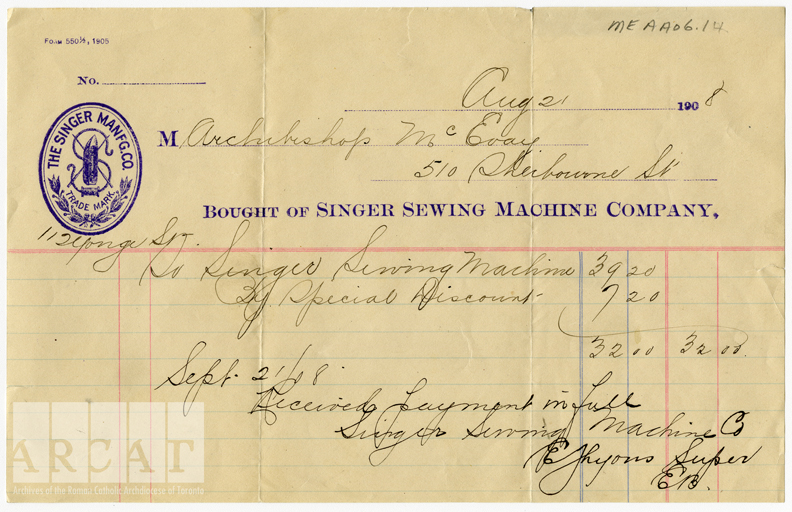
In 1908 Archbishop McEvay bought a Singer sewing machine for $32.00. Today, their sewing machines cost anywhere from $100 - $1000. The top of the line model even has an LCD touch screen!

Archbishop McEvay Fonds: ME AA06.14

Over the course of September, 1908, Archbishop McEvay bought peaches, pears, grapes, apples, oysters and salmon from Gallagher's Fruit and Oyster House, and he only spent a grand total of $5.85. If you can tell us what the first two items he bought were, you win a prize!

Archbishop McEvay Fonds: ME AA06.25

In 1908 you could buy a rug and a mattress for $9.25 from The J. F. Brown Company. The J.F. Brown site is now a heritage building at 193 Yonge St., across from the Eaton Centre.

Archbishop McEvay Fonds: ME AA06.31

$35.50 for carriage repairs at The Enright Shoeing Forge in December, 1909. Very important to maintain your means of transportation!

Archbishop McEvay Fonds ME AA06.78

We take ice for granted now. We can just reach into the freezer or buy a big bag from the store if necessary year round. In 1910, Archbishop McEvay paid $8.00 for a four month supply of ice cut from Lake Simcoe.

Archbishop McEvay Fonds: ME AA06.88

$4.00 for office supplies from Grand & Toy in 1910.


Archbishop McEvay Fonds: ME AA06.146

"2 to Depot - 1 home" $1.00 in 1901 for Archbishop O'Connor

Archbishop O'Connor Fonds: O AC01.01

Some of you might remember shopping at Eatons. In 1899 you might have paid $27.00 for 28 yards of carpet.

Archbishop Walsh Fonds: W AA11.02

Only $35.00 for a brass bed in 1899 from the Schomberg Furniture Company.

Archbishop O'Connor Fonds: O AC01.01

Rye, Sherry Wine and Claret purchased from George J. Foy, Importer of Wines, Liquors and Cigars in 1899 for $6.20.

Archbishop O'Connor Fonds: O AC01.01

$26.89 for work on the Cathedral by William Simpson in 1902. The receipt is signed off on by the architect, A.W. Holmes.

Archbishop O'Connor Fonds: O AC01.01

Bishop Power paid £3.40 for various items of clothing from Walter MacFarlane in 1844, including 12 nightcaps, 4 pairs of cashmere hose, and 5 India handkerchiefs.

Bishop Power Fonds: P AD01.04

The bill for Archbishop Walsh's funeral includes charges for washing and dressing remains, shaving, embalming, a purple silk plush casket, coachmen and footmen in livery, and other things. The total came to almost $800.00. Rosar-Morrison Funeral Home still exists on Sherbourne St. in Toronto.

Archbishop Walsh Fonds: W AA11.02

Friday, 31 October 2014

Record of the Week: the mysterious Death Mask

Today is All Hallows' Evening - or Hallowe'en if you enjoy grammatical contractions. With its roots in Western Christianity, All Hallows' Eve is the vigil before All Saints' Day. All Souls' Day follows on November 2nd, commemorating all the faithful departed.

Essentially, this part of the liturgical year is for remembering the dead. So what could be more appropriate than a death mask?

The 'Unknown Death Mask', a.k.a. the Archives' creepiest artifact.
Artifacts Special Collection, AF.107
Death masks are typically plaster casts of a person's face taken after death. Before the invention of photography, they were often created as mementoes of the deceased, or as a reference for portraiture. Masks of unknown corpses were also made to help with identification.

Our own plaster piece was in desperate need of identification. It was described as 'unknown death mask' in our artifacts catalogue. For the purposes of this blog, we wanted to cast some light on the issue (weak pun intended).

Handling the mask gingerly with cotton gloves, we searched for any identifying marks:
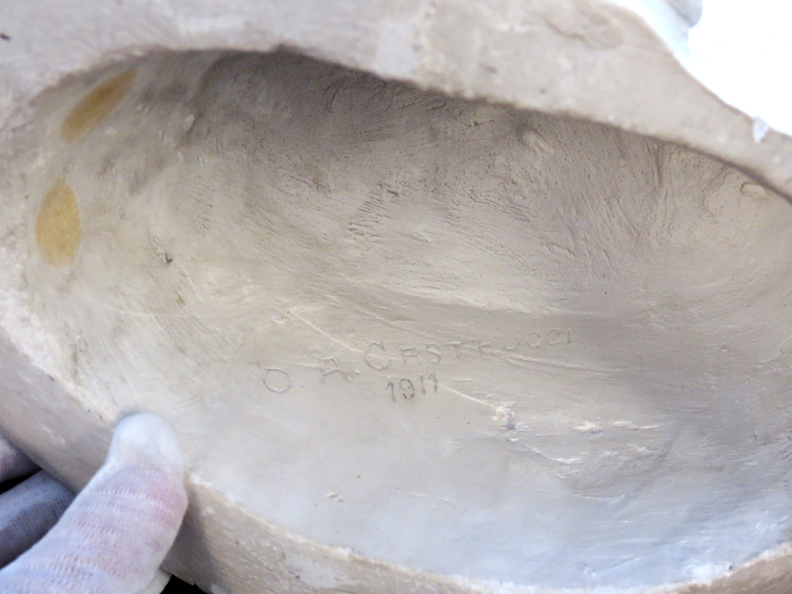
The maker's signature and date of creation: "O.A. Castrucci 1911"
Lo and behold, inscribed in the plaster is "O. A. CASTRUCCI 1911".  Our database did not find any Toronto clergy with this surname.  However, an online search confirmed that Castrucci Co. was a plaster cast studio located on Yonge Street in Toronto.*  This made us pretty confident that the deceased must be an important local figure.

Out of biological necessity, masks are created close to the date of death, so we searched our database to see who had died in 1911. Amazingly, two Archbishops of Toronto - Fergus McEvay and his predecessor, Denis O'Connor, C.S.B. - died within weeks of each other in the middle of that year.

Both of these bishops were robust in life and similar-looking, as evidenced by their portraits below. Both men died after suffering from disease, which would account for the gauntness of the face in the death mask.

Portraits of Archbishops of Toronto, Denis O'Connor C.S.B (left) and Fergus McEvay (right)
Somewhat disturbing are the eyelashes and eyebrow hairs embedded in the plaster.
After very little deliberation, we determined that this is likely the face of Most. Rev. Fergus McEvay, fifth ordinary of Toronto (1908-1911).  His prominent aquiline nose, which is noticeably crooked at the end, was the deciding factor.

Halloween mystery solved!

More on death masks: some of the most famous death masks include those of Dante Alighieri, Mary Queen of Scots, and Napoleon Bonaparte. The Laurence Hutton Collection of Life and Death Masks at Princeton University Library contains over a hundred likenesses of English and American literary and political figures.
_______________________________
*Klempan, Brabara. "Early Manufacture of Artists’ Materials in Canada: A History of Canadian Art Laboratory," Journal of the Canadian Association for Conservation, 37 (2012): p.50.
Zucchi, John E. Italians in Toronto: Development of a National Identity, 1875-1935 (Montreal: McGill-Queen's University Press, 1990), p.148.