Showing posts with label Archbishop Pocock. Show all posts

Friday, 11 October 2019

What could this light be? A council!


A well known image shows Council Fathers seated in St. Peter's Basilica. Over 2000 bishop and other experts from around the world participated in the Second Vatican Council, including several Canadians.

[October 11, 1965 - December 8, 1965]

PH 14V/05cp
ARCAT Photo Collection

October 11, 1962 was a turning point for modern Catholicism: The Second Ecumenical Council of the Vatican (Vatican II) was opened by Pope Saint John XXIII. The Council brought bishops and theologians from around the world to address problems faced by the Church and its people. The Council's significance was so great that it is common to hear people talk about "pre-Vatican II" and "post-Vatican II."

Over the course of four sessions ending in December 1965, 16 documents were produced that addressed issues of the Church in the modern world. The changes that came out of these documents are still discussed and debated today.

A letter sent to bishops in the Canadian Catholic Conference contained text of a July 1962 statement of Pope Saint John XXIII explaining his inspiration for calling the Council:
"Let us take, for example, the idea of the ecumenical council. How did it happen? How did it develop? It happened in such a way that to relate it seems unreal, because so suddenly did the thought arise of such a possibility and too, the determination to apply Ourselves to carrying it out. 
"A question posed during a particular conversation with the Secretary of State, Cardinal Tardini, brought forth the observation of how the world is immersed in serious distress and agitation. We pointed out, among other things, how it is claimed that people want peace and agreement but, unfortunately, sometimes it happens that ultimately disagreements become more acute and threats are increased. 
"What will the Church do? Must the Mystical Barque of Christ remain at the mercy of the waves and go adrift? Is there not rather expected from the Church not only an admonishment, but also the light of great example? What could this light be? 
"The questioner was listening with an attitude of reverent respect and expectation. Suddenly Our soul was enlightened by a great idea that We felt just at that moment, and which We welcomed with indescribable trust in the Divine Master; one solemn and binding word came then to Our lips. Our voice expressed it for the first time: a council! 
"To tell the truth, at once the fear arose that this might cause perplexity, if not dismay. Undoubtedly, We would now have to listen to a list of grave difficulties, if for no other reason than that the sudden announcement would lead to the thought of a natural and lengthy preparation that such an aim would entail. 
"Instead, the answer came without delay. A clear feeling beamed over the face of the Cardinal: his assent was immediate and exultant. 
"This was a first definite sign of God's will. Who does not, in fact, know the necessary and attentive consideration with which the Roman Curia customarily examines the major and minor questions that present themselves? (PO VA14.04)" 

Here in the archives, we have records from five of our bishops who attended the Council: Cardinal McGuigan, Archbishop Pocock, Cardinal Carter, Bishop Marrocco, and Bishop Allen. We have previously written about the commemorative rings they all received, but there are many other documents of historical significance in our storage rooms.

Commemorative edition of Humanae Salutis, the document convoking the Second Vatican Council. The last pages contain the signatures of all the cardinals.

"The forthcoming Council, then, will meet happily and at a moment in which the Church has a more lively desire to fortify her faith and to contemplate herself in her own awe-inspiring unity, just as she feels the more urgent duty to give greater effectiveness to her healthy vitality and to promote the sanctification of her members, the spread of revealed truth, and the consolidation of her structures. This will be a demonstration of the Church, always living and always young, that feels the rhythm of time, that in every century beautifies herself with new splendor, radiates new light, achieves new conquests, all the while remaining identical to herself, faithful to the divine image impressed on her face by her divine Bridegroom, who loves her and protects her, Christ Jesus." (translation)

December 25, 1961

AF 074
ARCAT Artifacts Collection


Pope Saint John XXIII greeting Cardinal McGuigan during preparatory meetings at the Church of the Canadian Martyrs in Rome.

1962

PH 09V/15P
ARCAT Photo Collection

A letter which includes instructions for what to wear to the Council. Can you imagine the big task of making sure over  2000 participants were dressed appropriately?

August 9, 1962

PO VA04.11
Archbishop Pocock Fonds

Bishop Carter's Vatican passport specially issued for the Council. On the next page it reads,

"Hamlet John Cicognani Cardinal Bishop of the Holy Roman Church of the Title of the Suburban See of Frascati Secretary of State to His Holiness Pope John XXIII requests all Civil and Military Authorities to permit the bearer, who is one of the Fathers of the Second Vatican Ecumenical Council, freely to pass, and, in case of need, to provide him with every opportune assistance and protection. From the Vatican, 1962."

CA AA07.03
Cardinal Carter Fonds

Philip Pocock attended the Council while Auxiliary Bishop of Toronto. Though his fonds is not yet available to researchers, it contains several boxes of documents and notes from his work during that time. An especially exciting item is his handwritten diary from the first session of the Council. It details behind-the-scenes discussions and his personal thoughts and reflections. On December 16, 1962 he wrote,
"On Dec. 8 the solemn closing of the first session took place. All the Fathers joined in the singing of the Gregorian at the Pontifical mass. It was very powerful and beautiful. At the end of the mass the Holy Father walked in, took his throne and spoke to us for about a half hour. He again stressed the pastoral purpose of the Council. Much work would be accomplished in the interval before the reopening of the Council, September 8/63. He seemed to be well and his voice was strong, However, I fear that he is suffering from a chronic disorder, perhaps cancer. (PO AA13.03)" 
Pope Saint John XXIII would die within six months, but his successor, Pope Saint Paul VI would continue the work of the Council.

Bishop Pocock in St. Peter's Square during the first session of the Council.

1962

PH 14V/08P

ARCAT Photo Collection

We are lucky to have a box of newspapers and magazines with articles about the Second Vatican Council in Archbishop Pocock's fonds. Included are titles such as Life, Newsweek, and The New Yorker, to name a few.

1960s

PO VA71-75
Archbishop Pocock Fonds

Here's a bonus note from Archbishop Pocock to the Chancery Office sent during the Council's last session in 1965. It is a transcription of a dictaphone recording:

"Message from his Grace:

We are installed at last here in Rome and we have had two day sat the Council. We had a beautiful trip over and two terrible days of rain in Capri. I suppose I better not talk to you about it because you will be finding out all the news in my letters anyway. I hope this machine that I rented works all right. If the speed is wrong or if it is hard to interpret, i wish you would let me know by a cable so I won't waste too much time here. Give my love to all the girls and my respectful regards to the clergy there at the Chancery Office."

September 1965

PO CO05.409
Archbishop Pocock Fonds


Friday, 2 August 2019

The Archdiocese goes to the Ex

The opening day of the 140th Canadian National Exhibition is only a couple of weeks away. As we look to enjoy the final weeks of summer, we wanted to share some ephemera and correspondence about the C.N.E. from our collection.

Cardinal McGuigan and Archbishop Pocock were often invited to attend the inaugural day ceremonies and accompanying luncheons during their Episcopacy. Busy schedules (and later in life declining health) meant they often declined the invitations, yet we know that Archbishop Pocock attended at least a couple of the opening day celebrations.

Archbishop Pocock sits third from right at the opening day ceremonies
at the CNE bandshell, August 15, 1974

PH14D/12CP

In 1965, the organizers must have realized that the head of the Catholic Archdiocese would not very well be bringing a wife to the event. "Lady" is crossed out and "Guest" added in. Cardinal McGuigan would have had to decline the invite due to his declining health.

Invitation to attend the inaugural ceremonies, 1965, addressed to Cardinal McGuigan

ARCAT Chancery Office Files : Canadian National Exhibition

Archbishop Pocock was invited to attend on opening day in 1969 when he was still Coadjutor Archbishop. He agreed to say grace before the luncheon that day and we have a draft of the prayer he intended to say along with a letter from the President of the C.N.E. expressing his thanks.

 "Eternal Father, gathered here to open the ninety-first Canadian National Exhibition we humbly offer you our thanks for all the blessings you have given to our beloved country; the beauty of its landscapes, the richness of its soil, the wealth of its resources, the dreams and sacrifices of its founders, the dedications of its leaders and of all who try courageously to guide it towards its destiny in justice, in unity and in peace. we thank you above all for our spiritual heritage, our faith and our dependence on you, our Lord and creator.

We ask your forgiveness for our shortcomings and we earnestly ask you to make of us a free people; free of selfishness, free of discrimination, free of greed, free of separation one from another.

On these historic grounds we now place on display the first fruits of our minds, our hearts and our hands; the achievements of the arts, of science, of industry and of agriculture. All of these we offer to you, our Lord and Master, with the earnest prayer that we may use our talents and resources in your service and in the service of your people here in Canada and throughout the world.

As you have blessed us so abundantly, so make of us a people dedicated to the highest ideals of social justice, of mutual understanding and love and grant us the effective determination to live at peace among ourselves and with all nations. This we humbly ask in your holy name. Amen."


ARCAT Chancery Files: Canadian National Exhibition

The Archdiocese also ran a Catholic Church Exhibit for the C.N.E. at least once. This pamphlet from the exhibit is from 1964 shows what the exhibit would have looked like. Interesting items on display include the sandals worn by Pope John at his coronation.

ARCAT Chancery Files: Canadian National Exhibition

Friday, 24 May 2019

Passport to Man and His World: Expo '67 and the Christian Pavilion

From April to October 1967, Canada's centennial year, Montreal hosted 62 countries and over 50 million visitors for a world's fair: the much acclaimed Expo '67.

Though large fairs were held before it, the first world's fair is commonly considered to be London's Great Exhibition of 1851. Nations and manufacturers from around the world contributed cultural and industrial displays for the six million visitors. Canada sent a canoe. Over almost two centuries these fairs have been a place to wow crowds with the latest technological advancements, exchange ideas, and share cultures.

The theme of Expo '67 was 'Man and his World,' addressing "universal problems of humanity" and "man's social responsibility and environmental consciousness." Attractions included the space capsule in which the first man orbited the earth, and the geodesic dome that can still be seen on its island location in the St. Lawrence River.

Toronto's Bishop Allen kept his season's pass that allowed him unlimited visits during the expo. It had pages to collect stamps from the various national exhibits.

Bishop Allen's Season's Pass to Expo '67

AL AA12.05
Bishop Allen Fonds


Instead of building their own display, the Catholic Church in Canada chose to participate with six other Christian groups to erect the Christian Pavilion. Their endevour is best described in their own words:


(April 14, 1967. PO SU 35.30, Archbishop Pocock Fonds)


The organizing committee provided missalettes for Catholic congregations to promote the Pavilion and raise funds: 

"Expo '67 will be an unprecedented achievement in the history of Christianity. This is the Christian Pavilion. Seven Christian churches, after several months of meetings and exchanges, have decided to erect together a Christian Pavilion which can proclaim to the world that God has made himself flesh to live among us and that he is present at everything that happens on the land of men.

"Today Catholics are called upon to do their part in this common endeavour which gives rise to much hope. Give according to your means but generously."

May 29, 1966

PO SU35.26
Archbishop Pocock Fonds


The architecture of the pavilion was described this way:
"The architecture of the Pavilion has been entrusted to the associated architects, Roger d'Astous and Jean-Paul Pothier of Montreal. These two architects are well-known throughout Canada ... The shape of the roof, which recalls that of arms uplifted to the Lord, tries to signify that the Christian welcomes the entire universe so that he might offer it to God in a perpetual Eucharist. The cross at the entrance is not identified with the Christian religion any more than with any other religion; it is the "taw" (Greek) which is found among the most primitive Christian symbols. The small building at the extreme right is to welcome visitors and to house the administrative services. It covers a little more than a thousand square feet. There is a garden in front of the central portion. Fed by a fountain with a water spout, a little pond adds to the peaceful atmosphere of the entrance of the Pavilion. The part of the building devoted to the Exhibit itself consists of three levels: a first level, almost square with the entrance, a second level lower, and a third level reached by a slight incline. These architectural data serve the setting itself. Indeed, the visitor is welcomed as he is; then led to take consciousness of the great problems of mankind, by himself passing through a kind of crucible, and finally invited to that burst of hope provided by the gospel of Christ. The presentation takes place on a surface of 7,800 square feet. The walls are in white stucco. The roof is in laminated wood." (February 14, 1966. PO SU35.24. Archbishop Pocock Fonds)

A poster asking parishioners to do their part to support the Christian Pavilion at Expo '67.

PO SU35.34c

Archbishop Pocock Fonds

The Christian Pavilion was well-received by visitors. One reviewer claimed, "it is not only one of the best exhibits at the fair but a moving example of how the Gospel can be presented to late 20th century man in a vigorous contemporary idiom" (Harvey Cox: Commonweal, May 26, 1967). It was truly a reflection of growing ecumenism combined with contemporary media practices.

Expo 2020 will be held in Dubai. In just one trip you'll be able to see over 190 countries. Time to start planning your vacation! 


Friday, 26 October 2018

Director's Cut: Vatican II rings and certificates

As the Director of Archives at the Archdiocese of Toronto I am often complimented on the consistently fabulous posts of The Archivist's Pencil. I am always quick to point out that I myself have written very few and the accolades for these wonderfully composed pieces must go to my colleagues. I thought it might be nice to give them a little break every now and again and share with our readers some of my favourite things in our holdings.

My first post in the Director's Cut series features an artifact and its corresponding documentation... an archivist's dream!

When I began working here I quickly learned that I needed to educate myself on the Second Vatican Council, which is often referred to as Vatican II. Although I was vaguely aware that changes to the way Mass was celebrated had been made at some point in my parents' lifetime, my studies of history hadn't delved much into the post-World War II era, so I was largely ignorant of this major event in the history of the Catholic Church and needed to know more about it to understand the context of a large number of the records in our holdings. If you too would like to educate yourself, you can start with the documents of the Second Vatican Council which can be viewed on the Vatican's website here.

October 28 marks the 60th Anniversary of the election of St. John XXIII as Pope. His Holiness announced very early in his papacy that he intended to convene the Ecumenical Council. Several of the former, current and future auxiliary bishops, archbishops and cardinals that served the Archdiocese of Toronto attended sessions of the Council. Listed among the Council Fathers are: Auxiliary Bishop Francis Allen, G. Emmett Cardinal Carter, Auxiliary Bishop Marrocco, James Cardinal McGuigan, Archbishop Philip Pocock and Auxiliary Bishop Benjamin Webster. You can view a full list of bishops who attended each of the four sessions here.

At the closing of the Second Ecumenical Council in December 1965, St. Paul VI gifted each of the Council Fathers a commemorative certificate and gold ring.

AF.103 ARCAT Artifact Collection and PO AA41.023 Archbishop Pocock Fonds


Another view of AF.103
ARCAT Artifact Collection

The Vatican II Council ring is made entirely of yellow gold. The ring shaped like a mitre (bishop's hat) with a point at the top. Depicted are three arched niches: Christ in the centre; St. Peter on the left; St. Paul on the right. The artist’s signature is inscribed, “E. Manfrini”. St. Paul VI’s coat of arms in stamped on the inverse of the band.

PO AA41.023
Archbishop Philip F. Pocock Fonds

Accompanying the ring was this commemorative certificate from Pope Paul VI. It attests in Latin to Archbishop Pocock's participation at Vatican II and expresses the hope that the message of the Second Vatican Council will be conveyed to all Catholics.  We have similar certificates in our collection for Auxiliary Bishop Francis Allen (AF.135a), G. Emmett Cardinal Carter (AF.009) and James Cardinal McGuigan (AF.135b).

Cardinal Carter wore his Vatican II Council ring (AF.361) as his regular day-to-day episcopal ring. His Eminence's ring in on display at the G. Emmett Cardinal Carter Library at King's University College in London, Ontario where it is on permanent loan.

AF.361 - Card. Carter's Vatican II ring
ARCAT Artifact Collection


Friday, 7 September 2018

A New Medium and the Catholic Message: The Archdiocese on the Small Screen

September 6th and 8th, 1952 were big days for Canadians: CBC Television began broadcasting in Montreal and Toronto. Though some who lived close to the border had been watching American stations since the 1940s, this was the first time we had real networks of our own. Its popularity quickly exploded: by 1965, television sets were in 92% of households.

While Bishop of London, Cardinal Carter appeared on the Windsor television show Grey Scale.

March 11, 1977

PH 18G/01P
ARCAT Photograph Collection

Catholic leaders recognized the value of the medium for reaching out. In his 1957 encyclical letter Miranda Prorsus, Pope Pius XII called the development of television "an event of great importance in human history," and wrote,
"It is well known to Us with what deep interest vast numbers of spectators gaze at television programmes of Catholic events. It is obvious, of course, - as We declared a few years ago - that to be present at Mass portrayed by Television is not the same as being actually present at the Divine Sacrifice, as is of obligation on holy days. However, from religious ceremonies, as seen on Television, valuable fruits for the strengthening of the Faith and the renewal of fervour can be obtained by all those who, for some reason, are unable to be actually present; consequently, We are convinced that We may wholeheartedly commend programmes of this kind."

The television networks also recognized the value of providing religious programming. There are lots of examples in the archives of stations writing to the Bishops about their plans, including the following from CBC:

"Your Excellency:

"The first program for Christmas Day this year on your local CBC-TV station will be live coverage of the Midnight Mass from St. Basil's Seminary Chapel, Toronto. 

"The service, celebrated by Reverend Eugene R. Malley, will commence at 12:01 a.m. on Christmas Day and will include prayers and Christmas carols sung by the Basilian Seminarian choir directed by Reverend George Vander Zanden.

"The gospel and certain prayers of the Mass will be illustrated by paintings and drawings appropriate to the theme.

"Perhaps you would like to inform your parish priests about this program.

"Sincerely, 
Dillwyn Hatton
Information Services"

December 14, 1961

PO CM01.03a
Archbishop Pocock Fonds

"Canadians at Worship
MEETING PLACE

"As the Fall returns and the pace of life quickens, our MEETING PLACE returns too, with worship from churches and synagogues across Canada.

"The response we receive from viewers has been tremendously encouraging. Some tell of the pleasure they receive from particular hymns, prayers, sermons. Others say they pick up new ideas for their own church, from watching others.

"We don't intend MEETING PLACE as a substitute for worship in a community. But for instance, I know of an elderly couple who cannot get out to church. Once a week, they put on their Sunday best - she chooses her Sunday hat - and they go down to the living room to be part of MEETING PLACE. 

"We try to make MEETING PLACE as complete an experience as possible. I hope it succeeds as well for you.

"Donald Henderson
CBC Television"

[1974-1980]

PO CM01.88
Archbishop Pocock Fonds


In the 1970s, the Archdiocese of Toronto helped to fund The Church Today, which aired on Global, CHCH, and CFTO, was hosted by Fr. Martin Foley, C.Ss.R, and focussed on issues of importance to Catholics. Archbishop Pocock established a Governing Board for Radio and Television which produced various TV spots on topics such as Family Life and Racism.
  
"Start your weekend with The Church Today"

[1970s]

OC13.AV03
The Church Today Fonds

In 1987, the Archdiocese started The Sunday Mass for a Television Community, bringing mass into the homes of those who couldn't get to a church. The program ran until this year when it was taken over by the Daily TV Mass, which is produced by the National Catholic Broadcasting Council.

The Sunday Mass for a Television Community

[1980s]

AW18
ARCAT Artwork Collection

The Archbishops of Toronto have had to become experts in being in front of the camera. The archdiocesan Office of Public Relations and Communications provides ongoing training for the bishops, priests, and lay staff so that they can be comfortable and communicate the Catholic message clearly.

Cardinal Carter filming an interview with CTV's Sandie Rinaldo.

June 15, 1992

PH 31C/1398CP
ARCAT Photograph Collection

Cardinal Ambrozic on the Bruce Trail with a crew filming the documentary God's Dominion: In the Name of the Father.

May, 1992

PH 31C/1192CP
ARCAT Photograph Collection

Cardinal Collins speaks to news crews at St. Michael's Cathedral on the day of Pope Benedict XVI's retirement.

February 11, 2013

Courtesy of the Office of Public Relations and Communications


Today, Catholics can enjoy lots of quality Catholic programming on their own networks such as Salt + Light, The Eternal Word Television Network (EWTN), and others. There is also lots to watch on the Archdiocesan YouTube Channel!

Here's a bonus video of Cardinal Carter in front of the camera posted by St. Michael's College School:


Friday, 6 July 2018

Toronto's Archbishops Live at Massey Hall


Last weekend Gordon Lightfoot played the last concert at Toronto's Massey Hall before two years of renovations. In its 124 year history, the greatest names in music including Igor Stravinski, George Gershwin, Bob Dylan, Neil Young, Glenn Gould, Charlie Parker, Joni Mitchell, and St. Michael's Choir School amongst many others have performed in the space. It holds the distinction of being Canada's oldest concert hall, but its design has held up as an intimate space to hear world-class musicians.

Over the years, the Archbishops of Toronto have been invited to and have attended many events at Massey Hall including a 1933 protest against Hitler. In 1959 Cardinal McGuigan joined the St. Michael's Choir School boys onstage: 

Cardinal McGuigan addresses the crowd at a concert honouring Ukrainian Greek Catholic Metropolitan Archbishop Andrew Sheptytsky, OSBM.

December 13, 1959

PH 34/03P
ARCAT Photograph Collection  


Archbishop McNeil was invited to an event celebrating the opening of a house on Beverly Street by Sir Arthur Pearson to train men blinded in the first world war:

"Archbishop Neil McNeil, Toronto.

Dear Sir, -

I beg to enclose herewith a platform ticket for the Public Testimonial to be held at Massey Hall on Tuesday, January seventh, at 8 P.M. in honor of the Canadian Soldiers blinded in the war and Sir Arthur Pearson, Bart.

The Hon. W.J. Hanna, K.C., will preside and, besides Sir Arthur Pearson, there will be a number of interesting speakers.

On behalf of the institute, I am pleased to extend to you an invitation to be present and to occupy a seat upon the platform.

Yours faithfully,

L.M. Wood, President."

January 2, 1919

FW GC01.68
First World War Collection


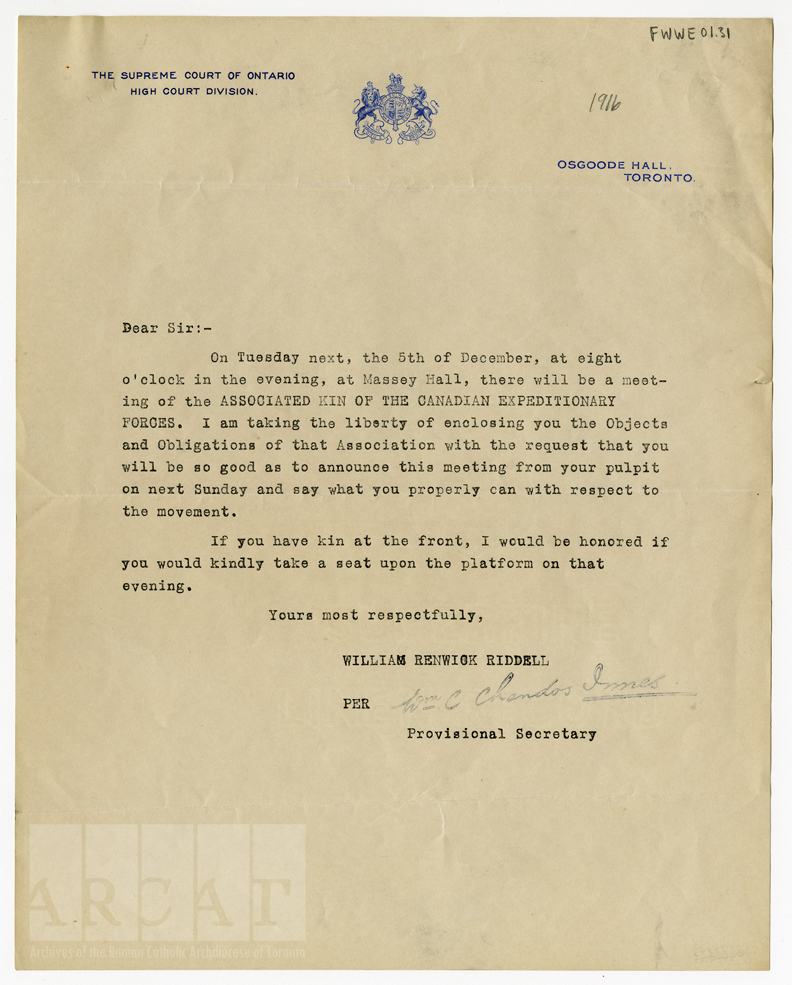
In 1916 Toronto pastors were asked to announce a meeting at Massey Hall of the Associated Kin of the Canadian Expeditionary Forces, which was an association of relatives of First World War soldiers working to "promote and care for the best interests of the men who [were] fighting for King and Country."

"Dear Sir:-

On Tuesday next, the 5th of December, at eight o'clock in the evening, at Massey Hall, there will be a meeting of the ASSOCIATED KIN OF THE CANADIAN EXPEDITIONARY FORCES. I am taking the liberty of enclosing you the Objects and Obligations of that Association with the request that you will be so good as to announce this meeting from your pulpit on next Sunday and say what you properly can with respect to the movement.

If you have kin at the front, I would be honored if you would kindly take a seat upon the platform on that evening.

Yours most respectfully,

William Renwick Riddell" 

1916

FW WE01.31
First World War Collection


The Catholic Youth Organization held a rally in 1938:

"His Excellency
The Most Reverend James C. McGuigan, D.D.
Archbishop of Toronto
invites you to be present at the
Catholic Youth Organization Rally
in Massey Hall
Wednesday Evening, January 19th, 1938
at 8.15 p.m.
Reserved seats will be held until 8.10 p.m."

MG TA01.115
Cardinal McGuigan Fonds


The National Chorus of Toronto performed annually from 1903 to 1928:

"The National Chorus
Announces its Thirteenth Annual Concert at
Massey Hall, on Tuesday evening, January 18th
With Mr. Morgan Kingston as the assisting soloist,
and the net proceeds to be devoted to Red Cross purposes.

Their Royal Highnesses the Duke and Duchess of Connaught and the
Princess Patricia have announced their intention of being present.

Tickets may now be procured at Tyrrell's Book Store, 780 Yonge Street, near Bloor Street."

1916

MN AH05.03
Archbishop McNeil Fonds


Admiral Earl Beatty of the British Navy visited Toronto in 1921:

"Dear Archbishop McNeil;-

On Monday, next, November 28th, at 2 P.M., Admiral Earl Beatty, O.M., etc., will be the guest of the Navy League of Canada at Massey Hall.

As Head of the Roman Catholic Church, we are enclosing a ticket, which will admit you, by way of the stage door, to the platform. Will you kindly be seated by 1.45, as the Admiral will enter at 2 o'clock.

Admiral Earl Beatty O.M., etc., will be in the City from 8 A.M. to 4 P.M., therefore, he will only be with us for half an hour, but the League feels happy in being thus honoured. Please reply by telephone, Saturday morning, if possible.

In view of the fact that platform space is very limited, it will be necessary for you to present this ticket.

Faithfully yours, Cecil S.Williams Lieut Colonel. Manager."

November 25, 1921

MN AH10.134
Archbishop McNeil Fonds


Archbishop Pocock was on the board of directors of the Toronto Symphony Orchestra, which performed at Massey Hall until Roy Thomson Hall opened in 1982. He kept a copy of their 1964-1965 brochure. That year concert goers would hear the Canadian premiere of Britten's War Requiem, Stravinsky's Rite of Spring, and Prokofiev's Romeo and Juliet, amongst other great classical works. The back of the brochure shows pricing for season tickets. Fifty dollars would get you fifteen concerts in one of the best seats in the house:

1964-1965 Toronto Symphony Orchestra Season Ticket price chart.

PO OOR22.02b
Archbishop Pocock Fonds 


Massey Hall holds a special place in my heart because it was the venue of the first rock concert my sister took me to when I was in grade 10. I've seen many of my favourite artists there since then, and I'm looking forward to seeing more after the renovations are finished. It will be exciting to see the changes! In the meantime, I'll watch the Live at Massey Hall series online.


Friday, 4 May 2018

Yes, you are the one I am calling!

Today the Archdiocese of Toronto invites you to say a prayer for vocations. A vocation is a call to dedicate your life to something; today we pray that men and women will hear the call to the religious life.

In May 1965, Pope Paul VI said,

"By vocations, in this context, we mean the free and privileged invitations to serve Christ completely and to love Him with a love of preference in positions specifically determined by Holy Church. They are vocations to the priesthood and to the religious life, in which it is clearly manifest that Christ is inviting, that He has implanted this desire, that He is waiting for a reply. For it is indeed Christ who is calling. As He did to the Apostles whom He Himself chose and formed, Jesus still repeats in this our day: "Come, follow me." It is the Shepherd who engages in a personal, and intimate, conversation that may well startle and even convince, for "He calls each one by name, nominatim:" Yes, you are the one I am calling! ...

"Let each one pause to consider that he has received the grace, the very great privilege of belonging to the Church, of being one of those who have been called; that he has his Christian vocation. And let each one of those who, realizing that he has received this sublime call, a call common to all, hear a more direct invitation, a deeper, a more exacting and more intimate call ... Vocation... is something which, today as in the past, may be a grace that is extended to many; to many souls who are aspiring for the better things of life, for perfection; to those who have an ardent desire for the salvation of their brothers; to many hearts who, no matter how humble, no matter how timid, feel within themselves that strength which renders all things not only possible, but easy. ...

"Let us pray that this may come to pass. Perhaps there are some who, listening to Our humble voice with their ears, hear within their hearts the voice of Christ the King who is calling to them. Let us pray that this may be so. We bestow a special blessing on all those who "hear the word of God and keep it." (Archbishop Pocock Fonds, PO CL26.35a)

If you need some extra inspiration for prayers, here are a few that Archbishop Pocock saved:

"A Prayer For Vocations by His Holiness, Pope Paul VI

O Jesus, Divine Shepherd of souls, who called the Apostles to become fishers of men, now call the ardent and generous hearts of our youth to make them Your followers and ministers. Let them share Your thirst for that universal redemption for which You daily renew Your Sacrifice upon the altar. O Lord Jesus, "always living to make intercession for us", extend our horizons to the entire world, where so many brethren make silent supplication for the light of truth and the warmth of love, so that answering Your call, many young men may prolong here Your mission, edify Your Mystical Body, the Church, and become "the salt of the earth and the light of the world".

"Extend, O Lord, Your loving call to many pure and generous-hearted young women, that they may grow in their desire for evangelical perfection and may dedicate themselves to the service of the Church and their neighbors who so desperately need such assistance and charity. Amen.

"(This prayer was composed by Pope Paul VI and is recommended to be said on Good Shepherd Sunday - World Day of Prayer for Vocations - and throughout the year.)"

1965

PO CL26.35b
Archbishop Pocock Fonds
  
"Prayer for Vocations

"O God, Who wouldst have all men to be saved and to come to the knowledge of Thy truth: send, we beseech Thee, laborers into Thy harvest, and grant them grace with all boldness to speak Thy Word; so that Thy Word may run and be glorified, and all nations may know Thee the only God and Him Whom Thou hast sent, Jesus Christ Thy Son, our Lord. Who liveth and reigneth world without end. Amen"

1934

PO SU52.06
Archbishop Pocock Fonds


"O My God, Thou who art the God of wisdom and of counsel, Thou who readest in my heart the sincere will to please Thee alone, and to govern myself with a regard to my choice of a state of life, entirely in conformity with Thy most Holy desire, grant me, by the intercession of the most Blessed Virgin, my Mother, and of my holy patrons, specially of St. Joseph and St. Aloysius, the grace to know what state I ought to choose, and when known to embrace it, so that in it I may be able to pursue and increase Thy glory, work out my salvation, and merit that heavenly reward which Thou hast promised to those who do Thy holy will. Amen."

1929

PO SU52.07
Archbishop Pocock Fonds

And a poem!

"The Call of Christ

"So many others I might ask, 
Yet I am calling thee;
And wilt thou hesitate, My child,
To come and follow Me?

"I will repay each sacrifice:
The great ones and the small,
None shall be lost in heaven,
Where I am Judge of all.

"Come, I will make the burden light;
My yoke, a bondage sweet,
That shall bring gladness to they heart
And swiftness to thy feet.

"Come, give thy will and all to Me,
And live forevermore;
Each sacrifice thou makest now,
Within My Heart I'll store.

"And when life's pilgrimage is done,
With thee I'll keep My tryst;
In heaven's court thou shalt be called
The chosen friend of Christ.
-Anon"

1938

PO SU52.01
Archbishop Pocock Fonds


For more information about vocations to religious life, check the website of the Archdiocese of Toronto's Office of Vocations, and the website of the National Association of Vocation and Formation Directors. If you'd like to spend time promoting vocations, check out the website of Serra Canada.

Thursday, 22 February 2018

Dog Blog

Today is apparently Walk Your Dog Day. (Although your dog will not hesitate to remind you repeatedly that every day is Walk Your Dog Day).

The Chinese Year of the Dog began last week.

Alas, this blog post is going to the dogs.


Photographs Special Collection, PH24H/20P and /21CP

Photographs  of Rev. James J. G. Hayes with his first dog, a Rough Collie (left) and visiting the St. Andrews Parish Cemetery, Brechin, with his Basset Hound, "Guv'nor" (right).
 
Photographs Special Collection, PH18D/25CP

Cardinal Carter's love of dogs was well known and his breed of choice was the Golden Retriever. His dog, Duffy, is pictured here at Cardinal Carter's residence, ca. 1984. 

Photographs Special Collection, PH18D/25CP

Cardinal Carter's dog, Kelty, among her litter mates (above) and a photo of the town in Ireland after which she was named. 

Artifacts Special Collection, AF322a&b

Collar, leash and dog tags belonging to Cardinal Carter's dogs, Duffy and Kelty

Textiles Special Collection, TX 112a&b

Dog coats made for Cardinal Carter's dogs, Kami and Heidi, complete with decorative mitres.

Photographs Special Collection, PH 14C/28CP

Archbishop Pocock relaxes with a poodle at the cottage, ca. 1975.

Friday, 19 January 2018

Random Finds Are the Best!

There are lots of fancy things you can do with Photoshop, but there was a time when if you wanted to make a document pretty, you had to do it by hand. In the archives, we always stop to take a look when we come across an example of beautiful calligraphy as impressive as the one below.

This small parchment booklet was produced for the Pontifical University of St. Thomas Aquinas in Rome, which is commonly known as the Angelicum. The university traces its roots to 1222, when the Order of Preachers (Dominicans) founded a house of studies.

The lettering is so well done that we debated whether it might be printed, but very small differences between letters lead us to believe that it was done by hand.

The Angelicum is a pontifical university, which means that it has been given authority by the Holy See to grant degrees in sacred faculties.

1934

PO AA41.04

Archbishop Pocock Fonds


The text inside states that Fr. Philip Pocock graduated magna cum laude with a doctorate in canon law in 1934.

The parchment has been stored folded for so long that if we had tried to flatten it for a nicer scan, we would have damaged it.

1934

PO AA41.04

Archbishop Pocock Fonds
Even the back has been decorated with the seal of the university, which features the eponymous St. Thomas Aquinas. It is difficult to capture on the screen the way the gold ink shines when it catches the light.

1934

PO AA41.04

Archbishop Pocock Fonds


Finding treasures like this is one of the best parts of being an archivist!


Friday, 8 September 2017

In Memory of Archbishop Pocock

Earlier this week marked the 33rd anniversary of the death of the ninth Ordinary to the Archdiocese of Toronto, the Most Reverend Philip Francis Pocock. The former Archbishop of Toronto died on September 6, 1984, at the age of 78.


Photographs Collection, PH 14/08P

A prayer card that would have been distributed at Archbishop Pocock's funeral mass, September 10, 1984.
 
Archbishop Pocock joined the Archdiocese of Toronto as Coadjutor Archbishop on February 18, 1961, and succeeded to the See of Toronto upon Cardinal McGuigan’s resignation on March 30, 1971.

As archbishop, Pocock established the Archdiocesan Pastoral Council and Senate of Priests to help manage the transitions that followed Vatican II and created Sharelife to replace the Council of Catholic Charities.

On April 27, 1978, Archbishop Pocock resigned as archbishop and took up residence at St. Mary's Parish in Brampton. Here he remained active as a priest, performing regular parish duties, celebrating mass at elementary schools, confirming students, and visiting a senior citizens' home.
 
Archbishop Pocock died on September 6, 1984. His funeral took place at St. Michael’s Cathedral on September 10th, and he was interred at Holy Cross Cemetery, Thornhill.


Archbishop Pocock Fonds, PO AA49.02

A handwritten note from Cardinal Carter in response to the outpouring of condolences following Archbishop Pocock's death, 1984

Although his time as See of Toronto was short, Archbishop Pocock has a lasting legacy in the Archdiocese. You can read more about Archbishop's religious life and archdiocesan achievements on our website.