Showing posts with label Archbishop Walsh. Show all posts

Sunday, 13 August 2017

Record of the Week: Archbishop Walsh's episcopal ring?


Provenance is a fundamental organizing principle in archives. It refers to the individual, family, or organizational body that created or accumulated material in a collection. The principle of provenance dictates that records of the same origins be kept together to preserve their context, rather than grouping items of various origins together by subject (the way books are catalogued) or medium (as artworks may be).

As provenance is intrinsic to our profession, it is very frustrating to be faced with an item whose previous owner cannot be identified. With textual records, there are often clues, but an artifact without accompanying documentation can be a real mystery.

Last year, custodianship of some of our former bishops' rings was transferred from the Chancery Office to the Archives. Unfortunately, it was not clear as to which of our bishops these rings had belonged.

A Roman Catholic bishop receives an episcopal ring when he is consecrated. Aside from those personally purchased or gifted, bishops' rings belong to the Church. The ordinary of a See inherits the previous bishop's ring collection, which is held in trust. A bishop may be buried with a ring that he owned, but all those belonging to the Church must be returned upon his death. Bishops may also choose an episcopal ring formerly worn by a predecessor, which can further obscure its provenance.

Accession 2016-047

Rose gold episcopal ring with a large amethyst, flanked on either shoulder with a mitre, cross and crozier.
On the gemstone is etched a dove holding a branch embellished with tiny diamonds.
Accession 2016-047

Inside the band is engraved: Nov. 10-1867 and Nov. 10-1890


From this tradition, we can conclude that the episcopal rings transferred to the archives were likely worn by a bishop that retired or died in Toronto. One of the rings in question has two dates engraved on the band: "Nov. 10-1867 and Nov. 10-1890". The former is a significant date to only one of our ordinaries: Archbishop John Walsh was consecrated bishop on that day, after being appointed Bishop of Sandwich (i.e. Windsor), the former seat of the Diocese of London, Ontario.

Case closed? Not quite.

Most Reverend Walsh was appointed Archbishop of Toronto on August 13, 1889 (coincidentally, 128 years ago today) and installed here on November 27, 1889. Therefore, the second date seems to have little significance to Archbishop Walsh. The word "and" in the engraving suggests (at least to me) that the dates refer to the same person rather than a subsequent wearer.  In any case, November 10, 1890 does not pertain to any of our other bishops.

To determine if the ring was ever worn by Walsh, we checked his official portraits taken in London and in Toronto. Unfortunately, it's not a match. The ring in the photos seems to have a large central stone encircled by a halo of small diamonds. The setting is lower than that of our mystery ring.

ARCAT Photographs Collection, PH 05/01P

Carte de visite portrait of Most Reverend Walsh, Bishop of Sandwich (and then London, when he move the seat of his See back there) by Frank Cooper, Artistic Photographer, Dundas St., London, Ontario [ca. 1880?]

ARCAT Photographs Collection, PH 05/02P

Carte de visite portrait of Most Reverend Walsh, Bishop of Sandwich, by Edy Bros. photographers, 214 Dundas St., London, Ontario [ca. 1870?]

ARCAT Photographs Collection, PH 05/13P

Portrait of Most Reverend John Walsh, Archbishop of Toronto, seated, and Apostolic Delegate to Canada, Cardinal Rafael Merry del Val, who was a Monsignor at the time. Taken in Toronto, 1897. The sign under the chair states:

"Entered according to Act of the Parliament of Canada, in the year 1897, by Frederick Lyonde, at the Department of Agriculture"

The mystery ring is certainly larger and more ornate that the ring he is wearing in the portraits, which is probably the ring from his consecration gifted by the Toronto clergy. Most Reverend Walsh began his career in Toronto and was much respected by his fellow priests. According to the Jubilee Volume 1842-1892 of Archbishop Walsh and the Archdiocese of Toronto, the clergy presented "a mitre, crozier, pectoral cross and ring" to "their dearly beloved brother."

Though the photos do not confirm that our mystery ring belonged to Archbishop Walsh, they do not remove the possibility either. Bishops may own multiple episcopal rings, and they are a common gift. Fancier ones may be saved for special occasions rather than everyday use.

One could speculate that he was given this ring to mark his elevation to archbishop on the anniversary of his consecration date. November 10, 1890 would have marked the first anniversary of Walsh's consecration that he celebrated as Archbishop of Toronto. Although it would have been more appropriate to bestow an archbishop's ring on Walsh at his Installation Mass in 1889 (or, for that matter, in the Jubilee year of 1892 when the diocese turned 50 and Walsh celebrated 25 years of ordination), it is not completely outside the realm of possibility.

Until further information comes to light, that frustrating question mark will stand beside the issue of provenance.

To read about provenancial mysteries that we've actually solved, see these former posts:

Record of the Week: "the famous cameo ring"
Record of the Week: the mysterious Death Mask
Record of the Week: Cardinal McGuigan Gets the Key to the City
***We are also happy to announce this week that the short biographies of our former bishops and archbishops (which used to be hosted on ARCAT's now defunct website) have been migrated to the Archdiocese of Toronto's site. You can read more about Archbishop Walsh here.***

Friday, 8 January 2016

Bills Bills Bills

In this space we like to explore how the ARCAT collection reflects the history of Catholic Toronto, but we also like to look at the broader context. Today we are featuring a type of document that has been around for thousands of years: bills and receipts.

These documents give us an amazing glimpse into the past by showing us what people were purchasing, what they were eating, and what they were wearing. They show us where people were shopping, the types of businesses that existed in the city, and how much things cost. They help us fill in the picture of what everyday life was like for those whose actions created our modern world.

This 1908 Bell bill shows that Archbishop McEvay paid $1.05 for calls to Hamilton, Guelph and Niagara Falls in the month of August.

Archbishop McEvay Fonds: ME AA06.12 

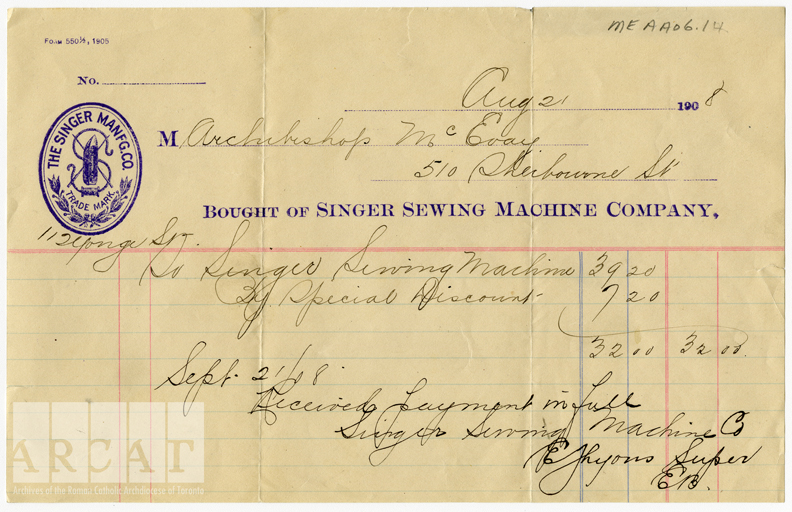
In 1908 Archbishop McEvay bought a Singer sewing machine for $32.00. Today, their sewing machines cost anywhere from $100 - $1000. The top of the line model even has an LCD touch screen!

Archbishop McEvay Fonds: ME AA06.14

Over the course of September, 1908, Archbishop McEvay bought peaches, pears, grapes, apples, oysters and salmon from Gallagher's Fruit and Oyster House, and he only spent a grand total of $5.85. If you can tell us what the first two items he bought were, you win a prize!

Archbishop McEvay Fonds: ME AA06.25

In 1908 you could buy a rug and a mattress for $9.25 from The J. F. Brown Company. The J.F. Brown site is now a heritage building at 193 Yonge St., across from the Eaton Centre.

Archbishop McEvay Fonds: ME AA06.31

$35.50 for carriage repairs at The Enright Shoeing Forge in December, 1909. Very important to maintain your means of transportation!

Archbishop McEvay Fonds ME AA06.78

We take ice for granted now. We can just reach into the freezer or buy a big bag from the store if necessary year round. In 1910, Archbishop McEvay paid $8.00 for a four month supply of ice cut from Lake Simcoe.

Archbishop McEvay Fonds: ME AA06.88

$4.00 for office supplies from Grand & Toy in 1910.


Archbishop McEvay Fonds: ME AA06.146

"2 to Depot - 1 home" $1.00 in 1901 for Archbishop O'Connor

Archbishop O'Connor Fonds: O AC01.01

Some of you might remember shopping at Eatons. In 1899 you might have paid $27.00 for 28 yards of carpet.

Archbishop Walsh Fonds: W AA11.02

Only $35.00 for a brass bed in 1899 from the Schomberg Furniture Company.

Archbishop O'Connor Fonds: O AC01.01

Rye, Sherry Wine and Claret purchased from George J. Foy, Importer of Wines, Liquors and Cigars in 1899 for $6.20.

Archbishop O'Connor Fonds: O AC01.01

$26.89 for work on the Cathedral by William Simpson in 1902. The receipt is signed off on by the architect, A.W. Holmes.

Archbishop O'Connor Fonds: O AC01.01

Bishop Power paid £3.40 for various items of clothing from Walter MacFarlane in 1844, including 12 nightcaps, 4 pairs of cashmere hose, and 5 India handkerchiefs.

Bishop Power Fonds: P AD01.04

The bill for Archbishop Walsh's funeral includes charges for washing and dressing remains, shaving, embalming, a purple silk plush casket, coachmen and footmen in livery, and other things. The total came to almost $800.00. Rosar-Morrison Funeral Home still exists on Sherbourne St. in Toronto.

Archbishop Walsh Fonds: W AA11.02

Thursday, 26 March 2015

Record of The Week: A Cloth Shrouded in Mystery

Over the past few weeks, many parishes around the archdiocese have been hosting sindonological researcher Walter Pezzo for a reflection on the Passion of Jesus and the spiritual value of the Shroud of Turin. 

The shroud, which is believed by some to be the burial cloth of Jesus, has been the subject of study and debate especially in the last century. In 1898, a photographer named Secondo Pia was allowed to photograph the shroud while it was on display in the Turin cathedral. The photograph revealed the image of a man with wounds consistent with crucifixion. After that, the scientific and historical study of the shroud (sindonology) exploded. 

The Catholic Church does not officially recognize the shroud as authentic, but respects it as a symbol. It was recently announced that Pope Francis will make a pilgrimage to Turin to visit the shroud while it is on display in June. 

Below is a lithograph copy of Pia's photograph with a prayer in Latin which was found in the Archbishop Walsh Fonds. 

W AA03.16Archbishop Walsh Fonds
"The Holy Shroud of Our Lord Jesus Christ"

There is still one more chance to catch Mr. Pezzo's presentation at Holy Spirit Parish in Barrie on Monday, March 30th at 7:00 pm. 

Friday, 10 October 2014

Feasts of Thanksgiving: Historical Menus

At Thanksgiving, we gather with family and friends to be mindful of our blessings.
Thanksgiving is also a harvest celebration; there is no denying that many of us will indulge in the abundance of food prepared for the Thanksgiving feast.

In the spirit of food and feasting, we decided to post some historical menus from various celebrations...some of them featuring a variety of very weird and wonderful dishes.

Menu of Archbishop Lynch's banquet on the occasion of the 25th anniversary of his consecration, held at Rossin House, Toronto.
Archbishop Lynch's 1884 banquet was held at Rossin House, which stood at the Southwest corner of King and York streets from 1857 to 1969.
Anyone for Arches of Buffalo Tongues? Aspic of Lobster a la Parisienne?
Duck en surprise on Pedestal? Sweetbreads Larded, a la Financiere?

Menu for Archbishop Walsh's Silver Jubilee Banquet, held in 1892 at the Archbishop's Palace.
Green Turtle Soup and Haunch of Venison? Sign me up!

By 1944, menus for episcopal events were becoming somewhat more simple. 

This menu (courtesy of the General Archives of the Basilian Fathers) is interesting for its hockey-reminiscent food names, but it is even more interesting because of the note on the front, which indicates that the banquet was cancelled because of VE Day.

We couldn't resist finding recipes for some of the more interesting dishes from these menus:

From The Gastronomic Regenerator: A Simplified and Entirely New System of Cookery (1847) by Monsieur A. Soyer, p. 427.

From The Royal Cookery Book (1869) by Jules GouffĂ©, p. 490.

From White House Cook Book: A Selection of Choice Recipes, Original and Selected (1889) by Fanny Lemira Gillette, p. 329.
From White House Cook Book: A Selection of Choice Recipes, Original and Selected (1889) by Fanny Lemira Gillette, p. 321.

Are you inspired to make Turkey Galantine for your family this weekend? Perhaps they would prefer Boiled Turkey with Oyster Sauce, or a Pyramid of Spring Chicken, or Arches of Buffalo Tongues. 

For more historic menus, check out the Toronto Public Library's virtual exhibit Local Flavour, and the New York Public Library's What's On The Menu project.