Showing posts with label Pope Pius XII. Show all posts

Friday, 19 April 2019

Remembering an Easter Tradition: Agnus Dei

Sunday April 21st marks the celebration of the resurrection of Jesus Christ, commonly known as Easter. This holiday concludes Holy Week and is one of the most important times for Christians. People may partake in various traditions: they may attend mass, participate in an Easter egg hunt, and/or get together with loved ones for a meal.

Spanning from the 5th century to the 20th century, a very unique Easter ritual took place: the making of the Agnus Dei sacramental. The Agnus Dei, perhaps the oldest known sacramental of the Church, is a round or oval wax disc made from the wax of the previous year's Easter candles. These candles were collected, melted down, and impressed with a lamb on one side and a saint or the pope on the other. Popes would consecrate these discs on the first year of their pontificate and every seven years following. They would then distribute the discs, often to visiting bishops and Cardinals. With the Lamb of God embossed on them, these discs were seen as a symbol of Jesus' sacrifice.

We have three Agnus Dei in our collection, as well as several documents for the rite and usage for the consecration of Agnus Dei.

This statement was issued in 1862 and roughly translates to, "The Ritual Use of Forms that the Candles are Blessed and Consecrated by the Pope of Rome".

Rite and usage for the blessing and consecration of the 'Cereas Formas', commonly called Agnus Dei (a wax impression).
1862

John Joseph Lynch Fonds
L RC44.01
 

The Agnus Dei below are two copies of the same impression, consecrated by Pope Pius XI at an unknown date:

Relief of Victorious Lamb/Lamb of God

Special Collections - Artifacts
AF 233

Relief of Victorious Lamb/Lamb of God

Special Collections - Artifacts
AF 233

On the other side, a relief of the bust of St. Andrea:

Relief of bust of St. Andrea

Special Collections - Artifacts
AF 233

Relief of bust of St. Andrea

Special Collections - Artifacts
AF 233

The Agnus Dei below was consecrated by Pope Pius XII in 1935:

Relief of Victorious Lamb/Lamb of God
1935

Special Collections - Artifacts
AF234

On the other side, a relief of an unidentified bust:

Relief of an unidentified bust
1935

Special Collections - Artifacts
AF 234

The Agnus Dei practice was largely abandoned following the Second Vatican Council. The last pope to consecrate them was Pope Pius XII.

To read more on the history and significance of Agnus Dei, click here.

Friday, 18 January 2019

Party Like It's 1947


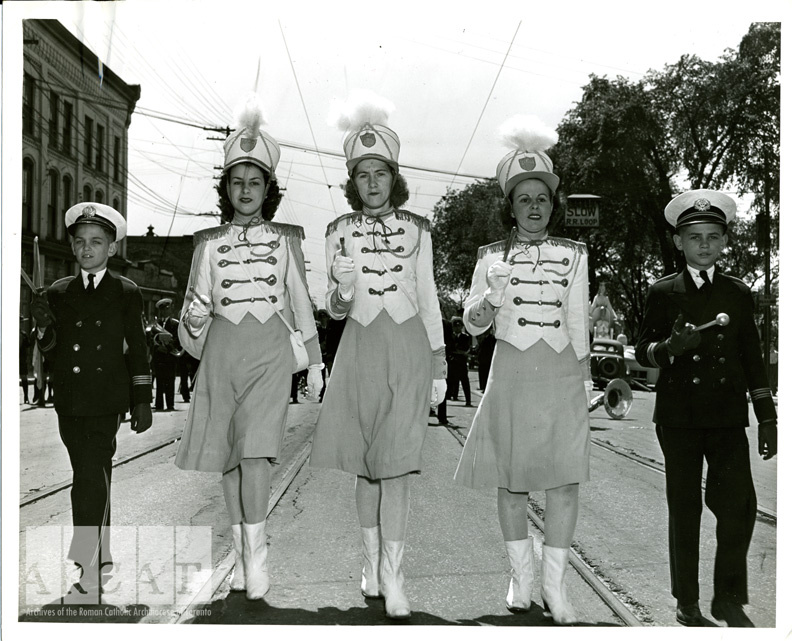
"Drum majorettes in a monster two-hour long parade which was a feature event of the Marian Congress Saturday, with 20 religious floats."

June, 1947

PH 09M/56P
ARCAT Photograph Collection

It's time to celebrate! Strike up the band! This week was Cardinal Collins' birthday. He was born January 16, 1947. Here in the archives we started wondering what it would have been like for for Cardinal McGuigan in 1947. He had been made Cardinal the year before and was a celebrated leader in the city. The second world war had just ended, and people were thinking about what to do with returning soldiers, as well as reconstructing Europe, and the threats of communism and fascism. The population was rapidly growing as European immigrants moved to Canada and country folk became city dwellers. Lots of changes were coming!

In Toronto there were about a million people. The Maple Leafs won the Stanley cup that year, the St. Mike's Majors won the Memorial Cup, and the Argos won the Grey Cup. The movie Gentleman's Agreement picked up three Oscars including best picture, and music by Frank Sinatra, The Andrews Sisters, and Al Jolson was popular. Radio was well established in the home, though it would soon give way to television.

The King was George VI, the Prime Minister was William Lyon Mackenzie King, and the Premier was George Drew:

"Deeply grateful for your kindness. As I was leaving immediately I had no opportunity to thank you before departure. Have just returned from Germany where conditions are beyond imagination. Will look forward to discussing this with you on my return. - George Drew."

May 27 1947

MG DA33.19
Cardinal McGuigan Fonds


The Pope was Pius XII:

A portrait of Pope Pius XII

1940s

PH 62/33P
ARCAT Photograph Collection
The Pope's inscription reads, "To Our Beloved Son, James Charles Cardinal McGuigan, Archbishop of Toronto, to his Clergy, Religious and Faithful We lovingly impart Our Paternal Apostolic Benediction.

Pius pp.XII

From Castelgandolfo, November 8th, 1947"

PH62/33P
ARCAT Photograph Collection


In 1947 Cardinal McGuigan lived at 264 Old Yonge Street, where he was visited by a few Sisters of Saint Joseph on September 6:


One of the highlights of his year must have been his June trip to the Marian Congress in Ottawa, where he was Papal Legate:

Cardinal McGuigan with other Papal representatives at the Marian Congress.

June 1947

PH 09M/42P
ARCAT Photograph Collection


The Congress drew a few hundred thousand pilgrims to Ottawa, and there were many spectators for the parade held in its honour:

"People cling like flies to every vantage point to watch the monster two-hour long parade which was a feature event of the Marian Congress Saturday, with 20 religious floats."

June 1947

PH 09M/54P
ARCAT Photograph Collection


Besides being a frozen moment in time on a sunny Saturday in June 1947, photos like this allow us to see some of the fashions that year. Many of the women's outfits were still the boxy utility style of wartime, but were giving way to more feminine shapes:

The hats were the best! 

Looking very cool in those shades.

For more of 1947's high points, including footage of Cardinal McGuigan at the Marian Congress, the CNE, the Stanley Cup game, and the Santa Claus Parade, check out this amazing video posted by Library and Archives Canada:


And for more footage of Cardinal McGuigan and the Marian Congress, check out this video:


Friday, 17 August 2018

Body and Soul in Celestial Glory


Cardinal McGuigan leads a procession at Notre-Dame-du-Cap Shrine in Trois-Rivières, Quebec, on the Feast of the Assumption, 15 August, 1950. The church is Canada's national shrine to St. Mary.

PH 09N/04P
ARCAT Photograph Collection


On 15 August we marked the Feast of the Assumption of Mary, the day on which we celebrate God taking Mary, body and soul, directly to heaven at the end of her earthly life. Though Catholics have believed in the Assumption for centuries, it was not official doctrine of the Church until 1950, when Pope Pius XII defined the 'Dogma of the Assumption.' 

The 2 November, 1950 issue of The Globe and Mail explained, 
"Vatican officials said that a world-wide movement for that dogma was started in 1863 by the initiative of Queen Isabel of Spain. From that time the Vatican has received 2,600 petitions from cardinals, archbishops and bishops; 83,000 from members of the secular and religious clergy, and 8,000,000 from Catholic laymen. Pope Pius referred to these requests and said that they had become so numerous that on May 1, 1946, he decided to ask all bishops whether "your clergy and the faithful so desire." The replies were almost unanimously in the affirmative, the Pope said."

Here in the archives, we have a copy of the letter that Pope Pius XII wrote to the bishops: 

Deiparae Virginis Mariae

"In order that We may receive the gift of heavenly light, do you, Venerable Brethren, in pious competition, unite your entreaties with Ours. But, while paternally exhorting you to do this, thus following the example of Our Predecessors, and particularly that of Pius IX when about to define the dogma of the Mother of God's Immaculate Conception, we earnestly beg you to inform us about the devotion of your clergy and people (taking into account their faith and piety) toward the Assumption of the most Blessed Virgin Mary. More especially We wish to know if you, Venerable Brethren, with your learning and prudence consider that the bodily Assumption of the Immaculate Blessed Virgin can be proposed and defined as a dogma of faith, and whether in addition to your own wishes this is desired by your clergy and people."

1 May 1946

MG RC268.09
Cardinal McGuigan Fonds


Cardinal McGuigan was an ardent advocate of the dogma and had received many letters of support from clergy in the archdiocese. He replied to the pope's letter via telegram in August: 

"With heart overflowing spiritual joy have received Encyclical letter asking for expression opinion definition dogma Assumption Blessed Lady. Glad recall to Your Holiness occasion taking possession Titular Church Santa Maria Del Populo publicly expressed hope and ardent wish that this common belief faithful be solemnly proclaimed in these words: "What exulting joy would fill our hearts if, as Pius IX proclaimed her Immaculate Conception, it were the will of God that our present Pontiff, Pope Pius XII, should give to Mary her most radiant crown, and amidst the jubilation of the Church Universal, solemnly affirm the dogma of her Assumption into Heaven and declare her the Queen of Angels and of Saints, the mediatrix of all graces, the co-redemptress of mankind."

"Hence in the name clergy, religious, faithful express most ardent desire that Your Holiness declare corporal Assumption Blessed Virgin Mary Dogma of our Holy Faith. 

"On this glorious feast, all diocesans pray that she may indercede with her Divine Son for your continued health, strength and happiness. May God through her loving intercession preserve you to give serene courage and spiritual fortitude of soul to all who join you throughout the world in preserving precious heritage in Holy Faith." 

14 August, 1946

MG RC268.19
Cardinal McGuigan Fonds 


Cardinal McGuigan wrote a pastoral letter to the faithful of the archdiocese explaining the importance of devotion and prayer to Mary:

"The solemn definition of the dogma of the Assumption may well be one of the predestined ways of increasing devotion to the Immaculate Heart of Mary and thus bringing down God's mercy to save mankind from the abyss to which it seems rushing, body and soul ... It is my most earnest wish that the faithful of the Archdiocese of Toronto, priests, religious, and laity, engage in a crusade of prayer that the Supreme Magisterium of the Catholic Church should soon give this glorious tribute to the Mother of God. St. peter, the first Pope, preaching on the day of Pentecost and proclaiming the truth of Our Divine Lord's Resurrection, applied the words of the psalmist, that God would not suffer His Holy One to see corruption. The three great prerogatives of Mary are her sinlessness, her charity or union with God, and Her royalty or Queenship over the universe. It is on these prerogatives that we base our belief that her body, from which the Second Person of the Blessed Trinity took His flesh, was not left in the tomb but was reanimated by her soul, full of grace, and was raised to Heaven by the side of Her Divine Son, where she reigns as Queen of Angels and of Saints and as Mother of all mankind through whom God bestows the treasures of His grace.

"Let us pray, then, for this special intention, that the dogma of the Assumption may be defined by the Church for the glory of God and the greater honour and love of His Mother among the faithful on earth. Let us strive in every way to increase our devotion to Mary, which simply means love of our Heavenly Mother. The Gospel tells us that the wise men from the East found Jesus with Mary His Mother, and assuredly we shall always find Jesus when we go to Mary."

14 August 1946

MG DA02.347
Cardinal McGuigan Fonds

On November 1, 1950, Pope Pius XII spoke ex cathedra in St. Peter's Square. The next day, The Globe and Mail described it this way:
"Pope Pius XII today proclaimed the dogma of the assumption. The pontiff spoke ex-cathedra as the supreme pastor of the church and the teacher of Catholic doctrine during an open-air ceremony of unprecedented pomp and magnificence to an audience of 36 cardinals and 480 archbishops and bishops in the grandiose setting of St. Peter's Square.
"A crowd of 200,000 faithful, including Holy Year pilgrims from so many countries that they could truly be said to represent the whole Catholic world, packed every inch of space of the oval-shaped square, which had been transformed for the occasion into a vast Christian temple.
""We pronounce, declare and define to be a dogma, revealed by God: That the immaculate Mother of God, Mary, ever a virgin, at the end of her earthly life, was taken up into celestial glory, in soul and body," the Pope said."

The new dogma and the reasoning behind it were published:


"Hence the revered Mother of God, from all eternity joined in a hidden way with Jesus Christ in one and the same decree of predestination, immaculate in her conception, a most perfect virgin in her divine motherhood, the noble associate of the divine Redeemer who has won a complete triumph over sin and its consequences, finally obtained, as the supreme culmination of her privileges, that she should be preserved free from the corruption of the tomb and that, like her own Son, having overcome death, she might be taken up body and soul to the glory of heaven where, as Queen, she sits in splendor at the right hand of her Son, the immortal King of the Ages."

1 November, 1950

MG PS132.03
Cardinal McGuigan Fonds


To get a sense of the scale of the proclamation of the Assumption, check out the video posted by the Bibliothèque et Archives Nationales du Québec (BAnQ). See if you can spot Cardinal McGuigan!


Friday, 26 May 2017

Papal Audience Protocol

Papal audiences have been coming up in the news lately. Meeting such an important figure must be nerve wracking. How are you supposed to behave? What are you supposed to wear? Luckily, protocol has been developed for such occasions. Clear expectations help to take a bit of the edge off of such anxiety-inducing meetings.

Unless you're one of the lucky few to whom le privilège du blanc applies, you are expected to dress in a certain way during a private audience. In The Church Visible, James Charles Noonan Jr. explains,
"Style and deportment at the Vatican, especially in association with a visit to the pontiff, has always been highly formal ... "Formal dress," ... for gentlemen is always the black business suit and black four-in-hand necktie. For ladies, this protocol would include the black calf- or knee-length dress with long sleeves or a black shawl that covers the arms and a black mantilla ..." (p. 203, Revised Edition) 
Here in the archives we managed to find a few photos of some Canadians lucky enough to have a private audience with a few Popes. Most of them seem to be appropriately attired:

A group visits with Pope Pius XII. Bishop Allen is seen to the left of the Pope.

[1946-1954]

PH 62/14P
ARCAT Photo Collection
Toronto Mayor Nathan Phillips and his wife Esther greeting Pope Paul VI. Doesn't she look elegant in her black mantilla?

1964

PH 64/07CP
ARCAT Photo Collection

Mayor Phillips and Mrs. Phillips with Pope Pius XII.

1957

PH 62/21CP
ARCAT Photo Collection

A group poses with Pope Saint John XXIII.

[1960-1963]

PH 63/12CP
ARCAT Photo Collection
 Also in the news recently was the ad limina visit to Pope Francis of the bishops of Ontario. In the archives we found an 1877 letter from the Sacrae Congregationis de Propaganda Fide with instructions for bishops during their visits.

Instructions for bishops when making their formal visit to Rome. Included are directions about what kind of information to prepare and who they need to talk to. Similar instructions are still provided to current bishops making their ad limina visit.

1877

L RC60.08
Archbishop Lynch Fonds

Canadian bishops visit Pope Paul VI, 1965. Archbishop Pocock (coadjutor at the time) is second to the left of the Pope. These bishops are all wearing the ferraiolo (cape), but the bishops visiting this year dressed only in cassocks. Can you spot Cardinal Carter?

1965

PH 14V/17P
ARCAT Photo Collection


So, if you're planning to visit Pope Francis, be sure to brush up on your protocol. There is even a dress code to just visit the Vatican, and it is strictly enforced by the Swiss guards. Knowing the rules ahead of time makes for a smoother and more enjoyable trip.

Friday, 17 June 2016

Happy (Holy) Father's Day!

This Sunday is Father's Day. In the Catholic Church, we all share one spiritual father, the Pope. This week we thought we'd highlight records from some of the Holy Fathers who have reigned since the creation of the diocese in 1841.

Gregory XVI: February 2, 1831 - June 1, 1846

1839 apostolic letter of Gregory XVI condemning the slave trade.

M PS21.01
Bishop Macdonell Fonds

Blessed Pius IX: June 16, 1846 - February 7, 1878

This photo of Pope Pius IX is a carte de visite, which was a popular photograph format of the 1800s. Cartes were traded and collected by many. You could almost say they were the 19th century Facebook!

PH 25/23AL

Part of a letter from Pius IX to the Catholics of Toronto, complete with signature.

July 9, 1862
L RC44.15


Leo XIII: February 20, 1878 - July 20, 1903

Another carte de visite from the same album as the photo above with a drawing of Leo XIII.

PH 25/23AL
Signed letter from Leo XIII in response to the Bishops of the province of Toronto on the occasion of the Pope's Golden Jubilee of Priestly Ordination.

June 20, 1886
L RC69.10

Saint Pius X: August 4, 1903 - August 20, 1914

Postcard of Pius X from 1954.

PH 59/03PC

Benedict XV: September 3, 1914 - January 22, 1922

Letter from Benedict XV to Archbishop McNeil imparting apostolic blessings on the occasion of McNeil's 25th anniversary of his episcopal consecration.

September 8, 1920
MN RC109.03

Pius XI: February 6, 1922 - February 10, 1939

A telegram from Pietro Di Maria, Apostolic Delegate, informing Archbishop McNeil of the election of Cardinal Ratti as pope under the name Pius XI. The apostolic delegate is the pope's representative to the Church in Canada. Since the 1960s Canada has had an Apostolic Nuncio, who is the pope's representative to the government as well as to the Church.

February 7, 1922
MN DS24.02

Venerable Pius XII: March 2, 1939 - October 9, 1958

Postcard of Pius XII.

PH 62/04PC

Saint John XXIII: October 28, 1958 - June 3, 1963

John XXIII with Toronto Mayor Nathan Phillips and Mrs. Phillips.

PH 63/13CP

Blessed Paul VI: June 21, 1963 - August 6, 1978

Image of Paul VI printed on silk and used as a greeting card.

PH 64/03

Letter from Paul VI to Cardinal McGuigan congratulating him on his Golden Jubilee of priestly ordination.

May 10, 1968
PO RC4810.09

Servant of God John Paul I: August 26, 1978 - September 28, 1978

John Paul I blessing Cardinal Wojtyla (Pope John Paul II).

1978
PH 82/01P
Booklet from the Requiem Mass for John Paul I at St. Michael's Cathedral. Unfortunately, this pope only lived 33 days in office, which made 1978 a year of three popes.

1978
OC29


Tuesday, 23 June 2015

Papal Encyclicals of the Past

Last week, the world received a letter from Pope Francis entitled Laudato Si': On Care for Our Common Home. He wrote about our responsibility to care for the environment.

Encyclicals, which are circular letters written by the Pope, have been around in their modern form since Pope Benedict XIV began to write letters in the 1740s. The letters are written in a pastoral teaching style, and generally address the ways that the Catholic faith interacts with contemporary issues of the world at large. 

Below are a small selection of Papal Encyclicals from ARCAT's holdings:

1846 - Pope Pius IX - Qui Pluribus - On Faith and Religion
P PS28.01 
1847 - Pope Pius IX - Praedecessores Nostros - On Aid for Ireland
P PS29.01
1851 - Pope Pius IX - Exultavit Cor Nostrum - On the Effects of the Jubilee
C AK01.05
1864 - Pope Pius IX - Quanta Cura - Condemning Current Errors
L PS46.01
1894 - Pope Leo XIII - Iucunda Semper Expectatione - On the Rosary
W RC77.03  
1903 - Pope Pius X - E Supremi - On the Restoration of All Things in Christ
O RC86.04
1907 - Pope Pius X - Pascendi Dominici Gregis - On the Doctrines of the Modernists
O RC90.11 
1932 - Pope Pius XI - Caritate Christi Compulsi - On the Sacred Heart
MN PS114.01
1936 - Pope Pius XI - Vigilanti Cura - On Motion Pictures
MG PS118.01
1953 - Pope Pius XII - Fulgens Corona - On the Marian Year and the Dogma of the Immaculate Conception
MG PS135.02
1954 - Pope Pius XII - Sacra Virginitas - On Holy Virginity
MG PS136.04
1956 - Pope Pius XII - Haurietis Aquas - On Devotion to the Sacred Heart
MG PS138.01
1957 - Pope Pius XII - Miranda Prorsus - On Motion Pictures, Radio and Television
MG PS139.04
1962 -Pope Saint John XXIII - Paenitentiam Agere - On the Need for the Practice of Interior and Exterior Penance
MG PS144.02
1967 -Pope Paul VI - Populorum Progressio - This Is Progress
MG PS149.03
1968 - Pope Paul VI - Humanae Vitae - On Human Life
MG PS150.04

And just for fun, an encyclical from the office that was a precursor to the Congregation for the Doctrine of the Faith condemning the use of magnetism in superstition, hypnotism and clairvoyance:

1856 - Supreme Sacred Congregation of the Roman and Universal Inquisition - Adversus Magnetismi Abusus - Against the Abuse of Magnetism
C RC38.05

ARCAT holds many more Papal Encyclicals, including Pius IX's Nullis Certe, on Temporal Power and Napoleon III, Leo XIII's Quod Apostolici, which condemns socialism, and Pius XI's Mit Brennender Sorge on the state of the Church in Germany.