Friday, 22 May 2015

Record of the Week: Forwarding the Cause of Br. André

Saint André Bessette, C.S.C., is one of our country's most beloved saints. Commonly referred to as Brother André, he was a  member of the Congregation of Holy Cross. The French-Canadian was known for his strong personal devotion to St. Joseph, in whose name he administered to the sick. Br. André died in 1937 in the famous St. Joseph's Oratory in Montreal.

Photographs Collection, Holy Cross Brothers (C.S.C.), PH27H/01P

Portrait of Brother André Bessette, C.S.C [ca. 1920]
Tomorrow marks the 33rd anniversary of Br. André's beatification. We were surprised to find that our own Cardinal McGuigan played a small part in this first step towards sainthood. The Archbishop of Toronto was asked by the Vice-Postulator* to write to Pope Pius XII "asking him to introduce the cause of this Servant of God." Cardinal McGuigan complied with this request in 1946, although Br. André was not made Blessed until May 23, 1982. He was finally canonized in 2010 by Pope Benedict XVI.

*A postulator is one who is charged with furthering a cause for sainthood - making a judicial case for beatification and then canonization of an individual by gathering evidence of miraculous events attributed to the holy person. Postulators often authorize the issuing of relics of the venerable person.

James Cardinal McGuigan fonds, MG DA32.49 (a)

"June 5, 1946...therfore, as Vice Postulator of his Cause, I respectfully would ask your Eminence if you would be kind enough to write a postulatory letter to His Holiness, Pope Pius XII asking him to introduce the Cause of the servant of God."

As the note on the top suggests, Fr. Egan was probably charged with drafting the actual letter.

James Cardinal McGuigan fonds, MG DA32.49 (c)

"Brother Andre was universally acclaimed as a miracle worker. His ability to read the consciences of the pilgrims and convert even the most hardened sinner was one of his greatest gifts."


Friday, 15 May 2015

Are you going to the [Cottage, Cabin, Camp, Chalet]?

In this part of the world, the Victoria Day Weekend is known as the start of cottage season. Today thousands will pack up the kids and leave the city to head north to open the cottage and for the first sweet taste of summer.

There's nothing more relaxing than sitting in the middle of the woods listening to the birds in the trees and the loons on the lake. As John Burroughs put it, "I go to nature to be soothed and healed, to have my senses put in order." Even our bishops have been known to escape to the cottage once in a while...

Emmet Cardinal Carter with his mother, Minnie Carter at Fourteen Island Lake, 1946. Cottages can be a great place to spend time with family.
PH18F/163P
Archbishop Pocock spent some time with friends, including Bishop of Sault Ste. Marie Alexander Carter, at a cottage in the 1970s. I would love to have been able to hear some of the conversations that happened in this circle!
PH14C/25CP
Archbishop Philip Pocock relaxes at a cottage in the 1970s. This looks like a great place to nap, and the dog knows it!
PH14C/28CP
Even the Pope needs a cottage getaway once in a while! Saint John Paul II relaxed for a few days with the Basilian Fathers on Strawberry Island in Lake Simcoe during his visit to Toronto for World Youth Day in 2002. The Archdiocese's own Emanuel Pires had the opportunity to have lunch with him, which you can read about on the Archdiocesan Blog.

Emanuel Pires, Fr. Thomas Rosica, CSB, and Pope John Paul II on Strawberry Island in July 2002.
Photo courtesy of Emanuel Pires.
ARCAT wishes everyone a fun and safe holiday weekend. Don't forget the sunscreen!

Friday, 8 May 2015

Hail Virgin, dearest Mary! Our lovely Queen of May!

In May, Catholics take the time to honour St. Mary. While devotion to Mary is popular year-round, many parishes organize special events in her name during this month.

Here in the Archives, we decided to celebrate Mary by highlighting some of the parishes named in her honour. It is clear that Mary is a popular saint within the Archdiocese of Toronto, as there are twelve churches named for her, and that doesn't even count the churches dedicated to 'Our Lady!'

If you would like to see each church as it appears today, the linked addresses listed below will take you to Google Streetview. It is fun to see how the churches have changed, as well as the neighbourhoods around them.


St. Mary's Church, Toronto, 1914
PH31P/227AL/03P
St. Mary's, the third parish in Toronto, was established in 1852. It is located at 588 Adelaide St. W. The land was originally part of a military training ground called Garrison Reserve. A parcel was granted to Bishop Macdonell with his promise that there would be seats for Catholic soldiers. The land was described as being on Lake Ontario because there were no other buildings between it and the water. The present church is the third located on that site, having been built between 1885 and 1889.


St. Mary's Church, Barrie, 1963 & 1973
PH102/0128/28P, PH102/0128/35CP

The pastoral needs of early Catholic settlers in the Barrie area were provided for first by missionary priests, and then by priests from parishes in Penetanguishene and Newmarket. Sacraments were performed in private homes. In the late 1830s, land for a church was granted to the Catholic community at the corner of McDonald and Mulcaster streets. By 1850, the first church was blessed. In 1855, a pastor was appointed specifically to Barrie, and St Mary's became its own parish. A second church was completed in 1872. In 1968, construction began on the current St. Mary's Church at 65 Amelia St. (above right). It was blessed on May 26, 1969.

St. Mary's Parish, Brampton

St. Mary's Church, Brampton, [1910-1964] & 1974
PH102/0135/01P, PH102/0135/04CP

Catholics in Brampton were originally served by priests from nearby parishes. The first church in the area was Guardian Angels Mission Church, which was destroyed by arson in 1878. A Presbyterian church was purchased and used until 1910, when a new church named St. Mary's was completed. In 1918 St. Mary's was established as a parish. A bigger church, located at 66 Main St. S., was blessed for the growing Catholic population by Cardinal McGuigan on December 13, 1964.

St. Mary's Parish, Collingwood

St. Mary's Church, Collingwood, 1963
PH102/0138/13P

Catholics in Collingwood were originally part of the Mission of Barrie. By 1859, there were enough Catholics in the area to purchase a church from an Anglican congregation. In 1886, Collingwood was established as a parish, and a new church was completed in 1888 at 63 Elgin St.

St. Mary Star of the Sea Parish, Mississauga

St. Mary Star of the Sea Church, Mississauga, 19 April 1953
PH102/0155/04P

The earliest masses in the Port Credit area were said in private homes. In 1880, St. Mary's Church was built as a mission of St. Patrick's, Dixie. By 1914, there were enough Catholics in the area to establish St. Mary's as a parish. As the Catholic population grew, the need for a new church became apparent. The current St. Mary's was built at 11 Peter St. S., and was blessed on April 19, 1953 by Cardinal McGuigan.

St. Mary of the People Parish, Oshawa

St. Mary of the People Church, Oshawa, 1973
PH 102/0168/07CP

With the expansion of industry in Oshawa in the early 1950s, the Catholic population of the city increased. A new parish was established in 1957 to meet the growing need. The first mass was held in St. Christopher school. A new church was completed at 570 Marion Ave. and was blessed on January 16, 1966 by Archbishop Pocock.

St. Mary Immaculate Parish, Richmond Hill

St. Mary Immaculate Church, Richmond Hill, 1963 & 1973
PH102/0178/30P, PH102/34CP

The first St. Mary's in Richmond Hill was built on Mill St. in 1857 as a mission of St. John Chrysostom, Newmarket. In 1894, a new church was built at 10295 Yonge St. In 1918, St. Mary's was established as a parish. The population explosion of the 1950s necessitated a new church, and the present St. Mary Immaculate Church was dedicated on July 28, 1968 by Apostolic Delegate to Canada Most Reverend Emanuele Clarizio.

St Mary's Polish Parish, Toronto

St. Mary's Polish Church, Toronto, 1981
PH102/0085/01CP

St. Mary's Polish Parish was established in 1914 when members of the Polish population began to move into West Toronto. They were able to build a church in 1915 at 1996 Davenport Rd.

St. Mary of the Angels Parish, Toronto

St. Mary of the Angels Church, Toronto, 1963
PH102/0086/10P

St. Mary of the Angels Parish was built from a need to relieve some of the pressure from St. Clement's Parish, which was overflowing with a growing Italian population. The task of building the new church was given to a Franciscan priest, Fr. Settimio Balo. The cornerstone was laid at 1481 Dufferin St., and the building was blessed by Cardinal McGuigan on June 20, 1937.

St. Mary's Parish, Victoria Harbour

St. Mary's Church, Victoria Harbour, 1963
PH102/0186/07P

The original St. Mary's was built as a mission of St. Margaret's Midland in 1882 on William St. It was established as its own parish in 1919. The church was destroyed by fire in the 1930s, and the present church was built at 266 Albert St. shortly after.

St. Mary's Mission, Nobleton

St. Mary's Church, Nobleton, 1963
PH102/209/02CP

With the influx of Irish immigrants in the mid 1800s, the need for churches in York County increased. St. Mary's was established as a mission of St. Patrick's, Schomberg in 1855. The first mass was held at the church on the Tenth Line on September 23.

St. Mary's Mission, Achill

St. Mary's Mission Church, Achill, 1963
PH102/213/03P

St. Mary's was established as a mission of St. James Parish, Colgan in 1875. In 1892, the original frame church was destroyed by fire. A new church, located at 2458 4th Line of Adjala, was dedicated by Very Reverend Joseph McCann, Vicar General of the Archdiocese.

Friday, 1 May 2015

MayDay 2015: Disaster Preparedness


May 1st is "MayDay," when archivists and cultural heritage professionals take personal and professional responsibility for doing something simple that can have a significant impact on a repository’s ability to respond to a disaster.

After a series of emergency situations in the United States, starting with Hurricane Katrina, a heritage assessment of historical repositories was conducted. The report found that few institutions have an up-to-date disaster plan, if they have one at all. In response to these findings, MayDay was initiated and is heavily promoted by the Society of American Archivists.

To participate in MayDay this year, we updated the emergency contacts list in our Disaster Contingency Plan. We then made business cards listing emergency contact phone numbers for each of the staff to keep in their wallets.

Lastly, we took stock of our Disaster Supply Kit and beefed up our stores to include: coveralls, hard hats, rubber shoe covers, rubber gloves, back support belts and headlamps (as modeled by our Director, Marc Lerman):

ARCAT Staff photo

Our model is all geared up in coveralls, hard hat, rubber shoe covers, rubber gloves, back support belt, headlamp, safety googles and dust mask. He is carrying a walkie-talkie with a functioning battery, as well as an up-do-date copy of the ARCAT Disaster Contingency Plan.

To the right, inside our storeroom, are duplicate hard copies of all of our findings aids.  If something happens to one set, or to our descriptive database, we'll have a back-up.
ARCAT Staff photo

Headlamps are especially useful during a power failure, when you need both hands free.

ARCAT Staff photo

Our Disaster Supply Store, kept in a watertight garbage bin.
ARCAT Staff photo

And thankfully, these rubber dress shoe covers allow you to salvage in style!

If you find yourself wondering what natural disaster could possibly befall Toronto, don't forget:
  • 1834 Cholera Epidemic
  • 1847 Typhus Epidemic
  • 1849 Great Fire
  • 1904 Great Fire
  • 1954 Hurricane Hazel
  • 1998 Ice Storm
  • 2002-03 SARS
  • 2008 Flood
  • 2010 Earthquake (5.0-magnitude)
  • 2013 Ice Storm
  • 2013 Flood
Happy Prepping!


Monday, 27 April 2015

What's behind the sweet suite door: Archives Open House

The Archives serve the offices of the archdiocese on a daily basis but many employees at the Catholic Pastoral Centre have no idea of what lurks behind the Archives suite door.  So we decided to invite everyone to come and see for themselves during an informal open house last Friday:


Our open house promised three things:
  • Treasures: samples of the most interesting, eye-catching or generally awe-inspiring documents and artifacts in our holdings
  • Trivia: a contest ballot that visitors could complete while wandering around the archives 
  • Treats: we made some edibles based on records in our holdings
ARCAT Director Marc Lerman (left) discusses vestments.

Bling is always a hit with visitors!
In addition to pectoral crosses and episcopal rings, there was also a benemerenti and a Companion to the Order of Canada medal on display.

In our reading room were documents such as papal bulls, the decree erecting the See of Toronto and items from the most recent papal conclave.
We loaded microfilm of an old baptismal register to be deciphered for a trivia question.

Examples of different types of black and white photos and their storage.

Examples of textual records, such as a broadsheet of The Toronto Mirror (1856), a ticker tape telegraph, greeting cards, and a note signed by Prime Minister John A. MacDonald

Visitors were encouraged to explore one of our climate controlled storerooms.  The newest addition is this wall-mounted grid that allows us to hang framed items, including archbishops' portraits, our old archdiocesan coat of arms and a limited edition crucifixion relief by Salvador Dali.

The trivia questions.  Happy to report we some very intrepid trivia hounds and three winners.

On their way out, we invited guests to help themselves to some records-inspired treats.
We made "French Kisses" (coconut and almond meringues) that were listed under Ornamented Confectionery in this 1884 banquet menu (only because we thought "Arches of Buffalo Tongues" was slightly over the top).
We also made a Cinnamon Loaf cake from the 1976 Centennial Recipe Book from St. Patrick's Parish, Schomberg.

In addition, we tried to familiarize our colleagues with some of the work we do by setting up a conservation station, a processing station, and a photography table.

Our conservation "lab" displayed various preservation tools and materials (right) as well as a humidification chamber (centre).  We have been using the chamber to soften brittle, rolled architectural drawings, so they can be flattened and stored flat (left).

At the processing station we demonstrated how contemporary records that are transferred to us are appraised, arranged, described and rehoused.
The photography table in the background is for shooting items for the Sacred Objects Exchange.

We are happy to report that the open house was a sweet suite outreach success. Our colleagues were engaged and it was fantastic opportunity for us to show off the archives!

Saturday, 18 April 2015

The Year of Consecrated Life: Franciscan Orders

This week, we are highlighting the many Franciscan orders that have been present in the Archdiocese of Toronto throughout its history.

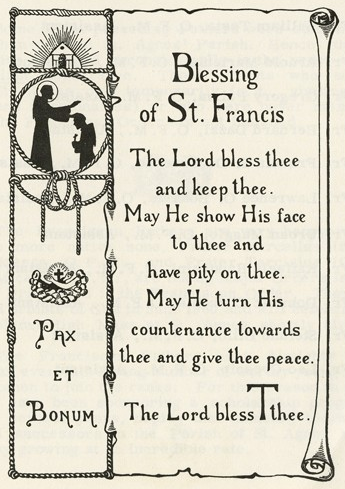
St. Francis of Assisi is one of the most popular and well known saints. The orders that follow the example of St. Francis demonstrate a shared commitment to the values of poverty, simplicity, and self-denial. They live the Gospel in joy and hope and walk in the footsteps of Jesus with humility and charity.

Franciscan friars and religious are especially noticeable due to their distinctive habit or robes. They typically wear a brown, black or gray habit with a simple three-knotted cord which represents their vows of poverty, chastity, and obedience.

TX.56: Complete black/brown Franciscan habit. Includes: a) cassock; b) hood; and c) cincture. 
In researching for this post we discovered anew some Vocations posters and literature distributed by the Felician Sisters of Mississauga and the Capuchins of Mount Alverno in Orangeville. Although the items are from several decades ago, the message remains relevant.


Religious Orders fonds: Franciscan Felician Sisters (C.S.S.F.): Publications: Vocations Posters

Religious Orders fonds: Capuchins (O.F.M. Cap.): Capuchins of Central Ontario - Orangeville, Ont.: History
The following is a list of Franciscan orders who are currently sharing or have shared their missions and ministries with the Archdiocese of Toronto:


Religious Orders fonds: Franciscans (O.F.M.): Publications
from: The Franciscan Fathers of the Immaculate Conception Province: Silver Jubilee Commemoration at Saint Agnes Church Grace and Dundas Streets Toronto, Canada. 1959.

Thursday, 9 April 2015

Archives Awareness Week 2015: Summerhill Then & Now

We are in the midst of Archives Awareness Week in Ontario.  To engage the staff who work at the Catholic Pastoral Centre, we decided to use this opportunity to permanently install a series of photographs in the foyer outside our office:

Outside ARCAT's office: a new permanent installation of historical photos purchased from the City of Toronto Archives.  The photos show the site of our office building and neighbourhood.


The five photographs show the current site of the Catholic Pastoral Centre at 1155 Yonge Street as it was between 1910 and 1945.  The northeast corner of Yonge Street and Shaftesbury Avenue was formerly occupied by the Rosedale Hotel. The photos also capture the surrounding streetscape, including the CPR crossing (now beside the flagship LCBO) and streetcar track extension (eventually replaced by the Yonge Street subway line).

Click the titles below to see the historical images:
Northeast corner of Yonge Street and Shaftesbury Avenue, Rosedale Hotel, 1914 (City of Toronto Archives, Fonds 1231, Item 1114). 
What it looks like now: 
  

Rosedale Hotel, ca.1945 (City of Toronto Archives, Fonds 1257, Series 1057, Item 535). 
 What it looks like now: 

Yonge Street at Canadian Pacific Railway level crossing, looking north, 1910 (City of Toronto Archives, Fonds 1244, Item 502). 
What it looks like now:  


Yonge Street track extension looking north to Shaftesbury Avenue, 1916 (City of Toronto Archives, Fonds 1231, Item 489).  
What it looks like now:    


Yonge Street track construction at Shaftesbury Avenue, ca. 1920 (City of Toronto Archives, Fonds 1231, Item 423). 
What it looks like now:  


Copies of the photographs were purchased from the City of Toronto Archives, which is home to a wealth of photographs featuring streetscapes, many of them digitized. Check out the amazing historical images of Toronto on the City's Flickr page.

So why not use your new found awareness of archives to search for photos of your street or neighbourhood through the City of Toronto Archives?