Tuesday, 30 June 2015

The Year of Consecrated Life: Carmelite Orders

The Order of the Brothers of the Blessed Virgin Mary of Mount Carmel was established around 1154 A.D. near the fountain of Elias on Mount Carmel, Israel.  The founders, after witnessing the horrors of the Crusades, retired as hermits to live a cloistered Christian life.*  The Blessed Virgin Mary appeared to one of the early priors and presented him with the brown scapular - a sort of work apron - which is why Carmelite Orders wear brown habits. As the Order’s patroness, Mary is referred to as Our Lady of Mount Carmel.

Carmelite Brothers and Fathers were invited to the Archdiocese of Toronto in 1875 by Archbishop Lynch. In Niagara, they built a monastery directly above the Canadian Falls. The house served as a spiritual retreat centre and became a Carmelite seminary in 1919.  In 1958, the Diocese of St. Catharines was established, separating the Niagara peninsula and the Carmelites from the Archdiocese of Toronto. However, Carmelite fathers were later invited by Archbishop Pocock back to the archdiocese to serve as pastors in Mississauga and Barrie parishes. The Mount Carmel Spiritual Centre in Niagara Falls continues to offer facilities for retreats and conferences.

Photograph courtesy of Wanita Bates, 2014


The original Carmelite monastery and seminary in Niagara Falls is now called the Mount Carmel Spiritual Centre.  It offers facilities, accomodations and services for retreats and conferences. The 2014 Catholic Archivist Group conference was held here.

Female branches of the ancient Order of Carmel have also served Toronto. After petitioning Archbishop Neil McNeil, the Carmelite Sisters of the Divine Heart of Jesus were invited to establish an orphanage and minister to Polish and Italian immigrants in the city. Upon their arrival in 1913, the archbishop drove the nuns around house hunting in his own carriage, until they decided on a place on Ossington Ave.*

Religious Order series,  Carmelite Sisters of the Divine Heart of Jesus, Foundations 1912

Letter to Archbishop McNeil, petitioning him to allow the Carmelite Sisters "to establish our community in Toronto for the purpose of serving the Emigrants." 
Photographs Collection, Religious Orders album, PH31P-228AL, ca.1960s

Top: Carmelite Provincial Motherhouse, Novitiate and Home for the Aged in Erindale (Mississauga), purchased in 1954. 
Bottom: Children's Home at 312 Ossington Avenue, Toronto, the Sisters' first home.

In 1967, another female Order, the Carmelite Missionary Sisters of St. Theresa of the Child Jesus came to Toronto.  They continue to run the Carmelite Day Nursery.


*Archdiocese of Toronto. Walking the Less Travelled Road: A History of the Religious Communities with the Archdiocese of Toronto 1841-1991 (Toronto: Mission Press, 1993), pp. 15-20.

Tuesday, 23 June 2015

Papal Encyclicals of the Past

Last week, the world received a letter from Pope Francis entitled Laudato Si': On Care for Our Common Home. He wrote about our responsibility to care for the environment.

Encyclicals, which are circular letters written by the Pope, have been around in their modern form since Pope Benedict XIV began to write letters in the 1740s. The letters are written in a pastoral teaching style, and generally address the ways that the Catholic faith interacts with contemporary issues of the world at large. 

Below are a small selection of Papal Encyclicals from ARCAT's holdings:

1846 - Pope Pius IX - Qui Pluribus - On Faith and Religion
P PS28.01 
1847 - Pope Pius IX - Praedecessores Nostros - On Aid for Ireland
P PS29.01
1851 - Pope Pius IX - Exultavit Cor Nostrum - On the Effects of the Jubilee
C AK01.05
1864 - Pope Pius IX - Quanta Cura - Condemning Current Errors
L PS46.01
1894 - Pope Leo XIII - Iucunda Semper Expectatione - On the Rosary
W RC77.03  
1903 - Pope Pius X - E Supremi - On the Restoration of All Things in Christ
O RC86.04
1907 - Pope Pius X - Pascendi Dominici Gregis - On the Doctrines of the Modernists
O RC90.11 
1932 - Pope Pius XI - Caritate Christi Compulsi - On the Sacred Heart
MN PS114.01
1936 - Pope Pius XI - Vigilanti Cura - On Motion Pictures
MG PS118.01
1953 - Pope Pius XII - Fulgens Corona - On the Marian Year and the Dogma of the Immaculate Conception
MG PS135.02
1954 - Pope Pius XII - Sacra Virginitas - On Holy Virginity
MG PS136.04
1956 - Pope Pius XII - Haurietis Aquas - On Devotion to the Sacred Heart
MG PS138.01
1957 - Pope Pius XII - Miranda Prorsus - On Motion Pictures, Radio and Television
MG PS139.04
1962 -Pope Saint John XXIII - Paenitentiam Agere - On the Need for the Practice of Interior and Exterior Penance
MG PS144.02
1967 -Pope Paul VI - Populorum Progressio - This Is Progress
MG PS149.03
1968 - Pope Paul VI - Humanae Vitae - On Human Life
MG PS150.04

And just for fun, an encyclical from the office that was a precursor to the Congregation for the Doctrine of the Faith condemning the use of magnetism in superstition, hypnotism and clairvoyance:

1856 - Supreme Sacred Congregation of the Roman and Universal Inquisition - Adversus Magnetismi Abusus - Against the Abuse of Magnetism
C RC38.05

ARCAT holds many more Papal Encyclicals, including Pius IX's Nullis Certe, on Temporal Power and Napoleon III, Leo XIII's Quod Apostolici, which condemns socialism, and Pius XI's Mit Brennender Sorge on the state of the Church in Germany. 

Friday, 12 June 2015

Visit to lovely London, Ontario

ARCAT staff recently attended the Archives Association of Ontario conference in London, Ontario.  The theme “Do we have it RIGHT?” addressed legal issues in archives: balancing access and privacy; the rights of donors, users and third-parties; and the wonderful world of copyright.

We figured it would only be right and just to pay a visit to our fine colleagues at the Diocese of London, Cardinal Carter Library and St. Peter’s Seminary.

The Diocese of London is considered one of the suffragan sees of Toronto. It was established (along with the Diocese of Hamilton) in 1856 to accommodate the influx of Irish immigrants. However, the diocese is home to the oldest parish west of Montreal, and holds some of Ontario's earliest marriage and baptism records, starting in the 1760s. The archives are located in the recently renovated Diocesan Centre and overseen by archivist Debra Majer.


Diocesan Centre entrance with display of artifacts from the Diocese of London Archives

Inside the storeroom at the Diocese of London Archives.
The portrait depicts Bishop Michael Fallon, O.M.I., ordinary of London from 1909 to 1931.
On shelves to the right: historical parish registers containing sacramental records are stored in this central, climate-controlled location for optimal preservation. 

The Diocese of London is home to the oldest parish west of Montreal, Our Lady of Assumption Parish in Windsor.
 The diocese holds some of Ontario's earliest vital records, including this 1764 marriage record from the parish. 

The reading room at the Diocese of London Archives. A Canadian chaplain's service kit is on display.

Before Cardinal Carter became the Archbishop of Toronto, he was appointed bishop of London. The library at King's University College is named in his honour.  The Director of Libraries, Claire Callahan, showed us around the special collections and display cases featuring Cardinal Carter artifacts.


Entrance to the Cardinal Carter Library through the newly renovated Darryl J. King Student Life Centre, King's University College, University of Western Ontario.
Cardinal Carter was the Bishop of London from 1964 to 1978, prior to his appointment to Toronto.

Cardinal Carter special collections exhibit at the library.
ARCAT has loaned a few items to the library for display, including the Cardinal's pectoral cross and a mitre.

Cardinal Carter artifacts on display in the Eaton Special Collections Room.

Finally, we made our way through the verdant grounds to St. Peter's Seminary, the alma mater of our current Archbishop of Toronto, Thomas Cardinal Collins. Following a quick peek at the seminary's beautiful chapel, librarian Frances Theilade gave us a tour of the seminary's library and the small, but skillfully arranged, archives.

St. Peter's Seminary Chapel.
View of the stained glass windows and wood carving in the sanctuary.
The windows are the subject of a book and film series, Panes of Glory.

The lower potion of the chapel walls are lined with richly carved wood panels.  Pews in the choir seating are flanked with carved angels - each with an individual personality.

The A. P. Mahoney Library at St. Peter's Seminary.
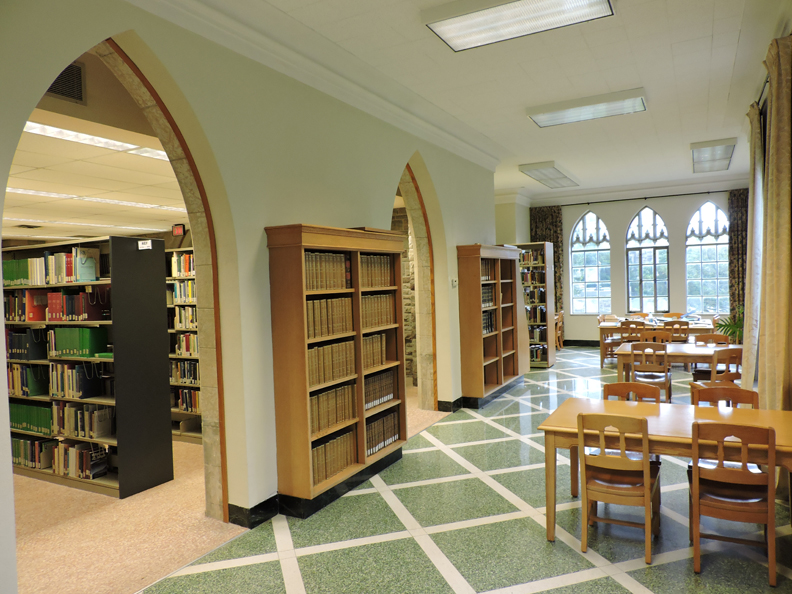
This part of the library was previously the seminary cloisters, as you can see from the exposed stonework and arched doorways. The stacks are located where the courtyard used to be.
Interesting artifacts from the seminary's archives:
A papal zucchetto of Pope Pius X, given to Bishop Fallon. Popes have a custom of giving away their skullcaps if presented with a new one as a gift. 
Left: The seminary's librarian shows off brass shells from WWI that were turned into a pair of vases.
 Right: A seal worthy of the Lannisters.

 Thanks again to Deb, Claire and Frances for welcoming us to the Forest City.

Friday, 22 May 2015

Record of the Week: Forwarding the Cause of Br. André

Saint AndrĂ© Bessette, C.S.C., is one of our country's most beloved saints. Commonly referred to as Brother AndrĂ©, he was a  member of the Congregation of Holy Cross. The French-Canadian was known for his strong personal devotion to St. Joseph, in whose name he administered to the sick. Br. AndrĂ© died in 1937 in the famous St. Joseph's Oratory in Montreal.

Photographs Collection, Holy Cross Brothers (C.S.C.), PH27H/01P

Portrait of Brother André Bessette, C.S.C [ca. 1920]
Tomorrow marks the 33rd anniversary of Br. AndrĂ©'s beatification. We were surprised to find that our own Cardinal McGuigan played a small part in this first step towards sainthood. The Archbishop of Toronto was asked by the Vice-Postulator* to write to Pope Pius XII "asking him to introduce the cause of this Servant of God." Cardinal McGuigan complied with this request in 1946, although Br. AndrĂ© was not made Blessed until May 23, 1982. He was finally canonized in 2010 by Pope Benedict XVI.

*A postulator is one who is charged with furthering a cause for sainthood - making a judicial case for beatification and then canonization of an individual by gathering evidence of miraculous events attributed to the holy person. Postulators often authorize the issuing of relics of the venerable person.

James Cardinal McGuigan fonds, MG DA32.49 (a)

"June 5, 1946...therfore, as Vice Postulator of his Cause, I respectfully would ask your Eminence if you would be kind enough to write a postulatory letter to His Holiness, Pope Pius XII asking him to introduce the Cause of the servant of God."

As the note on the top suggests, Fr. Egan was probably charged with drafting the actual letter.

James Cardinal McGuigan fonds, MG DA32.49 (c)

"Brother Andre was universally acclaimed as a miracle worker. His ability to read the consciences of the pilgrims and convert even the most hardened sinner was one of his greatest gifts."


Friday, 15 May 2015

Are you going to the [Cottage, Cabin, Camp, Chalet]?

In this part of the world, the Victoria Day Weekend is known as the start of cottage season. Today thousands will pack up the kids and leave the city to head north to open the cottage and for the first sweet taste of summer.

There's nothing more relaxing than sitting in the middle of the woods listening to the birds in the trees and the loons on the lake. As John Burroughs put it, "I go to nature to be soothed and healed, to have my senses put in order." Even our bishops have been known to escape to the cottage once in a while...

Emmet Cardinal Carter with his mother, Minnie Carter at Fourteen Island Lake, 1946. Cottages can be a great place to spend time with family.
PH18F/163P
Archbishop Pocock spent some time with friends, including Bishop of Sault Ste. Marie Alexander Carter, at a cottage in the 1970s. I would love to have been able to hear some of the conversations that happened in this circle!
PH14C/25CP
Archbishop Philip Pocock relaxes at a cottage in the 1970s. This looks like a great place to nap, and the dog knows it!
PH14C/28CP
Even the Pope needs a cottage getaway once in a while! Saint John Paul II relaxed for a few days with the Basilian Fathers on Strawberry Island in Lake Simcoe during his visit to Toronto for World Youth Day in 2002. The Archdiocese's own Emanuel Pires had the opportunity to have lunch with him, which you can read about on the Archdiocesan Blog.

Emanuel Pires, Fr. Thomas Rosica, CSB, and Pope John Paul II on Strawberry Island in July 2002.
Photo courtesy of Emanuel Pires.
ARCAT wishes everyone a fun and safe holiday weekend. Don't forget the sunscreen!

Friday, 8 May 2015

Hail Virgin, dearest Mary! Our lovely Queen of May!

In May, Catholics take the time to honour St. Mary. While devotion to Mary is popular year-round, many parishes organize special events in her name during this month.

Here in the Archives, we decided to celebrate Mary by highlighting some of the parishes named in her honour. It is clear that Mary is a popular saint within the Archdiocese of Toronto, as there are twelve churches named for her, and that doesn't even count the churches dedicated to 'Our Lady!'

If you would like to see each church as it appears today, the linked addresses listed below will take you to Google Streetview. It is fun to see how the churches have changed, as well as the neighbourhoods around them.


St. Mary's Church, Toronto, 1914
PH31P/227AL/03P
St. Mary's, the third parish in Toronto, was established in 1852. It is located at 588 Adelaide St. W. The land was originally part of a military training ground called Garrison Reserve. A parcel was granted to Bishop Macdonell with his promise that there would be seats for Catholic soldiers. The land was described as being on Lake Ontario because there were no other buildings between it and the water. The present church is the third located on that site, having been built between 1885 and 1889.


St. Mary's Church, Barrie, 1963 & 1973
PH102/0128/28P, PH102/0128/35CP

The pastoral needs of early Catholic settlers in the Barrie area were provided for first by missionary priests, and then by priests from parishes in Penetanguishene and Newmarket. Sacraments were performed in private homes. In the late 1830s, land for a church was granted to the Catholic community at the corner of McDonald and Mulcaster streets. By 1850, the first church was blessed. In 1855, a pastor was appointed specifically to Barrie, and St Mary's became its own parish. A second church was completed in 1872. In 1968, construction began on the current St. Mary's Church at 65 Amelia St. (above right). It was blessed on May 26, 1969.

St. Mary's Parish, Brampton

St. Mary's Church, Brampton, [1910-1964] & 1974
PH102/0135/01P, PH102/0135/04CP

Catholics in Brampton were originally served by priests from nearby parishes. The first church in the area was Guardian Angels Mission Church, which was destroyed by arson in 1878. A Presbyterian church was purchased and used until 1910, when a new church named St. Mary's was completed. In 1918 St. Mary's was established as a parish. A bigger church, located at 66 Main St. S., was blessed for the growing Catholic population by Cardinal McGuigan on December 13, 1964.

St. Mary's Parish, Collingwood

St. Mary's Church, Collingwood, 1963
PH102/0138/13P

Catholics in Collingwood were originally part of the Mission of Barrie. By 1859, there were enough Catholics in the area to purchase a church from an Anglican congregation. In 1886, Collingwood was established as a parish, and a new church was completed in 1888 at 63 Elgin St.

St. Mary Star of the Sea Parish, Mississauga

St. Mary Star of the Sea Church, Mississauga, 19 April 1953
PH102/0155/04P

The earliest masses in the Port Credit area were said in private homes. In 1880, St. Mary's Church was built as a mission of St. Patrick's, Dixie. By 1914, there were enough Catholics in the area to establish St. Mary's as a parish. As the Catholic population grew, the need for a new church became apparent. The current St. Mary's was built at 11 Peter St. S., and was blessed on April 19, 1953 by Cardinal McGuigan.

St. Mary of the People Parish, Oshawa

St. Mary of the People Church, Oshawa, 1973
PH 102/0168/07CP

With the expansion of industry in Oshawa in the early 1950s, the Catholic population of the city increased. A new parish was established in 1957 to meet the growing need. The first mass was held in St. Christopher school. A new church was completed at 570 Marion Ave. and was blessed on January 16, 1966 by Archbishop Pocock.

St. Mary Immaculate Parish, Richmond Hill

St. Mary Immaculate Church, Richmond Hill, 1963 & 1973
PH102/0178/30P, PH102/34CP

The first St. Mary's in Richmond Hill was built on Mill St. in 1857 as a mission of St. John Chrysostom, Newmarket. In 1894, a new church was built at 10295 Yonge St. In 1918, St. Mary's was established as a parish. The population explosion of the 1950s necessitated a new church, and the present St. Mary Immaculate Church was dedicated on July 28, 1968 by Apostolic Delegate to Canada Most Reverend Emanuele Clarizio.

St Mary's Polish Parish, Toronto

St. Mary's Polish Church, Toronto, 1981
PH102/0085/01CP

St. Mary's Polish Parish was established in 1914 when members of the Polish population began to move into West Toronto. They were able to build a church in 1915 at 1996 Davenport Rd.

St. Mary of the Angels Parish, Toronto

St. Mary of the Angels Church, Toronto, 1963
PH102/0086/10P

St. Mary of the Angels Parish was built from a need to relieve some of the pressure from St. Clement's Parish, which was overflowing with a growing Italian population. The task of building the new church was given to a Franciscan priest, Fr. Settimio Balo. The cornerstone was laid at 1481 Dufferin St., and the building was blessed by Cardinal McGuigan on June 20, 1937.

St. Mary's Parish, Victoria Harbour

St. Mary's Church, Victoria Harbour, 1963
PH102/0186/07P

The original St. Mary's was built as a mission of St. Margaret's Midland in 1882 on William St. It was established as its own parish in 1919. The church was destroyed by fire in the 1930s, and the present church was built at 266 Albert St. shortly after.

St. Mary's Mission, Nobleton

St. Mary's Church, Nobleton, 1963
PH102/209/02CP

With the influx of Irish immigrants in the mid 1800s, the need for churches in York County increased. St. Mary's was established as a mission of St. Patrick's, Schomberg in 1855. The first mass was held at the church on the Tenth Line on September 23.

St. Mary's Mission, Achill

St. Mary's Mission Church, Achill, 1963
PH102/213/03P

St. Mary's was established as a mission of St. James Parish, Colgan in 1875. In 1892, the original frame church was destroyed by fire. A new church, located at 2458 4th Line of Adjala, was dedicated by Very Reverend Joseph McCann, Vicar General of the Archdiocese.