Friday, 18 September 2015

Who Are You Voting For?


The Canadian Federal Election will be held next month on October 19th, and there will be new Members of Parliament in many ridings across the country. Here in the archives, we have correspondence with many MPs, but we were curious to see how many Prime Ministers' signatures we could find. Out of the 22 who have held the job, we were able to find 16. Not too shabby!

In order of appearance, we have:

1. Sir John A. Macdonald 1867 - 1873, 1878 - 1891
L AF02.31
1884

2. Alexander Mackenzie 1873 - 1878
L AE12.54
1876

4. Sir John Thompson 1892 - 1894
L AE12.131
1887

7. Sir Wilfrid Laurier 1896 - 1911
ME AE01.20
1909


9. Arthur Meighen 1920 - 1921, 1926
MN AH10.16
1921

10. William Lyon Mackenzie King 1921 - 1926, 1926 - 1930, 1935 - 1948
MG SU03.13
1937


11. R.B. Bennett 1930 - 1935
MN TA01.117
1933

12. Louis St. Laurent 1948 - 1957
MG DS50.64
1948

13. John Diefenbaker 1957 - 1963
MG PO06 54
1957

14. Lester B. Pearson 1963 - 1968
MG PO06.116
1963

15. Pierre Trudeau 1968 - 1979, 1980 - 1984
Papers of Cardinal Carter
1983

16. Joe Clark 1979 - 1980
Papers of Cardinal Carter

17. John Turner 1984
Papers of Cardinal Ambrozic

18. Brian Mulroney 1984 - 1993
Papers of Cardinal Carter

20. Jean Chrétien 1993 - 2003
Papers of Cardinal Ambrozic

21. Paul Martin 2003 - 2006
Papers of Cardinal Ambrozic

Stephen Harper's signature is probably somewhere in the building, but not yet in the archives!

Click here to read the Canadian Bishops' guide to voting in the upcoming election, and click here for information about voter registration. Don't forget to make your voice heard!


Tuesday, 8 September 2015

Record of the Week: Reign of Queen Elizabeth II

Tomorrow, Queen Elizabeth II will become the longest serving monarch in British history, supplanting her great-great grandmother, Queen Victoria, who reigned for 63 years 216 days.

After her uncle King Edward VIII abdicated, Elizabeth unexpectedly became second-in-line to the throne. The queen's reign began on February 6, 1952 when her father, King George VI, died. Elizabeth II's coronation took place on June 2, 1953 and was the first to be aired on television.

At the time of Her Majesty's accession, James Cardinal McGuigan was the Archbishop of Toronto. As the senior cardinal and ranking prelate of the Roman Catholic Church in Canada, His Eminence sent words of sympathy and acknowledgement to the new Queen of Canada. In the archives, we have the monarch's brief response, sent via telegraph:

Cardinal McGuigan finds, MGPO06.99

Telegram, 10 February 1952

"Buckingham Palace London
LTF Cardinal McGuigan Toronto
I am sincerels (sic) grateful for your kind message please assure all those for whom you speak that I deeply value their kindness and sympathy
Elizabeth R"

The queen signs official documents "Elizabeth R". The "R'' stands for regina, which is Latin for queen.

Friday, 28 August 2015

It's our 100th post!

It has been two years since we started The Archivist's Pencil and this is our one hundredth post.
In honour of this milestone, we thought it would make a lot of cents (!) to feature ten records with reference to "100":

Archbishop Lynch fonds, LRC69.23

Offering of 100 lire on the occasion of the golden jubilee of Pope Leo XIII's priestly ordination (24 December 1886)
First World War, FWGC01.13

"21st April 1916
Your Grace, 
This morning your cable 'hundred masses' arrived here, and I hasten to express my profound thanks for this great kindness and valuable help...
Three of my priests have been appointed military chaplains in connection with the expedition against German East Africa...
It took me over two months to visit all the missions; - I covered over 750 miles on a push bike."

Parish Collection, St. Mary's Toronto

"Souvenir of St. Mary's Parish, Bathurst and Adelaide Streets, Toronto, Ontario
Centennial Year 1852-1952"

St. Mary's is the third oldest parish in the city, after St. Paul's Basilica and St. Michael's Cathedral

Archbishop Neil McNeil fonds, MNAH16.104

"June 17, 1927...Enclosed find receipt for 100 Special Permits (Minister of the Gospel)."

The Liquor Control Board of Ontario (LCBO) was created in 1927 with the end of prohibition, which had been introduced in the province in 1916. However, temperance was still encouraged and from 1927 to 1962, the LCBO required people who wanted to purchase liquor to possess a permit. This letter to the LCBO suggests that priests were issued special permits for mass wine.
Archbishop Neil McNeil fonds, MNAH16.104

"Monastery of Our Lady of Charity, August 31, 1921
Enclosed is our cheque for One hundred dollars, the fifth and last payment on our new lot in Mount Hope Cemetery."

Mount Hope Cemetery is one of two operational Catholic cemeteries in downtown Toronto. It opened in 1900 as St. Michael's Cemetery began to fill up.
Archbishop Neil McNeil fonds, MNAH05.16

 "March 17, 1916
Your Grace, Just a note this evening to ask you if I could have a little extension of time in saying the remainder of those 100 Masses,
'ad intentionem,' which you so kindly gave me last October.  I offered 50 of them to the Bishop when I returned but he evidently had a good number of intentions on hand, because he didn't care to take mine."
Bishop de Charbonnel fonds, CAC02.09

September 15, 1853 - An Indenture made between the Roman Catholic Episcopal Corporation and John Butler, yeoman, for a transfer of land in the Township of Dereham, County of Oxford in consideration of one hundred pounds of lawful money.

The 1850s was a decade of wrangling over whether to adopt a sterling monetary system or a decimal monetary system based on the US dollar. In 1853, the sterling coinage was made legal tender, and all other silver coins were demonetized.  Therefore, one hundred pounds of lawful money refers to the British pound. The first Canadian coinage was not authorized and executed until 1858.
This land in the county of Oxford became part of the Diocese of London, which was erected in 1856.
Archbishop Lynch fonds, LRC44.12

Letter from Bishop Lynch asking Pope Pius IX to grant an indulgence of 100 days to the members of the Altar Boys' Confraternity, also for the College of St. Basil, the House of Providence, the Loretto Sisters, the St. Joseph Sisters and the various priests. (June 13, 1862)


Archbishop McEvay fonds, MEAF02.02

A letter from Archbishop McEvay scribbled on an envelope explaining that $100 worth of stock, received from Robertson and Coughlin, was sold for $32.00 (February 22, 1905)
Archbishop McNeil fonds, MNAH03.12

"Toronto, Feb. 2/14
Most Rev. Archbishop, This is the first opportunity I have had to reply to your letter re new hospital and infants' home.  While my means are not great I will try to send $100 a year for five years..."

This letter refers to St. Mary's Hospital and Infants' Home, which addressed the lack of  maternity care for young, unmarried Catholic women. Archbishop McNeil invited the Misericordia Sisters of Montreal to establish and administer the home in 1914.


Friday, 21 August 2015

August 21st - The Feast of Pope Saint Pius X

Pope Saint Pius X in full Papal dress
PH 59/04P

August 21st is the feast day of Pope Saint Pius X, who led the Church from August 4, 1903 until his death on August 20th, 1914. We have a number of items in the archives associated with Pius X, some of which we are highlighting today.

In an August 1903 letter to Archbishop O'Connor, the Apostolic Delegate to Canada wrote "The Sacred College, directed by the Holy Spirit, has chosen a worthy successor to Leo XIII. The new Pontiff had gained the esteem and love of the Catholics in the diocese which he so wisely ruled for many years. He will, by his great piety and prudence, by his administrative ability and his breadth of view, maintain high, as did his illustrious and venerated predecessor, the prestige of the Church, and gain for her new triumphs."

Pius X appointed both Fergus McEvay and Neil McNeil as Archbishop of Toronto during his time as Pontiff. This kind of announcement was made by papal bull, which is an official document accompanied by a metal seal. The two below are handwritten on parchment.

Papal bull appointing Fergus McEvay Archbishop of Toronto.
April 13, 1908
ME RC91.03

Papal Bull appointing Neil McNeil Archbishop of Toronto.
April 10, 1912
PB02

Pius X was originally buried under St. Peter's Basilica, but his tomb was moved inside to the altar of the Presentation Chapel following his 1951 beatification. He is dressed in Papal vestments with silver covering his hands and face


Body of Pius X on display after his beatification in 1951.
PH 59/06P

Devotion to St. Pope Pius X started  shortly after his death and has remained popular. There are a church and a school named after him in Toronto.

A first class relic of Pope Saint Pius X. The relic has a wax seal and is accompanied by a certificate of authenticity.
AF 268

Some fun facts about Pope Saint Pius X:

He was born Giuseppe Melchiorre Sarto in 1835 to a postman and a seamstress.    
    
He was Patriarch of Venice from 1893 - 1903.              
                              
He was elected Pope in the last conclave in which a Catholic monarch used his right to veto candidates. Emperor Franz Joseph of Austria vetoed Cardinal Rampolla, Pope Leo XIII's Secretary of State. Pius X later removed this right.         
                                       
His Papal motto was Instaurare Omnia in Christo, or To Restore All Things in Christ.

He was responsible for a revision and codification of canon law which was published in 1917.

He valued causes of the poor and the education of children.

He lowered the age of eligibility for first communion from 12 to 7.  

In 1910 he had priests sign an oath against modernism, which was required until 1967. He was supportive of social justice causes, but was against the relativistic intellectual movement which denied that early Church teachings still held true.

His poor health was exacerbated by the outbreak of the First World War, which lead to his death. 

Several miracles were attributed to him, and he was beatified in 1951 and canonized in 1954. 

Friday, 14 August 2015

Record of the Week: 1861 Passport of Bishop Timothy O'Mahony

This week we are featuring the 1861 British passport of Bishop Timothy O'Mahony.

Timothy O'Mahony was born in Cork County, Ireland in 1825. He was ordained in 1849 and was a parish priest in the Diocese of Cork before being appointed first Bishop of Armidale, Australia in 1869.

Because of local Church politics, Bishop O'Mahony resigned his See in August of 1877 and returned to Europe. In 1879 he met Archbishop Lynch while the Archbishop was in Rome, which led to his appointment as the first Auxiliary Bishop of Toronto.

Upon his arrival in Toronto, Bishop O'Mahony took charge of St. Paul'sParish, where he began fundraising for a new church to accommodate the growing congregation. The new building was completed in 1889 and remains in use today. Bishop O'Mahony also performed episcopal duties and assisted Archbishop Lynch. In 1887 he even acted as the Administrator of the Diocese of Hamilton during the prolonged absence of Bishop James Carberry.

Bishop O'Mahony died in 1892, and was interred in a brick vault at the south-east corner of St. Paul's Church.

O'Mahony's 1861 passport is still in great shape even though the paper is thin and it was kept folded. It is stamped by officials of the Netherlands, Saxony, Dresden, Bavaria, and Austria. 

Travelling papers have been around in various forms for hundreds of years, and were issued in the monarch's name by the Secretary of State after 1794. They requested safe passage for the bearer, but were not necessarily required for travelers. The modern idea of a passport came into use during the First World War as a security measure.

1861 British Passport - a stamp from the Bavarian Embassy in London is visible in the top left corner. 

          "We Lord John Russell, a Member of Her Britannic Majesty's Most Honorable Privy Council, a Member of Parliament and Her Majesty's Secretary of State for Foreign Affairs, &c. &c. &c.
          Request and require in the Name of Her Majesty, all those whom it may concern, to allow Mr. Timothy Mahony (British Subject) travelling on the Continent
to pass freely without let or hindrance and to afford him every assistance and protection of which he may stand in need.
          Given at the Foreign Office, London, the 1 day of August 1861.
L AM13.03 - Obverse

Stamps from diplomatic institutions of  Austria, the Netherlands, Dresden and Saxony. We haven't been able to decipher the top stamp.

L AM13.03 - Reverse
For a brief history of British passports, see this 2006 Guardian article.

Friday, 7 August 2015

"Good friars, with zeal and affection for the glory of God:" 400 years of Catholicism in Huronia

On Wednesday, August 12th, a memorial mass celebrating the 400th anniversary of the first recorded Catholic mass in Ontario will be held at Carhagouha, a site near Lafontaine and Georgian Bay, commemorating the event which occurred nearby in 1615.

The celebrant of that mass was Fr. Joseph Le Caron, OMR, who was one of four Récollet Friars to accompany Samuel de Champlain to New France in 1615.

Statue of Fr. Joseph Le Caron at St. Ann's Church, Penetanguishene.
PH 170-33P
1954

Champlain brought the priests with him to evangelize the natives living in the area. The Récollets said the first recorded mass in Montreal on the Île de Montréal on June 24th, 1615. Fr. Le Caron then made the 1100 km journey by canoe and overland to Huronia. He was accompanied by twelve Frenchmen and guided by Ouendat traders. He took up residence among the native Ouendat people of the area, and some time later Champlain arrived.

This is how Champlain recorded the first mass that was said in his presence in Ontario:

The Works of Samuel de Champlain in Six Volumes: Volume III, 1615-1618. H.P. Biggar, ed. 1929. The Champlain Society: Toronto. pp. 22-23.
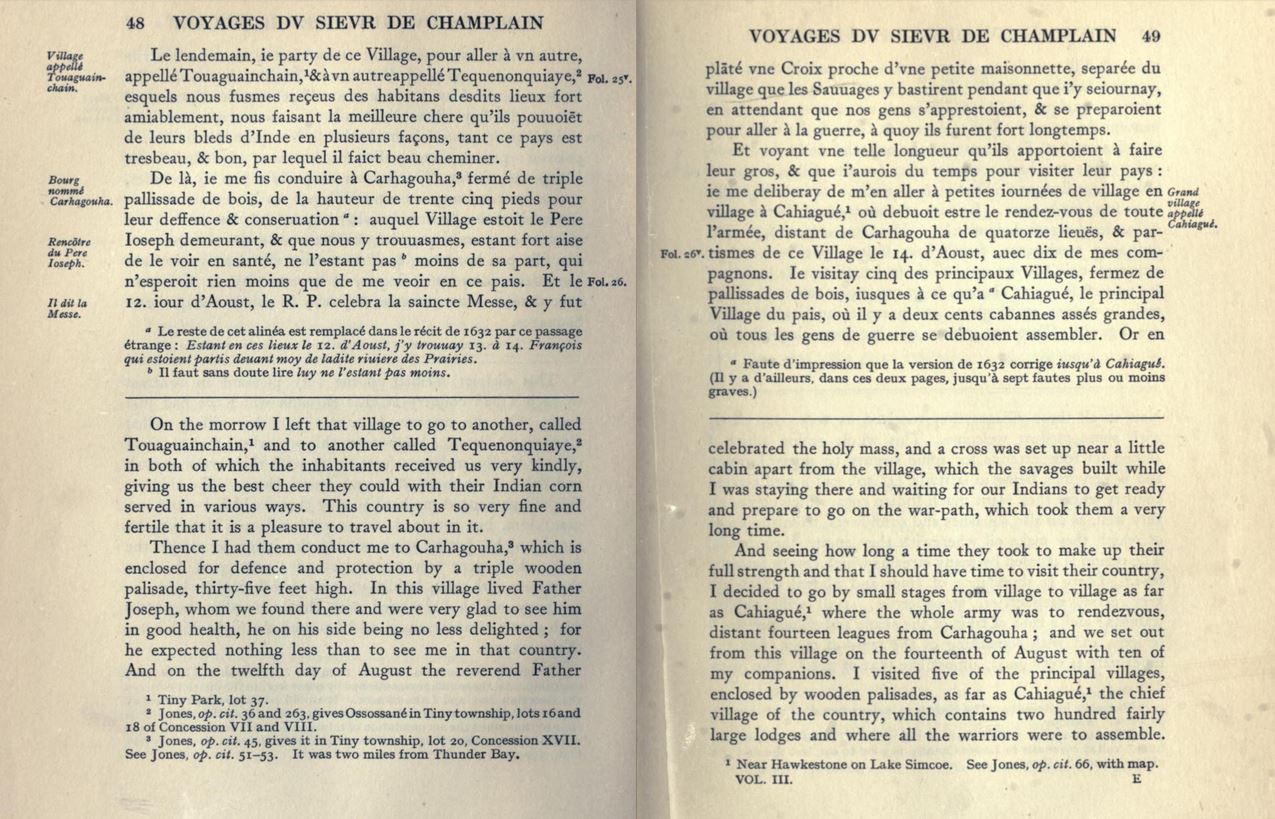
"On the morrow I left that village to go to another, called Touaguainchain, and to another called Tequenonquiaye, in both of which the inhabitants received us very kindly, giving us the best cheer they could with their Indian corn served in various ways. This country is so very fine and fertile that it is a pleasure to travel about in it.

"Thence I had them conduct me to Carhagouha, which is enclosed for defence and protection by a triple wooden palisade, thirty-five feet high. in this village lived Father Joseph, whom we found there and were very glad to see him in good health, he on his side being no less delighted; for he expected nothing less than to see me in that country. And on the twelfth day of August the reverend Father celebrated the holy mass, and a cross was set up near a little cabin apart from the village, which the savages built while I was staying there..."

Le Caron and the other Récollets only stayed in New France for a short time, and a few years later the Jesuit missionaries who are memorialized at Midland's Martyrs' Shrine took over their work.

In 1922, a cross was erected by the Knights of Columbus on the spot once believed to be Carhagouha (doubts about the exact site were later expressed by many). It was blessed by Archbishop McNeil.

PH 31C-14P
1976
PH31C - 03CP
1976

Memorial masses have been celebrated at the site over the years. In 1965, Archbishop Pocock celebrated the 350th anniversary of the mass:


PO SU20-07b
1965

Archbishop Pocock offers mass at the Carhagouha memorial.
PH 14C-07P
1965
In 1615 one French priest said mass for a handful of the Catholic faithful. 400 years later there are 223 parishes, 21 missions and 1.9 million Catholics in the archidocese. Between then and now there have been millions of stories of Catholics leaving their homes to explore new life in our region. The Archdiocese of Toronto was founded on the pioneering spirit, and that spirit lives on today.

For more information about Wednesday's mass and other events, check out the Martyrs' Shrine Events Calendar.


Friday, 31 July 2015

The Year of Consecrated Life: The Congregation of the Most Holy Redeemer

St. Alphonsus Liguori
Image from Wikimedia Commons

August 1st is the feast day of St. Alphonsus Liguori, who founded the Congregation of the Most Holy Redeemer - the Redemptorist Fathers.


St. Alphonsus founded the Congregation in Italy in 1732. A well educated priest and later Bishop of Sant'Agata de' Goti, he was canonized in 1839 and made a Doctor of the Church 1871 for his contributions to moral theology. His original intent for the Order was to minister to the poor around his home city of Naples.

The Congregation spread to Germany and other areas of Europe, then eventually to the United States, and from there to Canada - first to Quebec City in 1874, to Ste. Anne-de-Beaupre in 1878, and then to Toronto in 1881 at the invitation of Archbishop Lynch to take over St. Patrick's Parish, where they continue to remain in residence.


Letter from Pius IX on the subject of St. Alphonsus Liguori, discussing his defence of the faith and support of papal teachings, and attaching to his feast day a plenary indulgence for all who confess and visit a Redemptorist Church.
July 7, 1871
L PS54-01

As Fr. Karl Schindler, CSsR explains in his book To Serve God's People: A Hundred Years of the Redemptorists at St. Patrick', the Cradle of the Toronto Province 1881 - 1981, "The first Redemptorists to come to Toronto were Fathers Eugene Grimm, John Hayden, Augustine McInerny, and Brothers George and Alexander... They arrived in Toronto, January 15th, 1881. The following day, January 16th, His Grace signed the contract whereby the Redemptorist Fathers took possession of St. Patrick's Church. On February 12, Father F. Krein arrived from Quebec City to begin work for the German-speaking Catholics of Toronto."

By the late 1890s there were over 2600 members of the St. Patrick's congregation. In 1903 the Congregation started work on a new Church beside their monastery on McCaul St. The new St. Patrick's was dedicated on November 1st, 1908, and the old church became Our Lady of Mount Carmel, a parish for the Italian population in the area.

Today there are over 5000 Redemptorist Fathers internationally, with members of the congregation working in cities across Canada. Their numbers have included four saints, four blesseds, and six martyrs. They continue to uphold St. Alphonsus' vision of "[bringing] the message of the gospel to the most poor and abandoned" as pastors of many churches. They are also active in the areas of bioethics, social justice, and music.

For more information about the Canadian Redemptorists, visit their website. Don't forget to check out their archives page for excellent photographs.