Friday, 26 February 2016

The Winter Vault at St. Michael's Cemetery

"The winter dead wait...for the earth to relent and receive them." 

- The Winter Vault by Anne Michaels

February is finally winding down and we can start to look forward to the spring thaw.

In the 19th century, before ground breaking equipment existed, the frozen earth had greater implications for cemeteries. As they could not be buried during the winter months, corpses were often stored until spring in outbuildings known as "winter vaults" or "dead houses."

Photographs Special Collection, PH76/123CP

Photo of the Winter Vault at St. Michael's Cemetery, Toronto, by Tassielli Photography (1992).

The building is the finest example of an octagonal dead house, unique to Southern Ontario.  The Gothic architectural style is evident in the buttressing, spire and pointed archways.  Many have thought that the windows have been bricked up, but these "blind reveals" are part of the original design. 

The Winter Vault is the centerpiece of St. Michael's Cemetery in Toronto, placed at the intersection of two main axes. It was designed in 1855 by Joseph Sheard, a prolific architect who went on to become Mayor of Toronto in 1871. While he was Foreman of Public Works, Sheard was known for refusing to build the gallows to hang two leaders of the Upper Canada Rebellion, Samuel Lount and Peter Matthews.

Cemeteries series, CCSM01-11

Detail of St. Michael's Cemetery plot map (1932), showing the winter vault at the intersection of two main axes.  The winter vault can been seen from the eastern entrance, off Yonge Street, south of St. Clair Ave. 


For a fee of £18, Sheard drew the architectural plans and specifications for the dead house and cemetery fences, and supervised their construction. The total cost of materials and labour was £326.

The winter vault is a Gothic-style building, which was the architectural fashion of the time.  Its octagonal shape followed a mid-19th century fad for eight sided buildings that originated in the United States. Octagonal winter vaults, however, are unique to southern Ontario. There are five existing octagonal vaults in the region, including those in Aurora, King City and Richmond Hill. They are designated as buildings of historical and architectural value under the Ontario Heritage Act. The octagonal shape has the added practical value of offering more wall space for platforms on which to place the caskets.

To mark the 150th anniversary of the Archdiocese of Toronto in 1991, Catholic Cemeteries and Funeral Services decided to restore the winter vault at St. Michael's Cemetery. Specialists at Restoration Summit replaced some of the massive Douglas fir timbers and other wooden elements that had succumbed to rot. Cedar shingles and copper plating were used to repair the roof and cupola for a historically correct finish. Six hundred bricks on the exterior wall and buttresses had been cracked by tree roots and required replacement. To match the patina of the exterior masonry, bricks were salvaged from the interior walls to use outside. The restoration work received an Award of Merit from the Toronto Historical Board in 1993.

ARCAT Staff Photo

Archdiocesan staff visit the restored Winter Vault at St. Michael's Cemetery during a guided tour in 2010.*
ARCAT Staff photo

We were allowed access to the Winter Vault during a guided tour of the cemetery in 2010.* Originally, wooden platforms (such as the one against the wall) would have shelved caskets during winter months. The octagonal shape of the building offers more wall space for platforms on which to place the caskets.

Photographs Special Collection, PH32S/08P

In June 1992, Auxiliary Bishop M. Pearse Lacey unveiled a historical plaque rededicating the structure and marking the sesquicentennial year. 


Toronto author and poet Anne Michaels wrote a novel called The Winter Vault in 2009. To promote its publication, she gave a book reading inside the winter vault at St. Michael’s Cemetery.*


*Note: For the protection of the cemetery grounds and monuments, St. Michael’s Cemetery gates are now closed.  To visit the cemetery please contact Mount Hope Cemetery at (416) 483-4944.

Friday, 19 February 2016

The Maple Leaf Forever!

On Monday, February 15th, Canada celebrated Flag Day. It was on that day in 1965 that the red and white maple leaf flag was first officially used.

To celebrate, we pulled out a few interesting records from the archives.

The photo below is of one of a flag that was in use in Canada between 1922 and 1957 called the Canadian Red Ensign. In the upper left corner is the Union Jack, and in the lower right is the shield of the Canadian Coat of Arms. This particular flag was once used at St. Michael's Cathedral, but came to us through St. Augustine's Seminary.

Red Ensign Flag: ca. 1921-1957
TX 114

Close up of the shield of the Canadian Red Ensign, 1921-1957. In 1957 the three green maple leaves were changed to red.

Today's Canadian flag was adopted in 1965. There was a lot of disagreement about what the national flag should be, so Prime Minister Lester B. Pearson struck a parliamentary committee with members from all parties to find a new design. Thousands of suggestions were considered, but ultimately the single-leaf flag designed by George Stanley won out.

A print of the current Canadian flag signed by Prime Minister Lester B. Pearson. This item was owned by Cardinal Carter, who had it hanging in his cottage.

Today the flag is proudly flown across the country and around the world at Canadian installations. It has even been to space! When it is seen on a sleeve or a backpack in foreign places, people know they will find polite, kind and friendly travelers. Most of the time we live up to those expectations!

Friday, 12 February 2016

Family Day Family Photos

Monday is Family Day in Ontario.  It's been eight years since we first observed this statutory holiday.

To celebrate, we offer you some family photos of our former bishops and archbishops of Toronto.

Enjoy your holiday and your family!

Photographs Special Collection, PH09F-01P and PH09F/16P

Left photo: James C. Cardinal McGuigan as a Monsignor with his mother, Anne, and his sister, Mother St. George, C.N.D. (Gertrude), ca. 1927. He was serving as Vicar General in Edmonton at the time.

Right photo:  James C. Cardinal McGuigan with his parents, Annie Monaghan and George H. McGuigan, ca. 1946. The Archbishop of Toronto's choir dress is hand coloured in red, indicating that he has been made a cardinal.


Photographs Special Collection, PH11/07P

Studio family portrait shows Auxiliary Bishop of Toronto Francis V. Allen as a toddler, held by his mother Martha, with older brother Edward and maternal aunt Annie Malcolm, ca. 1911.  Edward was the only sibling who did not enter religious life.

Photographs Special Collection, PH11-13P

All seven Allen siblings, including Edward (in the suit), Murray (centre) and Francis (right).  Three of the four sisters were members of the Congregation of the Sisters of St. Joseph. 

Photographs Special Collection, PH14F/06P

Archbishop Philip Pocock as a young boy attending a family wedding.  He is pictured in the front row, right, ca. 1912.


Photographs Special Collection, PH14F/03P and PH14F/04P

Left photo: Young Philip Pocock, holding a cat, with brother Rev. John H. Pocock and one of his sisters, ca. 1915. There were eight children in the family.

Right photo: Archbishop Pocock, as a young priest, with his parents Stephen and Sarah, ca. 1930
 
Photographs Special Collection, PH18F/162P

G. Emmett Cardinal Carter as a young priest (right). Photographed with his siblings Rev. Alexander Carter and Sister Mary Lenore Carter, s.p., and Sister Mary Bibiana, s.p. (Sister Lenore's companion) at Fourteen Island Lake, ca. 1940s.

Photographs Special Collection, PH18F/163P

Rev. Carter with his mother Minnie at Fourteen Island Lake, 1946.
Photographs Special Collection, PH19F/02P

 Aloysius Cardinal Ambrozic (top) as a young man posing with his parents and six siblings. The family came to Canada from Slovenia in 1948 around the time this photo was taken. 


Friday, 5 February 2016

Here's One for the Philatelists

This may seem hard to believe, but there was a time before text messages, a time before email and computers, a time even before telephones, when people relied on words on paper to convey messages over long distances. These handwritten notes and letters were sent through the postal system for a small fee.

Since a good chunk of the ARCAT collection was created during this time, many of our records reflect the history and development of the postal system. We pulled some interesting examples as seen below.

Before Canada was a country, its parts were colonies of both France and England. Any attempts at regular mail service would be modeled on and administered by the Homeland. There were routes between Europe and North America, and smaller routes, for example, between Montreal and Quebec City. Service was not necessarily regular. In 1753, Benjamin Franklin (yes that Benjamin Franklin) and William Hunter were named Deputy Postmasters General for British North America. In 1754, a post office was set up in Halifax, which is considered the first in Canada.

Quebec officially became British territory in 1763, and Hugh Finlay was named first Postmaster in Quebec. A route was established between Quebec, Trois Rivieres, Montreal and New York. As the population grew and infrastructure improved, so did the postal service. More routes were established and service became more regular.

One of the earliest examples in the ARCAT collection is a letter sent from Sandwich, Upper Canada (present day Windsor) to York, Upper Canada (present day Toronto). There are many interesting things to note.

  • Before 1851, postage rates were calculated by distance and by number of sheets of paper. If you used an envelope, that counted as an extra sheet, so letters were just folded up and the recipient's information was written on the back.
  • This person paid the rate for one sheet being sent a distance of 201-300 miles, 11 pence. 
  • The letter is marked paid. This means that the sender paid for postage. If it wasn't marked as such, the recipient was meant to pay for it, but they had the right to refuse to accept the letter. 
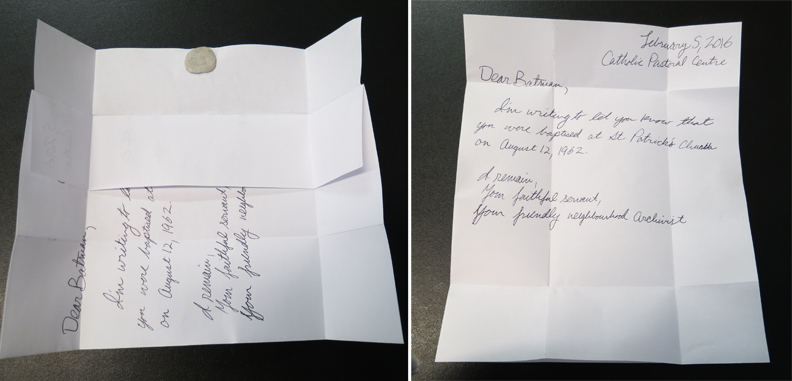
  • Self adhesive envelopes weren't invented yet, so they had to seal their letters with wax or with small discs of adhesive. There are many holes in the letters in our collection because of this.
  • Before adhesive stamps, letters were hand stamped by local postmasters. The example below was mailed July 22, 1830 from Sandwich, Upper Canada. 


Bishop Macdonell Fonds
M AB09.05
1830

By 1820 there were 19 post offices in Upper Canada. By 1831 the 'Grand Route' from Niagara to Montreal ran five times per week, and there were routes between York, Sandwich, and Amherstburgh.   

This letter set to Bishop Macdonell in Glengarry was sent at a rate of 2 shillings 4 pence, which would mean that there were 4 sheets sent at a cost of 7 pence each (12 pence in a shilling). The text of the letter informs us that there were bank drafts enclosed, but only the letter remains in the collection.
Note the cool wax seal!
Bishop Macdonell Fonds
M AB02.04
1828

A letter mailed from York, Upper Canada to Kingston, Upper Canada on November 3, 1832. The cost of sending the letter was 9 pence for one sheet at 101-200 miles, and the recipient was expected to pay for postage.
Bishop Macdonell Fonds
M AA02.18
1832

An unpaid letter mailed from Montreal to Ste. Martine on November 4th, 1834,  at the rate of 4 1/2 pence: a single sheet sent 0-60 miles.
Bishop Power Fonds
P AB01.02
1834

In 1851, the management of the postal system was transferred to the provinces, and the price of mail was was changed to be 3 pence per half ounce regardless of distance. A lot of the the note paper after this time seems to have gotten thinner!

The sender of this letter from Niagara to Toronto (note the name change!) paid 3 pence in 1854. The Money Letter stamp indicates that their was money enclosed. The recipient had to give the post office a receipt.
Bishop Charbonnel Fonds
C AB10.17
1854

In 1851, Canada issued its first adhesive postage stamp, the Three Penny Beaver, which was designed by Sir Sanford Fleming. This was the earliest example we could find in the collection. The earliest stamps didn't stick very well, so postmasters continued to use hand stamps until adhesive stamps became mandatory in 1875. 


Bishop Charbonnel Fonds
C AB12.05
1856

The first stamps issued in Cents instead of Pence were issued in 1859, following the adoption of decimal currency. Below is an example of the 'small queen' stamp. Local letters were 1 cent per half ounce. In the same year, the first street mailboxes were installed in Downtown Toronto. When Canada became a dominion in 1867, the name of the postal system became Royal Mail Canada.

Archbishop Lynch Fonds
L AH20.11
1875

In 1903 picture postcards were authorized for use in Canada:

ARCAT Photograph Collection
PH0159/22PC
1911

There is a lot more detail to the history of the mail in Canada, but there isn't enough room for all of it in this post. To find more information, check out:

The Canadian Museum of History's Chronology of Canadian Postal History

As a bonus, we recreated how a letter was folded to make its own envelope:


Friday, 29 January 2016

Year of Consecrated Life: Missionary Orders

This will be our last post marking the Year of Consecrated Life, which comes to an end on February 2nd. Over the last year we have attempted to gratefully remember some of the religious orders that have ministered in the Archdiocese of Toronto.

We are blessed to have living and serving among us more than 900 religious men and women of 100 different religious congregations. Although we could not feature them all, you can still honour these orders by observing the World Day of Prayer for Consecrated Life on Sunday, January 31 at 3 p.m. at St. Paul's Basilica (83 Power St., Toronto). This will be a special Mass to close the Year for Consecrated Life.
___________________________

This week, we highlight three missionary orders: The Missionary Oblates of Mary Immaculate, Scarborough Foreign Mission Fathers, and Our Lady's Missionaries.

The Polish Oblate Fathers (O.M.I)
Last week, the Missionary Oblates of Mary Immaculate celebrated the 200th anniversary of their order's foundation by the French aristocrat priest Eugene de Mazenod. The Oblates' first aim was to serve the impoverished parishes of Provence, whose spiritual needs had been neglected following the French Revolution and Napoleon's anti-clerical governance.

In 1841, Canada became the first foreign mission of the Oblates with headquarters in Montreal. Towards the end of the nineteenth century, the order sent for more priests from Europe who would be able to speak the languages of new immigrants to Canada.

In 1935, the first Oblates of Mary Immaculate arrived in Toronto to administer St. Stanislaus Kostka Parish.  These Polish priests were part of the Polish Oblate Province in Canada, called Assumption Province. Following World War II, thousands of Polish immigrants came to Canada and settled in Toronto.  Under the Oblates' leadership, parishioners were able to place every family that arrived.

The Polish Oblate Fathers have continued to administer St. Stanislaus and well as St. Casimir's (Toronto), St. Maximilian Kolbe (Mississauga), and St. Eugene de Mazenod (Brampton). The Assumption Province Oblates also run the Queen of Apostles Renewal Centre in Mississauga.

Read more about the Oblates in Canada in this special section of The Catholic Register.

Photographs Collection, Religious Orders Series, PH27O/01P

Group photo of the Oblate Generalate in Rome, 1949
with Cardinal McGuigan and Bishop Allen (front, 4th and 6th)

Photographs Collection, Parish Series, PH0101/16P

Archbishop Pocock celebrating Mass at St. Stanislaus Parish on the 25th anniversary of the St. Stanislaus Parish Credit Union.

The Credit Union, with its roots in social justice and charity, was instrumental in settling post-war Polish immigrants in Toronto.

Photographs Collection, Religious Orders Series, PH27O/02PC

Postcard of the Oblates' Queen of Apostles' Retreat House in Port Credit.
The location continues to be a popular retreat house in the archdiocese. 

Scarboro Foreign Mission Society
Rev. John Mary Fraser, the founder of Scarboro Missions, was a Toronto-born priest ordained in Italy to serve as a missionary. In 1902, he became the first North American priest to undertake mission work in China and, after eight years, decided the job was too large for one man.

In 1918, Fr. Fraser was permitted to establish the China Mission Seminary in the Archdiocese of Ottawa to train priests to accompany him overseas. The building soon proved too small to accommodate growing vocations so Fr. Fraser moved to the Archdiocese of Toronto. A new seminary was constructed in 1924 on the grounds of St. Augustine's Seminary, Scarborough, which allowed for shared classes. Because of its new location, the China Mission Seminary was renamed, and ordinandi called Scarboro Foreign Mission Fathers (S.F.M).

In 1949, following the Communist Revolution, all missionaries were expelled from China. The Mission Fathers changed their focus to other countries in Asia and Latin America.

In 1974, due to Vatican II reforms and declining vocations, the Mission began accepting lay men and women into their ministry. The organization is now called Scarboro Missions and defines itself as a society of Canadian Catholics, both priests and laity.


Photographs Collection, Religious Orders Series, PH27S/09P

Msgr. John Mary Fraser, founder of Scarboro Foreign Missions, in front of his new church in Fukuoka, Japan (c.1950s)

Scarboro Foreign Missions were originally based in China but all missionaries were expelled in 1949, following the Communist Revolution. Undaunted by the closure of the China mission, Monsignor Fraser soon accepted an invitation from the Bishop of Nagasaki, Japan to establish a new mission in that country. In May 1950, at 73, he left Toronto for a new life in Japan.

Sacred Objects Exchange, SOX-135

Travel size chalice and paten set with case.  The set was donated to the Archdiocese of Toronto's Sacred Object Exchange by Scarboro Missions. It was used by missionaries for celebrating mass while in transit on ships to China.

Our Lady's Missionaries
Another mission order with roots in Toronto is Our Lady's Missionaries (O.L.M).

The order of women was founded in 1949 by Msgr. Dan R. Macdonald, in Alexandria, Ontario. The first novices were trained for religious life by the Sisters of St. Joseph of Toronto. In 1956, the first graduates were invited to staff a parish school in St. Catharines (then a part of the Archdiocese of Toronto) and then provide nursing staff for a hospital. With this financing, the Order opened their first missions in Japan and Nigeria.

To address the need for low-cost housing in downtown Toronto, the Missionaries purchased the old Princess Hotel at Church and Dundas Streets.  By 1963, the building was completely renovated and reopened as the Maryglen Girls Residence, a safe-haven for thousands of young women coming to Toronto.

Our Lady's Missionaries continue to contribute dually to their home base in Canada and their missions in Brazil, Nigeria and the Philippines. They share their lives with the least privileged, focusing on children, families and women’s concerns.

This month, the O.L.M. hosted a book launch of Our Story, a history of Our Lady’s Missionaries from their beginnings until 2015.


Photographs Collection, Religious Orders Album, PH31P-228AL

Photos of Our Lady's Missionaries properties (c.1960s), including the Maryglen Residence for Young Women in Toronto.


Friday, 22 January 2016

Record of the Week: Cardinal Carter's Pallium

Yesterday Catholics celebrated the Feast of St. Agnes. From as far back as the tenth century, there has been a tradition of the Pope blessing two lambs, as shown in the video below which is from last year's ceremony:


The wool from these lambs is later used to create the pallia, which are episcopal vestments reserved for metropolitan archbishops and the Pope. The pallium is symbolic of the Good Shepherd, and of the authority of the archbishop in his jurisdiction. It is worn in his own territory; only one prelate will be wearing a pallium at a time. If the pope is in an archbishop's territory, he will be the one wearing a pallium, since his territory is universal.

The wearing of the pallium originated in early Christianity. Originally a Greek garment which was much larger and worn for warmth, Christians began wearing it as a symbol of their loyalty to the Church. It was adopted by the clergy, and was eventually given as a gift by the Pope. Over the centuries, its use was restricted to only the highest-ranking bishops, and its shape changed so that it was symbolic rather than functional.

When a new metropolitan bishop is named, he must request the pallium from the Pope within three months. Last year, Pope Francis made a change so that new metropolitans are invested with their pallia in their own sees rather than in Rome, although they are still present for the blessing of the pallia on the Feast of Sts. Peter and Paul. This practice serves to provide more involvement for the people of the local Church in the new archbishop's initiation.

ARCAT has a pallium which belonged to Cardinal Carter. It is rare for a pallium to be in an archives because they are usually buried with their owner when he passes away. However, this pallium was damaged and replaced by a new one, which was buried with Caridnal Carter.

TX 107a: Cardinal Carter's Pallium
The pallium is a white woolen circle with two two stems that hang down in front and back. It is embroidered with six crosses. 

TX 107b: The pallium folded in its case.

The pallium is held in place by three jewelled pins:

AF 355: Three pallium pins

This set belonged to Cardinal Carter to replace the set below.

AF 356: Three pallium pins
This set originally belonged to Cardinal McGuigan. When Archbishop Pocock received his Toronto pallium he used these pins, as did Cardinal Carter until he replaced them with the yellow set above. You can see this set in the photo below.


PH 18P/30CP: Cardinal Carter wearing his pallium at a large event.


Cardinal Ambrozic receiving his pallium from Pope St. John Paul II on the Feast of Sts. Peter and Paul, June 29, 1990.
PH 19P/01CP


Cardinal Ambrozic wearing his pallium in St. Michael's Cathedral, ca. 2006.
Photo courtesy of the Office of Public Relations and Communications.

For more information about the pallium and other vestments and traditions of the Church, read The Church Visible, by James-Charles Noonan Jr.

Friday, 15 January 2016

Year of Consecrated Life: The Paulists and the Catholic Information Centre

The Missionary Society of St. Paul the Apostle was founded in 1858 by five convert priests in New York City. Their ministry focused on reaching out to Protestants in North America by evangelizing in the Roman Catholic tradition.

The Paulists became renowned for their preaching style. The early order would send missionary teams to churches to conduct "Parish Missions" and this is how the community first arrived in Canada. At one such parish mission held in 1912 at St. Paul's Parish in Toronto, the Paulists drew huge crowds, resulting in the conversion of 212 Protestants. 

In 1913, Archbishop Neil McNeil invited the Paulists, under Fr. Thomas Burke, CSP, to establish and staff the Newman Centre at the University of Toronto, which they did until 1936. The following year, the Paulists agreed to administer St. Peter's Parish in perpetuity.

In 1938, Archbishop McGuigan urged the priests at St. Peter's to run instructive courses for prospective converts, which resulted in 50 to 75 conversions per year. The popularity of the courses, held in the church basement, prompted Fr. Frank Stone, CSP, to push for a purpose-built education facility. And so in 1958 the Catholic Information Centre (CIC) was built adjacent to the parish, at 830 Bathurst Street.

In addition to classes for converts, the CIC held workshops for Catholics wishing to grow in their faith, as well as marriage preparation classes for couples.

The Paulists' zeal for evangelizing and proselytizing expanded to media communications and the order became known for its radio shows, film productions and publishing presses.

By 2015 the Paulists determined that they did not have enough vocations to stay in Toronto. In June they returned to New York, and administration of St. Peter's Parish and the CIC reverted to the Archdiocese of Toronto.
Read these Catholic Register articles for a timeline of the Paulist century in Canada, and a reflection on the Paulist legacy.
The CIC building will continue to be used as a training facility by the archdiocese. During a recent cleaning of the building, a poster featuring photographs of the Catholic Information Centre was discovered and brought to the archives.

Photographs Collection, Religious Orders, PH27P/17P

Before the Catholic Information Centre was built, the Paulists held instructional classes in the basement of St. Peter's Church.
This is a photo of the "co-instructors" with Fr. Frank Stone, CSP (right) taken in 1948.
Fr. Stone initiated the building of the Catholic Information Centre.
Photographs Collection, Religious Orders, PH27P/09P and /10P

The Catholic Information Centre under construction, April to September 1958.
The CIC is located at 830 Bathurst Street, just south of St. Peter's Church, Toronto.
Photographs Collection, Religious Orders, PH27P/11P and /12P
The Catholic Information Centre under construction, April to September 1958.
Photographs Collection, Religious Orders, PH27P/13P and /14P
The Catholic Information Centre under construction, April to September 1958.
Photographs Collection, Religious Orders, PH27P/16P

Architect Lindsay Wardell's hand drawn rendering of the Catholic Information Centre, viewed from Bathurst Street, ca. 1957
Photographs Collection, Religious Orders, PH27P/15P

Catholic Information Centre, south side: equipment for construction of the Bloor subway line, 1960s. The CIC is situated across the street from Bathurst TTC station.