Friday, 27 May 2016

The Corpus Christi Riot of 1864

Thursday was the Feast of Corpus Christi, when we celebrate the real presence of Christ in the Blessed Sacrament. This Sunday, many parishes will take part in a traditional procession in which they will carry the sacrament through the streets.

In 1864, the annual Corpus Christi procession did not go well at all. In Toronto in the 1860s, tensions were high between Catholics and Protestants. This was a reflection of attitudes and events in Ireland, from where many of the city's inhabitants came. The city's Protestants were angered by public displays of Catholicism.

A May 30th, 1864 article in The Globe described how events unfolded:

"Yesterday being “Corpus Christi,” the day was as usual observed by the Roman Catholics in this city by a grand religious demonstration. The Church Street Cathedral was gaily decorated, and outside green arches were erected in front of the entrance on Bond Street, and the garden of the Bishop’s Palace, on the north side of the Cathedral, hung with numerous pictures, flags, etc. ... For some days past much apprehension has been felt of a disturbance on the occasion of the procession, which has [attracted] greater public interest in the event than usually attaches to it. Every precaution had been taken by the Mayor to prevent a riot, and to provide means to quell it in case one should occur."

As part of his precautions, Mayor Francis Henry Medcalf wrote to Bishop Lynch:

Medcalf to Lynch, May 28th, 1864:

"Rev'd Sir, This morning I have been waited on by a Deputation of the Citizens of Toronto, wishing to know of me if the Procession advertised in the Canadian Freeman of the 26th inst is to be a public one, or to be confined to the Grounds of the Roman Catholic Cathedral. 

"They also stated to me, in presence of His Honor the Recorder, that if such Procession was attempted in the public streets, they had reason to believe that it would occasion a very serious breach of the peace.

"Therefore, as Chief Magistrate of the City, I desire to learn, if you will have the kindness to inform me, whether the contemplated Procession is to be a public one, through any of the Streets of the City, and if it be, whether the "Host" is to be carried therein."

L AG01.01
Archbishop Lynch Fonds

The article continued:

"Long ere the appointed hour, the streets east, west, and south of the church were densely crowded, and the Bishop’s garden, on the north side, thronged with people. About four o’clock, numerous bodies of children, of both sexes, young women, in various uniforms, and all bearing paper flags and banners in their hands, made their appearance in the gardens, and took their places in front of a temporary altar erected on the north side of the Cathedral. ...  After his sermon he stated that ... they had a right to march through the streets if they chose ... but he deemed it best to confine the celebration to their own grounds, and no gentleman or lady would interfere with them."

Bishop Lynch was not pleased with the threat of violence, and he wasn't going to risk provoking trouble, but he was not afraid to make his opinion on the matter known in his reply to Medcalf's letter:

Lynch to Medcalf, May 28th, 1864:

"...I would inform those citizens through Your Lordship that as the free exercise of the Catholic Religion was guaranteed for the whole of Canada by treaty with England on the Capitulation of Quebec we could without infringing any law and in free exercise of our rights carry the Sacred Host through the streets of Toronto as is done in Quebec, Montreal, Ottawa and other places ... Dieu et mon droit is the motto of England and we adopt it as our own. We desire to live on good and kindly terms with our fellow citizens, and we expect a reciprocity of feeling."

L AG01.02
Archbishop Lynch Fonds 


Despite their efforts, trouble broke out:

"A few minutes after five, everything being prepared, the procession of the Host issued from the church, and wended its way round the garden towards the altar, to the solemn chanting of the clergy. Just at this juncture some person attempted to enter the gate of the garden next the cathedral doors, on Bond Street. He was refused admittance, and endeavoring to force his way in a scuffle ensued. So slight a disturbance, under ordinary circumstances, would probably have attracted little attention. But serious apprehensions of a fight existed; a great rush was made towards the fracas – the impression prevailed that the fighting had commenced – the fact was proclaimed in tones of alarm throughout the multitude, and the panic became general. All the efforts of the priests to reassure the people were unavailing. The affrighted girls broke from their ranks with screams – the poor children were terror-stricken – the spectators, chiefly ladies, were alarmed for their safety – and the scene became one of most admired confusion. The people poured from the church, some in their terror seeking safety in the vaults. A large part of the fence on Church Street was borne down by the press, and the population of the garden was soon emptied into the street. The alarm was no sooner over, however, than it was discovered to have been false – that the flight was without a pursuit. The affair in which it originated was long since over – and nobody hurt! The fire-bells began to sound the alarm, and still further accessions of force appeared upon the ground, but the excitement had died away. The procession was quietly reformed, and the ceremony proceeded..."

Bishop Lynch received many letters from political leaders expressing regret over the incident. Even Premier John A. Macdonald wrote to him:

Macdonald to Lynch, June 14th, 1864:

"My Dear Lord, I can assure you that I was much grieved to see the outrageous and riotous manner in which your religious observances were disturbed on Corpus Christi day. I have given instructions to the proper offices to make diligent inquiry into these unhappy proceedings.

"Sir Etienne Taché showed me your letter to him, and I will take an early opportunity of looking into the whole law of the matter, and particularly how far the prohibition of religious processions extends to Upper Canada."

L AG01.08
Archbishop Lynch Fonds

Though no physical harm was done, Protestant-Catholic relations deteriorated further. Over the next few decades, there were more clashes between the groups. Though the hierarchy warned them against violence, some Catholics felt that they had to defend themselves. In November of 1864, members of the Catholic Ancient Order of Hibernians heard rumours that there could be a threat from Protestants on Guy Fawkes day. As described by Fr. John Walsh to Archbishop Lynch:

"We are just now in the midst of great excitement here occasioned by the conduct or rather misconduct of the Hibernians on the 5th inst. ... It had been rumoured for some weeks past that the Orangemen would burn O'Connell's effigy on the night of the 5th inst. It had also been whispered about that the Hibernians would prevent such an occurrence at any hazard. On hearing these rumours and fearing the serious breach of peace we convened a meeting of some of the principal laymen to consult with them as to what was best to be done in the premises. ... We called upon the leading Hibernians and used every argument we could think of to dissuade them from making any demonstration whatsoever on that night, but all our arguments were lost upon them; for go they would and go they did, armed to the teeth with guns and pikes. Fortunately no collision took place between the hostile parties as the Orangemen failed to carry out their part of the programme. The Hibernians however were seen in hostile array. The cries of an intended Popish massacre were raised and hence the most fearful excitement prevails..." (L AE06.04, Archbishop Lynch Fonds)


These are only two episodes in the saga of the Irish in Toronto. Many books have been written about the Irish in Toronto, and the documents at ARCAT have been used extensively by historians of this subject. To learn more about Irish Toronto, check out some of these books:

The Waning of the Green: Catholics, the Irish, and Identity in Toronto, 1887-1922 by Mark McGowan

Piety and Nationalism: Lay Voluntary Associations and the Creation of an Irish-Catholic Community in Toronto, 1850-1895 by Brian Clarke

Friday, 13 May 2016

Record of the Week: The Pope Recovers

On this day in 1981, the Church and the world were shocked and saddened when Pope Saint John Paul II was shot while riding in an open vehicle through a crowded St. Peter's Square. It was just one in a spate of shootings at the time; John Lennon, Ronald Regan and Anwar Sadat were all victims within the same year.

In Toronto, Catholics and people from other faiths came together to pray for the Pope's recovery. His importance as a leader and advocate for peace was widely recognized.

Cardinal Carter considered Pope Saint John Paul a friend. In a letter dated June 8th, 1981, he wrote,

"You burst upon the scene of history like a meteor. Your charisma appears to be exactly what a tired world required. And we observed with admiration, and even awe, the impact which you were making on all parts of the world and in all realms of thought even among people who are far from sharing in our religious convictions. The concept of your being eliminated by this thoughtless act appeared to me to be intolerable. But I must confess that in all humility I offered myself in your place. I immediately decreed a public Mass in my Cathedral in thanksgiving for your salvation and in petition for your prompt and perfect reestablishment. I preached myself and one of the things which I said and which seems to have been very much appreciated by the gathering, which included the Greek and Anglican hierarchy, was that you were such a man that there could be no doubt that when you took the See of Peter you also offered your life in all its dimensions. And I said, "This is a very dangerous thing to say to the Lord because sometimes He takes us at our word. therefore the Pope was ready and is ready to die for the Church." This is a form of martyrdom and it is not underneath your capacity. The willingness after all is the real baptism of blood."

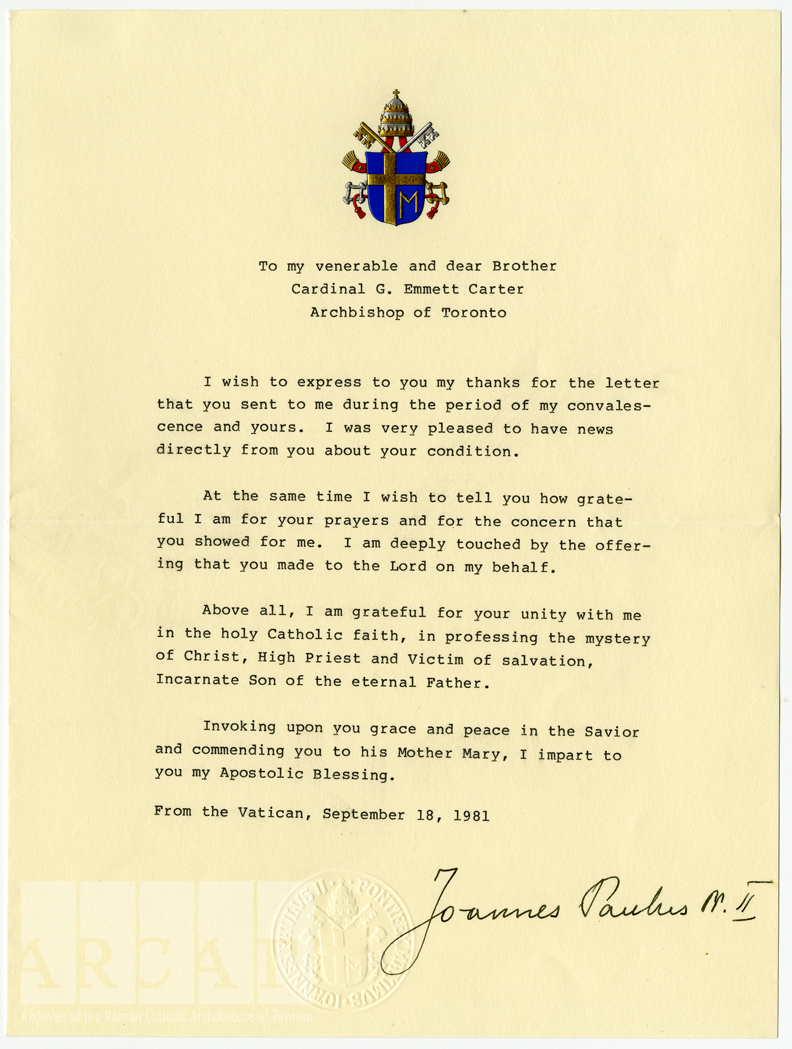
In reply, the Pope sent the letter below:

Signed letter from Pope Saint John Paul II.

September 18, 1981
Cardinal Carter Fonds

The Pope recovered fully, and went on to lead an exceptional Papacy for 24 more years. After this incident however, his security was taken more seriously (he was previously one of the most accessible Popes in history), and his 'Popemobile' was fitted with bulletproof glass.

Pope Saint John Paul II set an amazing example for us in 1983 when he visited his shooter in prison and personally forgave him. Although the shooter was sentenced to life in prison, he was pardoned by the Italian president at the Pope's request in 2000.


Friday, 6 May 2016

Records of the Week: Catholics Helping Their Neighbours

This week we have seen the devastating reports of the destructive wildfire burning in Fort McMurray, Alberta. Cardinal Collins is asking Archdiocese of Toronto Catholics to help their Albertan neighbours.

Catholics have a long tradition of donating to disaster relief funds. They donate millions every year. In 2013 alone Catholics in this Archdiocese gave $2.724 million for humanitarian aid.

We were curious to see if there were any records in the archives to show how Toronto Catholics responded when their neighbours were in need. Below are just a few examples out of many.

In 1866 Bishop Farrell appealed to Hamilton Catholics to help after portions of Quebec City were destroyed by a fire. Over 2000 homes were burned and 18,000 - 20,000 people were left homeless.

1866
L AD02.24
Archbishop Lynch Fonds

In this 1909 letter, Archbishop McEvay was raising funds for victims of the 1908 Sicilian earthquake that destroyed the city of Messina.

1909
ME AA05.08
Archbishop McEvay Fonds

This letter from the Apostolic Delegate thanks Cardinal McGuigan for Toronto's contribution of $17,335 (almost $144,000 in 2016 dollars) for disaster relief after the Chilean Valdivia earthquake, which is the strongest earthquake ever recorded.

1960
MG DS 62.20b
Cardinal McGuigan Fonds

In 1950 the Red River flooded, causing much damage to Winnipeg. Cardinal McGuigan sent a cheque for $15,000 ($156,000 in 2016 dollars) to the Archdiocese of Winnipeg.

1950
MG FA16.35b
Cardinal McGuigan Fonds

In 1917 Halifax was devastated when a munitions ship exploded in the harbour. Archbishop McNeil instructed the Pastors of Archdiocese to take up a special collection to send to Nova Scotia.

1917
MN PC05.04
Archbishop McNeil Fonds

In this letter, Archbishop McNeil asked the Pastors of the Archdiocese to take up a special collection for victims of the 1923 earthquake on Japan's main island. He asked the Pastors to discuss the catechism with parishioners: "If we are bound to help our neighbor in case of material need, no matter how far that neighbor may be from us in race or creed or distance, much more are we bound to extend to him the charity of prayer and other spiritual benefits."

1923
MN PC11.15
Archbishop McNeil Fonds


In the words of Bishop Farrell: "If you are rich, give generously; if you are poor, give willingly the little you can afford, remembering that in giving to the poor you are lending to the Lord, who will not fail to pay you back a thousand fold."

Friday, 29 April 2016

The Humidification Chamber: conserving photographs and documents

In January, we blogged about photographs we had recently acquired after they were discovered at the former Paulist Ministry Centre (previously the Catholic Information Centre).

The photographs were part of a poster entitled "1957-1958 Building the New Information Centre." Receiving this poster gave us an opportunity to practice some basic conservation and use our favourite device: the humidification chamber.

This inexpensive tool is remarkably effective for softening documents and photographs that have been rolled or creased so they can be flattened. Essentially, a humidification chamber is a sealed container that holds moisture, while preventing the documents from actually coming in contact with water.

In this case, we wanted to see if humidity would soften the glue that was used to adhere the photos to the poster board.


This was the original poster when it was transferred to the archives. There were twelve photographs glued to a banged-up piece of foamcore, along with some labels. The bottom photo was missing.

We appraised the contextual value of keeping the poster in this format: the glue and the foamcore were not archival quality; the poster was not particularly informative or aesthetically significant; it would require a large storage space. Therefore, we decided to remove the photos and discard the backing, but first we took this photo for reference.

Two of the photographs are duplicates: can you spot the matching pair?

When we first went through the humidification process, we used only the two duplicate photos to make sure it would work safely. After successful results, we humidified the remaining ten photos.

Here is our step-by-step process:

Step 1: Using a knife, cut the poster into smaller pieces containing the individual photos.


Step 2:
Seal the photographs in the humidification chamber.


The chamber is a closed container that holds humidity, while preventing the documents from actually coming in contact with the water.

Our chamber is made from a storage bin with cooling racks (used for baking) raised off the bottom and secured to the walls with zip ties. Photos are placed on the racks, an inch of water is poured into the bin and plastic sheeting is secured with masking tape to seal in the air. 
As the water slowly evaporates at room temperature, the surrounding air becomes very humid and the documents absorb the moisture.


Step 3: Let the humidity work its magic. Check on the material periodically.

Materials absorb humidity at different rates. The clear container allowed us to check for progress. Over the course of the day, the photographs buckled and pulled away from the backing, indicating that the glue was sufficiently softened.


Step 4
: Lift the photographs from the backing using a conservator's scalpel. In this case, they peeled right off.


Step 5
: Place the moistened items between sheeting to be pressed.

The photos were placed on Reemay, a polyester used as a support for drying materials because it's non-stick. This was important because the glue on the back of the photos was reactivated by the humidity and quite tacky. Paper towels were placed on top of the Reemay, as a blotting material to absorb moisture.


Step 6
: Press the moistened documents between so they dry flat. Leave overnight.


Step 7
: Remove dry material from the press.

Bonus: we discovered extra labelling on the back of the photographs which helped us to further identify, date and describe the items.


Step 8
: Rehouse and store the material.

The photos were placed in plastic sleeves, housed in acid-free archival boxes, and stored in climate controlled storage.

We have also had success using the humidification chamber for flattening rolled blueprints.  We do this specifically for architectural drawings that are crumpled, torn and brittle, which makes them very difficult to flatten for viewing.


Architectural Drawings Special Collection, ARCH 008 C

Fragile and damaged 1926 blueprints of Corpus Christi church, Toronto, are placed in the humidification chamber overnight.


The blueprints absorb moisture, making them pliable enough to be unrolled and pressed so that they dry flat. 

(In this case, scotch tape had been previously used in spots to repair the tears. Unfortunately, the humidity had little effect on the tape's adhesive. We decided to leave it rather than risk further damage by trying to remove it.  Never use tape on important records! Tape is the bane of archivists' existence.) 


After drying overnight, the flattened drawing is supported with museum board, interleaved with acid-free tissue and stored flat in an oversize archival box.

DIY humidification chambers can be made in a variety of ways. You can use a sink or nesting storage bins. Read more on how to make a humidification chamber

Friday, 22 April 2016

Canada Book Day 2016

Tomorrow is Canada Book Day, which coincides with UNESCO's World Book and Copyright Day, an annual celebration to promote reading, publishing and the protection of intellectual property through copyright.

April 23rd was chosen for its significance to world literature. Both William Shakespeare and Miguel de Cervantes died on April 23, 1616, making this year the 400th anniversary of their deaths. It is also the birth or death date of several other international authors.

In honour of Canada Book Day, we offer selections from the Sol and Morton Eisen Book Collection, which was donated to the Archdiocese in 2010. 

Sol Eisen (1898-1974) was a Toronto lawyer and rare book collector who specialized in Americana, Mexicana, Canadiana and early printing. Sol Eisen's Canadiana collection was donated to the University of Waterloo in 1992. The majority of the books donated to ARCAT relate to the history of the Church and Sol's son, Morton Eisen, wanted to return them to a Catholic repository.


Sol and Morton Eisen Book Collection
Cartilla Y Doctrina Christiana by Fray Bartholomé Roldán, O.P., Mexico, 1580

Example of the "Ex Libris Sol Eisen" bookplate attached inside many of the books' covers. Eisen's collecting focus included Mexicana.
This is one of eleven books in the collection that were not digitized because they were too fragile for scanning equipment.

Digitization of thirty-one books was generously sponsored by the John M. Kelly Library; they are available through https://archive.org/details/archdioceseoftoronto. The remaining eleven books in the collection were deemed too fragile or stiffly bound for the scanning equipment to be used safely on them. 


Sol and Morton Eisen Book Collection
Breviloquium of St. Bonaventure, Venice, 1472

Four of the books in the collection are incunabula, which means "from the cradle" or infancy of printing, specifically those printed in Europe before 1501. The Breviloquium is the earliest book in the collection and an example of Bonaventure's classic writings on theology and prayer.

St. Bonaventure (1221-1274) was a pivotal figure in the early development of the Franciscan Order and of the entire Western Church. A contemporary of St. Thomas Aquinas, Bonaventure studied and taught at the University of Paris. As Master General of the Order in the years after the death of St. Francis, he was crucial to the developments that made the Franciscans one of the most active and influential teaching, service and missionary orders in the Catholic Church. Later named a Cardinal by Pope Gregory X, he played a major part in the union of the Eastern and Western Churches at the Council of Lyon (1274).  He was named a Doctor of the Church in 1587.    

Sol and Morton Eisen Book Collection
De Psalmodia Christiana Y Sermonario De Los Sanctos Del Ano by Bernardino de Sahagún, Mexico, 1583

This is considered the most valuable book in the collection. It is a first edition written almost entirely in Nahuatl by Franciscan Fray Bernardino de Sahagún (1499-1590). De Sahagún, a Spanish Franciscan missionary in Mexico, wrote catechetical and liturgical books in the language of the Aztec people to whom he ministered. Famous in Mexico and among historians and other social scientists of the Americas, he is also often called the first ethnographer, since he did a broad and systematic study, by interviews with Aztec people, of the culture, social structure, art, religion and other key aspects of their society prior to European contact.  

Sol and Morton Eisen Book Collection
Arte De La Lengua Mexicana con la Declaracion De Los Adverbios Della...,by Padre Horacio Carochi, Mexico, 1645

This first edition by Jesuit priest Horacio Carochi, Rector of the College of Saint Peter and St. Paul de Mexico, is an academic teaching tool in the Nahuatl Aztec language itself. 

Sol and Morton Eisen Book Collection
Viage De Jerusalen Que Hizo Francisco Guerrero, Racionero, y Maestro de Capilla de la Santa Iglesia de Sevilla by Francisco Guerrero , Seville, 1694

This is a travel memoir through Jerusalem written by a 70-year-old Spaniard who had had a highly significant career as chapel master and composer of sacred music.  First published in 1590, the book being republished in 1694.

Its stiff leather cover and bindings made this book too difficult to digitize.

Why not celebrate Canada Book Day by visiting the Thomas Fisher Rare Book Library? To mark the 400th anniversary of Shakespeare's death, the library is holding a special opening of  the exhibition So long lives this’: A Celebration of Shakespeare’s Life and WorksHighlights include a selection of Shakespeare's printed plays and poems from the library's collection.

Thursday, 14 April 2016

Obscure Ecclesiastical Objects 101: The Results are In

Thank you to everyone who took the time to respond to our quiz here on Blogger, as well as on the Archdiocesan Instagram and Facebook pages. We were very impressed by your knowledge. A+ work!

#1: Chrism Oil Stock
This container is used to hold holy oil. The engraved letters "S.C." indicate that the oil in this container was Chrism (Sanctum Chrisma), which is used to anoint candidates for confirmation and holy orders, and during various blessings. Oil stocks generally come in a set of three, to hold the above mentioned oil, the oil of catechumens, and the oil of the sick. All three of these oils are blessed at the chrism mass on the morning of Holy Thursday.

This particular oil stock is sterling silver, and was made circa 1875 by the Benziger Brothers of New York.
AF22

#2: Bugia

This gilded, handled candlestick was used with a beeswax candle during mass. It was held by a server or attendant to the right of the book that a prelate was reading from during some liturgical celebrations.

This bugia was donated to ARCAT by the Sisters of the Good Shepherd and is dated to the 1920s.
AF83

#3: Sick Call Lamp

This candle holder with hurricane glass and bell set was meant to be used during sick calls to indicate that the blessed sacrament was being carried from the church to the home of the sick person.

This item dates to the 1920s.
AF88

#4: Sanctus Bells

The sanctus bells are so named because they were originally rung during the mass in two places: during the sanctus, and at the consecration. Because the mass was said in Latin, the bells were used to help the congregation understand when Christ became present in the consecrated sacrament.

This set of chimes dates from the 1920s.
AF91

#5: Thurible

The thurible is an incense burner that is swung on chains by the thurifer during the mass. The use of incense goes back to ancient Judaism, and helps to create an atmosphere of reverence and sacrifice.

This item dates to the 1880s, and was donated by the Sisters of St. Joseph of Toronto.
AF163

#6: Incense Boat

The vessel that holds the incense that goes in the thurible.

This item also dates to the 1880s and was donated by the Sister of St. Joseph.
AF164

#7: Sanctus Gong

The sanctus gong has the same purpose as the sanctus bells, but is rarely used today.

This item was donated by the Congregation of St. Basil and was used in their chapel at Clover Hill, Toronto.
AF237

#8: Pyx

Pyxides are containers used to carry the Blessed Sacrament when communion is given outside of the mass; for example, during sick calls. The pyx above is pictured with its carrying case, which would be tied around the priest's neck.

AF296

#9: Pax

The pax - also known as a pax-brede, pax-board, paxillium or osculatorium - dates from medieval times. Instead of the sign of peace, the kiss of peace was used. The pax would be passed around to the faithful to be kissed, and would often depict the crucifixion, the ressurection, the ascension, or the agnes dei.

This pax belongs to the Congregation of St. Basil, and dates from the late 1800s.
Courtesy of the General Archives of the Basilian Fathers

#10: Communion Paten

The communion paten is a precious metal plate with a handle. It is held under the chin of a person receiving communion to catch any stray particles of the blessed sacrament. It was more commonly used when communion was received on the tongue.

This communion paten was donated to the Sacred Objects Exchange.
SOX189


Friday, 8 April 2016

Obscure Ecclesiastical Objects 101: Final Exam

At colleges and universities across the country, classes are wrapping up and students are getting ready to take their final exams. We felt inspired to come up with a quiz for you, dear readers.

Below you will find photos of objects from our collection. Some may be recognizable, but some won't be as familiar to you. See how many you can name, and come back next week for the answers. Good luck!

#1.
AF22

#2
AF83

#3
AF88

#4
AF91

#5
AF163

#6
AF164

#7
AF237

#8
AF296

#9
Courtesy of the General Archives of the Basilian Fathers

#10
SOX189