Friday, 28 December 2018

Record of the Week: Missale Romanum

I've said it before, and I'll say it again: the best part of this job is coming across cool things that we didn't know we had. Like a lot of archives, not everything in our collection is in our database, so when we're looking for blog ideas some items don't pop up for discovery as easily. For this post, I was looking through the paper finding aid of our collection of missals, and noticed that we have one that was printed in Paris in 1683 with the note "used for the first mass at Old St. Paul's in 1824." We were all blown away. We didn't know we had something this awesome in a box in the basement! 

We don't have absolute proof that this was the missal used at that first mass, but it is certainly a well-used volume, and we had a lot of fun flipping through the pages.


The missal is covered with brown leather, and it looks like it had some kind of clasp at one time:

Front cover of the 1683 Missal

MS36
ARCAT Special Collections

The title page is beautifully illuminated with cherubs, and it looks like it got too close to a candle at some point:

Published in Paris in 1683

MS36
ARCAT Special Collections

The next page confirms the St. Paul's origin:

This belongs to the Catholic church of York, U.C. When you're the only church in town, you don't have to mention your name!

MS36
ARCAT Special Collections


The beginning of the book has charts to help readers figure out the liturgical year:

This is what they had to use before Google

MS36
ARCAT Special Collections

Instructions for the priest seem to be printed in red, and the words he says aloud are printed in black:

The Order of Mass

MS36
ARCAT Special Collections

Do you recognize this part of the mass? 

Sanctus, Sanctus, Sanctus, Dominus Deus Sabaoth. Pleni sunt caeli & terra gloria tua, Hosanna in excelsis. Benedictus qui venit in nomine Domini. Honsanna in excelsis.

MS36
ARCAT Special Collections

The missal uses the square notation of Gregorian Chant:

MS36
ARCAT Special Collections

The missal contains several historiated initials, which are first letters of paragraphs containing scenes: 

Historiated initial showing the Last Supper

MS36
ARCAT Special Collections

There are also several lovely engravings decorating the pages:

Behold the Lamb of God

MS36
ARCAT Special Collections

MS36
ARCAT Special Collections

MS36
ARCAT Special Collections

MS36
ARCAT Special Collections

MS36
ARCAT Special Collections

Now it's time for me to learn Latin so I can read this without having to use a translator!

Friday, 21 December 2018

Celebrating Christmas Mass

Christmas is, next to the Easter Triddum, the most important Mass celebration in the Catholic Church. Parishes traditionally prepare for several different Masses for Christmas Eve and Christmas Day, and each celebration will have a unique character defined by the time of day when it is to take place.

I recently found a small program for Christmas Mass Times at St. Michael's Cathedral from 1934. I was instantly drawn to the illustration on the cover and thought it would be appropriate to share ahead of the Christmas holidays.

"Jesus, sweetest Child born in Bethlehem of Mary ever Virgin, swathed in rags, laid in the manger, announced by angels, visited by shepherds, have mercy upon us.

Jesus, sweetest child, made known to the three Magi by a star, adored in the arms of thy Mother, presented with the mystic gifts of gold, frankincense and myrrh; have mercy upon us. -- From 'the Raccolta'"

Christmas Mass times, 1934. St. Michael's Parish Files. Archives of the Roman Catholic Archdiocese of Toronto.


Christmas Mass times, 1934. St. Michael's Parish Files. Archives of the Roman Catholic Archdiocese of Toronto
 
If you are interested in celebrating this Christmas at the Cathedral, here are this year's Christmas and New Year's Mass times.
 
You can also read more about the history and traditions of celebrating Christmas Mass on the website of the CCCB here.

Friday, 14 December 2018

God's Christmas Gift to Man

As the cold weather sets in and Christmas appears less than two weeks away, the streets and malls are gradually filling up with a frenzy of holiday shoppers. For some, you may still be brainstorming ideas of what gifts to get for the loved ones on your list.

This week, with the gift-giving nature of this holiday in mind, I went searching in our archives. If you're facing the cold and the crowds this weekend: good luck. In the meantime, enjoy this lighthearted Christmas hymn titled, "God's Christmas Gift to Man" by A. Farmer:

"God's Christmas Gift to Man" by A. Farmer
[before 1934]
Archbishop McNeil Fonds
MN PB03.08
 

Friday, 7 December 2018

A Singular Grace and Privilege Granted by Almighty God

December 8 is the Feast of the Immaculate Conception, when we celebrate the beginning of Mary's original-sin-free life. Though Church Fathers and theologians spoke of and debated Immaculate Conception for centuries, Pope Pius IX formally enshrined the idea in Catholic dogma on December 8th, 1854 in his bull Ineffabilis Deus:
"Wherefore, in humility and fasting, we unceasingly offered our private prayers as well as the public prayers of the Church to God the Father through his Son, that he would deign to direct and strengthen our mind by the power of the Holy Spirit. In like manner did we implore the help of the entire heavenly host as we ardently invoked the Paraclete. Accordingly, by the inspiration of the Holy Spirit, for the honor of the Holy and undivided Trinity, for the glory and adornment of the Virgin Mother of God, for the exaltation of the Catholic Faith, and for the furtherance of the Catholic religion, by the authority of Jesus Christ our Lord, of the Blessed Apostles Peter and Paul, and by our own: "We declare, pronounce, and define that the doctrine which holds that the most Blessed Virgin Mary, in the first instance of her conception, by a singular grace and privilege granted by Almighty God, in view of the merits of Jesus Christ, the Savior of the human race, was preserved free from all stain of original sin, is a doctrine revealed by God and therefore to be believed firmly and constantly by all the faithful.""

Mary holds a special place in the hearts of Catholics, and our love for her comes through in art, music, literature, and prayer. We were especially impressed by the altar that was decorated at St. Michael's Cathedral for the Feast of the Immaculate Conception in 1908:

Immaculate Conception Altar at St. Michael's Cathedral

December 8, 1908

PH102/0001/166P
ARCAT Photograph Collection

Immaculate Conception Altar at St. Michael's Cathedral, detail.

December 8, 1908

PH102/0001/166P
ARCAT Photograph Collection

Perhaps parishioners said the words of this 11th century prayer in front of this beautiful altar:
O Mary, you are inviolate, pure and without stain, you who became the glistening gate of heaven. O most dear and gracious Mother of Jesus, receive our modest songs of praise.
We beg you with heart and lips: make our bodies and our souls pure. By your sweet prayers, obtain eternal pardon for us. O Mother most kind! O Queen! O Mary! Who alone remained inviolate!

For more on the history of the Immaculate Conception dogma, check out articles from the International Marian Research Institute here and here.

Friday, 30 November 2018

Exhibit A: You can't always get what you want

Sometimes I can't help but hum the song from the Rolling Stones to myself when people request graphic material from us.

Everyone loves to see photographs of the past, and photographs of our bishops, parishes, priests, and various events to can help bring Toronto’s early Catholic history to life.

Unfortunately, we don’t always have photographs and portraits people are requesting. Photography was not accessible, never mind affordable, for most people until the late 1800s, when photography equipment and techniques drastically improved.

Finding visual documentation for the history of our Archdiocese is therefore a bit of a challenge.

For example, we at ARCAT have always wished for is a better portrait of our first Bishop, Bishop Michael Power. In our collection we only have photographs of a portrait belonging to St. Michael's Cathedral. If you call looking for a portrait of Bishop Power, we're going to send you this:

Photograph of an original painting of Bishop Michael Power

PH02/01CP

If you’re a follower of our blog you have probably seen his portrait before. Bishop Power died in 1847, before photography was popularized. And the portrait was painted in the 1930s, well after Bishop Power’s death. Although it’s beautiful, it’s never stricken me as exactly the most realistic portrait there is.

There is nothing else we can really pull from our archives when we're asked for publishable graphic of Bishop Power. We know of two other portrayals of Bishop Power that we found in books in our reference library, but unfortunately don't know who owns the originals, or if the originals still exist for that matter. And both books were published well after Bishop Power's death, so we don't know where the illustrations came from, when they were created, and how accurate they are. There are similarities between all three portraits of Bishop Power, and maybe through comparison we can better visualize what he would have looked like.

Bishop Michael Power's portrait and coat of arms, as published in  Armorial des Ă©vèques du Canada : album historico-hĂ©raldique contenant les portraits et les armoiries des Ă©vèques du Canada depuis Mgr de Montmorency de Laval jusqu'Ă  date avec notice biographique pour chacun by GĂ©rard Brassard.. [1940]

ARCAT Reference Library, 282.092 BRA 1940

Bishop Michael Power as illustrated in  Jubilee Volume - The Archdiocese of Toronto and Archbishop Walsh 1842-1892 edited by J.R. Teefy, 1892

ARCAT Reference Library, 282.713 TEE 1892

The illustrations we have, or rather don't have, for Bishop Power extends to other people, landmarks and subjects from our early days. While we will try to find something when we're asked for a photograph, sometimes, you're going to be disappointed.


Friday, 23 November 2018

Today's Breakfast: Surreal

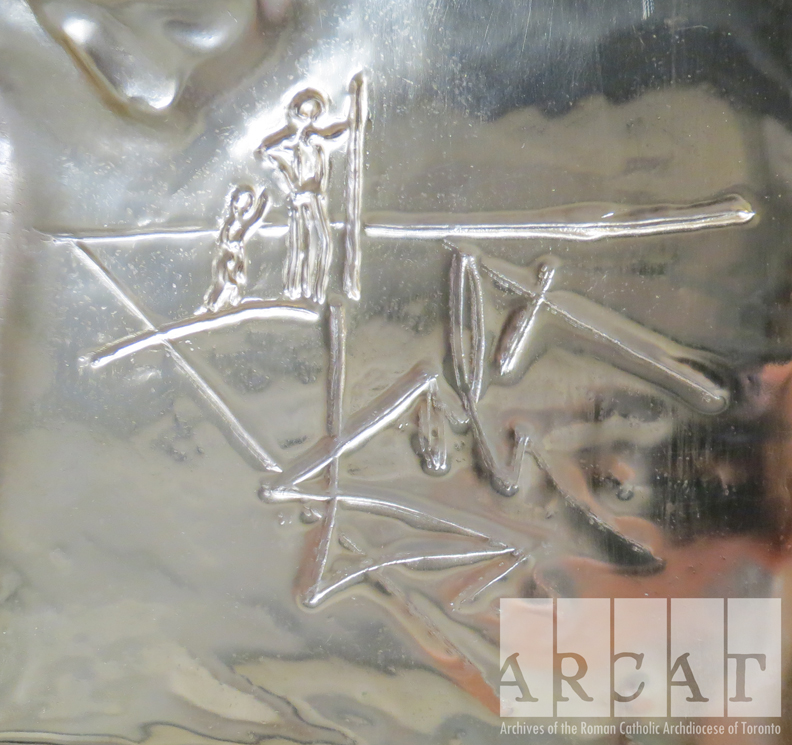
I started working in the Archives Department at the Archdiocese about 3 weeks ago. Within that time, I have been settling in and familiarizing myself with the extensive and varied holdings preserved here. While exploring our database one afternoon, my eyes suddenly landed on the word, “Dali”. It was Salvador Dali listed as a creator, and the item was an original relief wall sculpture located in one of our storage rooms. As a huge Salvador Dali fan myself, I immediately darted to its location and feasted my eyes upon this original work by the artist.

Relief wall sculpture mounted on velvet in a gold frame

AW82
Artwork Special Collections

AW82
Artwork Special Collections 

Titled, “Christ of St. John of the Cross”, the sculpture has been done in gold patina and hangs at a modest size of 76 x 46 cm. This sculpture happens to be one of many copies produced by Dali between the years 1951-1983 from a single master mold. The gold patina version was specifically limited to two editions of seventy-five sculptures each, and our friend sits at number 5 of the first edition. Other versions include platinum, silver and bronze patina.

Edition and copy number

AW82
Artwork Special Collections

The relief wall sculpture, "Christ of St. John of the Cross”, was originally developed from a painting by Dali of the same name, as seen below:
Christ of St. John of the Cross. c. 1951.
Oil on canvas. 204.8 x 115.9 cm.
Kelvingrove Art Gallery and Museum, Glasgow.
Digital photo taken from Gala-Salvador Dali Foundation. Cat. No. 667.

As one can see, the sculpture and the painting bear a striking resemblance to one another, sharing the central image of Christ with a boat and fishermen at the bottom of the image. Dali's inspiration for this painting, and ultimately the sculpture, came from two places: a drawing done by Saint John of the Cross, a 16th century Carmelite priest, after he had seen a vision of Christ during prayer (view it here); and the vision that Dali, too, had experienced when he dreamt of an image of Christ on the cross.
At the bottom of his studies for his painting, Dali wrote: 
“In the first place, in 1950, I had a ‘cosmic dream’ in which I saw this image in color and which in my dream represented the ‘nucleus of the atom’. This nucleus later took on a metaphysical sense; I considered it ‘the very unity of the universe’, the Christ! In the second place, when, thanks to the instructions of Father Bruno, a Carmelite, I saw the Christ drawn by Saint John of the Cross, I worked out geometrically a triangle and a circle, which aesthetically summarized all my previous experiments, and I inscribed my Christ in this triangle.”

Close up of figures and Dali signature

AW82
Artwork Special Collections

When the original painting was first exhibited, it was deemed “banal” by an important art critic and was not well received as it broke from the artist’s more surrealist techniques. Several years later in 1961, the painting would be slashed by a visitor while hanging in the Glasgow Museum. This did not deter Dali from creating hundreds of these relief wall sculptures. The painting has since been repaired and continues to have a profound effect on its viewers.
ARCAT received its relief wall sculpture through a donation in 2003 from the Estate of G. Emmett Cardinal Carter.

Friday, 16 November 2018

A Pleasant Journey Across the Pacific

This month Scarboro Missions celebrated its 100 year jubilee. Today we're sharing a few photos that the society's founder, Monsignor John Fraser sent to Cardinal McGuigan from Japan. The group's original purpose was to train priests to send to China, but Catholic missionaries were expelled from that country at the end of the 1940s. Instead, Fraser accepted the task of rebuilding a church in Nagasaki, Japan that had been destroyed in 1945.  

After leaving Toronto in May, Monsignor Fraser arrived in Tokyo on June 11, 1950:

"Tokyo, June 11, 1950

"Your Eminence,

"After a pleasant journey across the Pacific I arrived in Japan today. In a few days I leave for Nagasaki, a two days' journey by train to begin the repairs on the bomb-blasted church. 

"Humbly in Xo J.M. Fraser"

PH27S/45P
ARCAT Photo Collection

After arriving in Nagasaki, Fraser sent some souvenir photos of the recovering city and its harbour. 

A 1950s panorama of Nagasaki.

PH 27S\43P
ARCAT Photo Collection

A closeup of the church that Monsignor Fraser helped to rebuild. Getty Images has a 1920s photo from the same perspective.

PH 27S\43P
ARCAT Photo Collection

Another shot of Nagasaki by night.

PH 27S\44P
ARCAT Photo Collection


Over the next few years, Monsignor Fraser built churches in Fukuoka and Osaka.

Monsignor Fraser with parishioners at Mary Mother of God Church in Fukuoka, Japan.

[1955-1956]

PH27S\39P
ARCAT Photo Collection

Monsignor Fraser spent his life dedicated to spreading the Good News, and that spirit endured through 100 years of the Scarboro Missions. In a sermon during a mass held to send of young missionaries he said, "It is consoling to see that in this age of materialism and religious indifferentism, there are still generous souls consecrating the best of themselves, not for temporal interests, nor for political reasons or personal endeavours, but to enlighten people in truth and justice and charity." May that spirit continue!