Friday, 22 February 2019

The Venerable Cardinal Mindszenty

The cause for Cardinal Mindszenty's canonization advanced last week as the Vatican officially named him Venerable.

József Cardinal Mindszenty (29 March 1892 – 6 May 1975) was leader of the Catholic Church in Hungary. He held the titles of Prince Primate, Archbishop of Esztergom, and Cardinal at the time of his arrest in December 1948 by the Communist government of Hungary .  He was sentenced to life in prison as an enemy of the state, which was a significant turning point in his decades long struggle for religious and democratic freedom in Hungary.
 
Cardinal Mindszenty would visit Toronto twice, once in 1947 during his trip to Canada for the Marian Congress, and once during a North American tour in 1973.
 
We have quite a few files on Cardinal Mindszenty, his visits to Canada, and his arrest. The documents include photographs, newsclippings, ephemera, and correspondence between Cardinal Mindszenty and our Ordinaries at the time of his arrest and exile, Cardinal McGuigan and Archbishop Pocock. Below are a few items that resonated with me:
 
Cardinal Mindszenty celebrates Mass with Toronto's Hungarian faithful at St. Elizabeth of Hungary parish, 1947.

PH 35M/09P


Prayers for the Persecuted leaflet that was distributed soon after the Cardinal's arrest in 1948.

This leaflet uses a dramatic shade of red, which is now associated with Communism. Red is used here as the colour of the Cardinalate and to symbolize the blood of martyrs.

MG SP24.29b  
"They will send you before the Tribunals (Mark 13:9)" Our Lady of the Cape, March 1949

This issue is dedicated almost entirely to Cardinal Mindszenty, describing his life, his visit to Canada and the significance of his arrest.

MG SP24.32
 
 
You can also catch glimpses of the Cardinal at the Marian Congress in the video footage we posted last month.

Friday, 15 February 2019

The Family Bible

On Monday February 18th, we celebrate Family Day. Schools will remain closed from the weekend, most people get the day off work, and families of all definitions are encouraged to get together just for the sake of it.

Whether it's accepting donated items from the relatives of clergy members or finding Sacramental Records for soon-to-be-married couples, here at ARCAT we encounter the concept of family in a number of ways. One way in particular is through the multitude of genealogy requests we receive. Genealogy is the study of family history and requires the searcher to trace a family's lineage through oral histories, historical records, and other records that shed light on a person's ancestry.

Sacramental Records such as marriage certificates prove to be a rich resource for genealogists, along with birth and death certificates from government archives. However, mandatory government-implemented vital records registration only traces its roots back to the 19th century. In Canada, the Census and Statistics Act was first passed in 1847, providing for a decennial census and the registration of births and deaths. Legislation enforcing the registration of these life events with civil authorities was passed by various provinces between 1864-1905.

For vital records that pre-date mandatory vital records registration, where might a genealogist search for proof of lineage? The answer for many genealogists is the Family Bible.

Prior to the 20th century, the Family Bible was a staple in households and acted as the official place for a family's vital records. These books were often given as gifts to married couples or passed down through generations, allowing members to record their marriage, births of children, family deaths, and other vital family events. These sections for family history were found either at the back of the bible or in between the first and second testament.

Enjoy three family bibles from our collection:

1. The Holy Bible (Family Bible), published in Philadelphia by John E. Potter and Company.


The Holy Bible (Family Bible). Philadelphia: John E. Potter and Company. (Appropriation of Archbishop James F. Wood of Philadelphia).

1883 or earlier

RB.30
Special Collections: Rare Books

Page for Marriage Certificate

RB.30
Special Collections: Rare Books

Pages for births

RB.30
Special Collections: Rare Books

Pages for deaths and marriages

RB.30
Special Collections: Rare Books

Pages for family portraits

RB.30
Special Collections: Rare Books

Bonus genealogical resource! Note Adam is listed first as 'created'.

Genealogy of the Patriarchs

RB.30
Special Collections: Rare Books

2. The Holy Bible Translated from the Latin Vulgate, published in New York by D & J Sadlier.


The Holy Bible Translated from the Latin Vulgate. New York: D & J Sadlier. (Appropriation of Right Reverend Dr. Hughes, Bishop of New York).

Mid-19th Century

RB.60
Special Collections: Rare Books

Pages for family records - annotations by previous owner

RB.60
Special Collections: Rare Books

Names and news clipping recorded under 'Deaths'

"MACMILLAN. - On January 24th., at Tarbolton, Co. of Carleton, Ont., at the age of 101 years, Mary MacMillan, relict of the late John MacMillan, of Glengarry, for many years and elder of the Scots Church Lochiel. Mrs. MacMillan was a native of Lochaber, Scotland. She immigrated with her husband to Canada in 1791, at the age of 22 years. Of her 15 children, 8 survive her; the eldest being 80 years of age. She leaves 138 grand, and 185 great grandchildren. Mrs. MacMillan was aunt to the late Mr. McDonald, of the Montreal Transcript."

RB.60
Special Collections: Rare Books

15 children, 138 grandchildren and 185 great-grandchildren. Can you imagine?!

"Died at Alexandria on the 31st of September after a lingering and painful illness.
Catherine McDonald, a native of Glasgow, Scotland but a resident of Glengarry since 1815.
Deceased was a sister of the late Donald McDonald (Proprietor Montreal Transcript) widely known in this city."

RB.60
Special Collections: Rare Books

List of names

RB.60
Special Collections: Rare Books

Bonus leaf from the family tree...

Pressed leaf found within the pages

RB.60
Special Collections: Rare Books


3. The Devotional Family Bible with Practical and Experimental Reflections on Each Verse of the Old and New Testament, and Rich Marginal References, published in London & New York by George Virtue.


The Devotional Family Bible with Practical and Experimental Reflections on Each Verse of the Old and New Testament, and Rich Marginal References. London & New York: George Virtue. 2 volume set.

ca. 1880

RB.66a&b
Special Collections: Rare Books

Page for family record - marriages

RB.66a&b
Special Collections: Rare Books

Pages for births and deaths

RB66a&b
Special Collections: Rare Books

Page for births - close up on illustrations

RB.66a&b
Special Collections: Rare Books

Page for miscellaneous - close up of illustrations

RB.66a&b
Special Collections: Rare Books

Friday, 8 February 2019

Record of the Week: The Late Pope Pius IX

On February 7th, 1878, Pope Pius IX died. Archbishop Lynch saved the February 16th issue of Canadian Illustrated News commemorating the late pontiff:

The Late Pope Pius IX.

February 16th, 1878

L AJ01.01
Archbishop Lynch Fonds


Pope Pius IX Fast Facts:
  • He was history's longest serving Pope, from June 16th, 1846 to February 7th, 1878.
  • He was the last sovereign of the Papal States, which were seized by the Kingdom of Italy over several years ending in 1870.
  • He was known as 'Pio Nono.'
  • He convened the First Vatican Council, which defined Papal Infallibility.
  • He defined the Dogma of the Immaculate Conception.
  • He brought rail service to the Papal States, and his private rail cars are on display in Rome.
  • He raised Toronto to a metropolitan see in 1870, making Bishop Lynch an Archbishop. 
  • He created 17 dioceses in Canada.  
  • He was the first pope to be formally photographed.
  • He suffered from epilepsy.
  • He was beatified September 3rd, 2000, by Pope Saint John Paul II. 
Read the article inside the newspaper about Pope Pius IX here.

Friday, 1 February 2019

A Day for Rest and a Day for Football

Watching the Super Bowl is an annual tradition for many of us, and Sunday Night Football is such a part of our weekly routine, that it might come as a surprise to hear that Ontario banned commercialized sports on Sundays until well into the twentieth century.

Blue Laws  were a way for governments to restrict work, trade, and leisure on Sundays, which for Christians is the day set aside for worship and rest. These types of laws were common throughout North America and Europe. In Canada, Prime Minister Sir Wilfrid Laurier introduced the Lord’s Day Act. The act passed in 1907 and prohibited sport, entertainment and most commerce on Sundays, ensuring that most businesses close for the day.

In 1950, Toronto held a referendum to determine if the law should change to allow for commercialized sports on Sundays. The proposed change was pretty controversial in its day; citizens formed groups lobbying for the restrictions to remain in place. Cardinal McGuigan voiced support for the Lord's Day Alliance and the Toronto Citizens Committee Opposing Commercialized Sunday Sports. As you can see in the pamphlet below, most of the arguments against Sunday Sports are based solely on religious beliefs.

 
"Read what Prominent Citizens have to say...they all say NO!"
Leaflet against Sunday Sports, c. 1949
 
MG PO05.14c
Cardinal McGuigan Fonds

We have a couple of letters addressed to the Cardinal that show not all Toronto Catholics agreed with his viewpoint. The writer below presents some solid arguments as to why commercialized sports wouldn't demoralize Canada.

Letter to Cardinal McGuigan, December 6, 1949.

MG PO05.15d

Cardinal McGuigan Fonds

In the end, Toronto voted to allow sports on Sundays, however other areas of the Lord's Day Act would be upheld until the 1960s and even the 1980s.

If you're wondering where the Church stands on Sunday sports now, Pope Francis made a statement indicating they were approved as long as they did not prevent you from attending mass.

Friday, 25 January 2019

Making a phase box for architectural drawings

Here at the Archives of the Roman Catholic Archdiocese of Toronto, our holdings include over 1,000 architectural drawings, with further accruals being accessioned regularly. The majority of these drawings are stored in tubes, as seen below.


A recent accession came into the archives that included several architectural drawings. While the majority of them fit nicely into tubes, two drawings in particular were simply too large. Trying to squeeze an oversized roll into a small tube is a losing battle that feels a lot like this:


Once I realized that tubes were not a viable option, this forced me to get crafty. Scouring the web, I found a tutorial for making a non-adhesive phase box for a rare book. I was determined to adapt this simple method to suit the architectural drawings. After my first box was a success, I decided to create my own tutorial as I worked through my second box.

First, here are the supplies that you will require:


I used Neutracor B-Flute Board, but you can use any archival board depending on the amount of support your object needs.

Additionally, you will need the following supplies and tools:


To prepare the architectural drawings, roll them tightly and secure the roll with cotton tape.


Next, measure the roll and record its length, width and height.


*To ensure that the box would fit the roll, I added an extra inch onto each measurement. I also made the height and width the same measurement so that the box would be a perfect square.

Thus, my final working measurements were:
L = 25"
W = 6"
H = 6"

The first piece that is cut is the vertical piece. This is the piece that the roll will sit on. It will be need to be wide enough and long enough to accommodate the object's length, width and height. It also requires extra board to serve as flaps.
Ideally, the length of each flap would measure half the length of the object (in this case, 12.5") in order to cover the entire object once they are folded down. Unfortunately, my board was not long enough for this, so I used what board was left.
Width = W
Length = Flap [fold] H [fold] L [fold] H [fold] Flap
 

Using a pencil and ruler to make the fold lines, carefully fold the board. I refrained from folding the flaps until assembling the box to ensure that everything lines up in the end.


The second piece that is cut is the horizontal piece. This is the piece that wraps around the entire roll, enclosing it in a box.

Width = W [fold] H [fold] W [fold] H [fold] W
Length = L


Using a pencil and ruler to make the fold lines, carefully fold the board.


To start assembling the box, the vertical piece is placed on top, with the horizontal piece acting as a cradle. Use tape to temporarily hold the pieces in place.


This is where I took a moment to assemble my box in order to determine where the flaps need to be folded. Folding the horizontal piece together, you can use tape to temporarily hold the box together. By folding up the vertical piece to enclose the box, you can mark where the flaps need to be and fold them carefully so that they can be tucked inside the box.


Next, go back a step. Decide how many ties you require to keep your box secured. I decided on three. Use the box cutter to make rows of two slits, being sure to cut through both pieces.


Next, cut your cotton tape into lengths that can be wrapped around the box and tied. To thread the cotton tape through more easily, I used a safety pin as a 'needle'.


When the tapes are threaded through, pull them so that the boards are fixed in place. Remove the temporary tape.


Now you're ready to box up the object. Place the roll on the vertical piece, fold up the horizontal piece overtop, and tuck in the vertical flaps.


Once the box is closed, tie the tapes to secure.


Stick a label on it, and you're done!


Friday, 18 January 2019

Party Like It's 1947


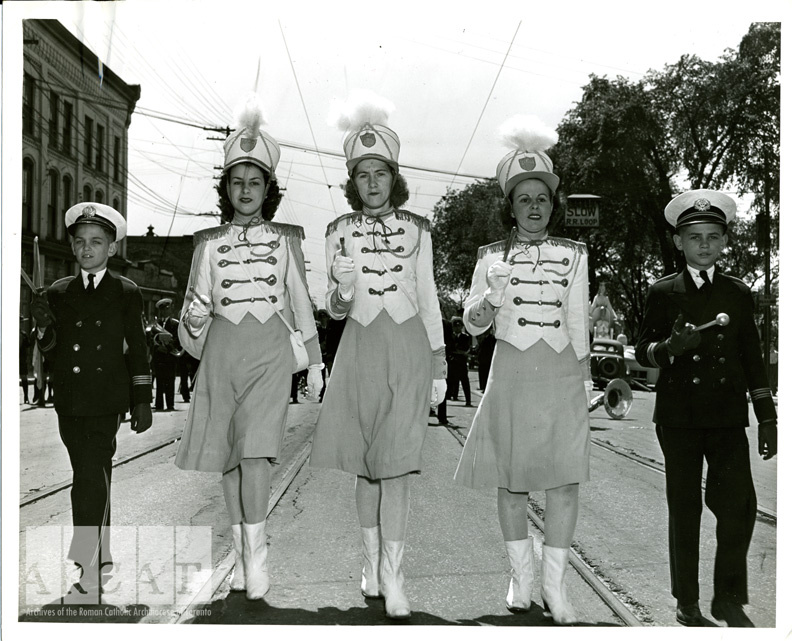
"Drum majorettes in a monster two-hour long parade which was a feature event of the Marian Congress Saturday, with 20 religious floats."

June, 1947

PH 09M/56P
ARCAT Photograph Collection

It's time to celebrate! Strike up the band! This week was Cardinal Collins' birthday. He was born January 16, 1947. Here in the archives we started wondering what it would have been like for for Cardinal McGuigan in 1947. He had been made Cardinal the year before and was a celebrated leader in the city. The second world war had just ended, and people were thinking about what to do with returning soldiers, as well as reconstructing Europe, and the threats of communism and fascism. The population was rapidly growing as European immigrants moved to Canada and country folk became city dwellers. Lots of changes were coming!

In Toronto there were about a million people. The Maple Leafs won the Stanley cup that year, the St. Mike's Majors won the Memorial Cup, and the Argos won the Grey Cup. The movie Gentleman's Agreement picked up three Oscars including best picture, and music by Frank Sinatra, The Andrews Sisters, and Al Jolson was popular. Radio was well established in the home, though it would soon give way to television.

The King was George VI, the Prime Minister was William Lyon Mackenzie King, and the Premier was George Drew:

"Deeply grateful for your kindness. As I was leaving immediately I had no opportunity to thank you before departure. Have just returned from Germany where conditions are beyond imagination. Will look forward to discussing this with you on my return. - George Drew."

May 27 1947

MG DA33.19
Cardinal McGuigan Fonds


The Pope was Pius XII:

A portrait of Pope Pius XII

1940s

PH 62/33P
ARCAT Photograph Collection
The Pope's inscription reads, "To Our Beloved Son, James Charles Cardinal McGuigan, Archbishop of Toronto, to his Clergy, Religious and Faithful We lovingly impart Our Paternal Apostolic Benediction.

Pius pp.XII

From Castelgandolfo, November 8th, 1947"

PH62/33P
ARCAT Photograph Collection


In 1947 Cardinal McGuigan lived at 264 Old Yonge Street, where he was visited by a few Sisters of Saint Joseph on September 6:


One of the highlights of his year must have been his June trip to the Marian Congress in Ottawa, where he was Papal Legate:

Cardinal McGuigan with other Papal representatives at the Marian Congress.

June 1947

PH 09M/42P
ARCAT Photograph Collection


The Congress drew a few hundred thousand pilgrims to Ottawa, and there were many spectators for the parade held in its honour:

"People cling like flies to every vantage point to watch the monster two-hour long parade which was a feature event of the Marian Congress Saturday, with 20 religious floats."

June 1947

PH 09M/54P
ARCAT Photograph Collection


Besides being a frozen moment in time on a sunny Saturday in June 1947, photos like this allow us to see some of the fashions that year. Many of the women's outfits were still the boxy utility style of wartime, but were giving way to more feminine shapes:

The hats were the best! 

Looking very cool in those shades.

For more of 1947's high points, including footage of Cardinal McGuigan at the Marian Congress, the CNE, the Stanley Cup game, and the Santa Claus Parade, check out this amazing video posted by Library and Archives Canada:


And for more footage of Cardinal McGuigan and the Marian Congress, check out this video: